I United States Inflation
II Long-term United States
Inflation
III Current United States
Inflation
IV Global Inflation
I United States Industrial
Production
IA
Mediocre Cyclical United States Economic Growth
IA1
Stagnating Real Private Fixed Investment
IID
United States International Terms of Trade
I United States
Employment Situation
I
Real Disposable Income
I United States Industrial
Production
I United States Inflation
II Long-term United States
Inflation
III Current United States
Inflation
IV Global Inflation
V World Economic Slowdown
VA United States
VB Japan
VC China
VD Euro Area
VE Germany
VF France
VG Italy
VH United Kingdom
VI Valuation of Risk Financial
Assets
VII Economic Indicators
VIII Interest Rates
IX Conclusion
References
Appendixes
Appendix I The Great
Inflation
IIIB Appendix on Safe Haven
Currencies
IIIC Appendix on Fiscal
Compact
IIID Appendix on European
Central Bank Large Scale Lender of Last Resort
IIIG Appendix on Deficit
Financing of Growth and the Debt Crisis
IV Global Inflation
V World Economic Slowdown
VA United States
VB Japan
VC China
VD Euro Area
VE Germany
VF France
VG Italy
VH United Kingdom
VI Valuation of Risk Financial
Assets
VII Economic Indicators
VIII Interest Rates
IX Conclusion
References
Appendixes
Appendix I The Great
Inflation
IIIB Appendix on Safe Haven
Currencies
IIIC Appendix on Fiscal
Compact
IIID Appendix on European
Central Bank Large Scale Lender of Last Resort
IIIG Appendix on Deficit
Financing of Growth and the Debt Crisis
I United States Inflation
II Long-term United States
Inflation
III Current United States
Inflation
IV Global Inflation
CPI prices increased 2.4 percent in
the 12 months ending in Jan 2026. The Annual Equivalent rate in Jan 2026 was
3.0 percent in the episode of shifting energy sources; and the monthly
inflation rate of 0.2 percent annualizes at 2.4 percent. Energy Services Prices increased 7.2 Percent in 12 Months
ending in Jan 2026, Increased at Annual Equivalent 7.4 Percent in Nov 2025-Jan
2026 and increased 0.2 Percent in Jan 2026 or 2.4 percent Annual Equivalent.
Consumer at Home Food Prices increased 2.1 Percent in 12 Months Ending in Jan
2026 and increased at Annual Equivalent 4.9 Percent in Nov 2025-Jan 2026 and
increased 0.2 Percent in Jan 2026 that annualizes at 2.4 Percent, Stagflation, Financial Repression, Recession Risk, Worldwide Fiscal,
Monetary and External Imbalances, World Cyclical Slow Growth, and Government
Intervention in Globalization
I United States Industrial Production
Output of manufacturing (SIC) in Jan 2026 at 45.6 percent
below long-term trend since 1919 and at 30.3 percent below trend measured from
1999 to 2006. Output of manufacturing (NAICS) at 49.7 percent below trend
measured from 1986 to 2006 and 30.9 percent below trend measured from 1999 to
2006, US Manufacturing Underperforming Below Trend in the Lost Economic Cycle of the Global Recession with
Economic Growth Underperforming Below Trend Worldwide, Stagflation, Global
Recession Risk, Worldwide Fiscal, Monetary and
External Imbalances, World Cyclical Slow Growth, and Government Intervention in
Globalization
© Carlos M. Pelaez, 2009,
2010, 2011, 2012, 2013, 2014, 2015, 2016, 2017, 2018, 2019, 2020, 2021, 2022,
2023, 2024, 2025, 2026.
Note: This Blog will
post only one indicator of the US economy while we concentrate efforts in
completing a book-length manuscript in the critically important subject of
INFLATION.
Preamble. United States total public debt outstanding is $38.8
trillion and debt held by the public $31.1 trillion (https://fiscaldata.treasury.gov/datasets/debt-to-the-penny/debt-to-the-penny) [Date last updated Feb 25, 2026.] The Federal Reserve
Bank of Saint Louis estimates Federal Total Public Debt as percent of GDP at 121.0
in IIIQ2025 and Federal Total Public Debt Held by the Public at 95.0 Percent of
GDP (https://fred.stlouisfed.org/series/GFDEGDQ188S). [Shutdown affects data: https://news.research.stlouisfed.org/2025/09/a-u-s-government-shutdown-could-delay-some-fred-data-2/] The Net International Investment Position of the United
States, or foreign debt, is $27.61 trillion at the end of IIIQ2025 (https://www.bea.gov/sites/default/files/2026-01/intinv325.pdf) [Shutdown affects data]. The United States current
account deficit is 2.9 percent of nominal GDP in IIIQ2025, “down from 3.3
percent in the second quarter” (https://www.bea.gov/sites/default/files/2026-01/trans325.pdf)
(Next release Jan 14, 2026) [Shutdown affects data].
The Treasury deficit of the United States reached $1.8 trillion in fiscal year
2024 (https://fiscal.treasury.gov/reports-statements/mts/). Total assets of Federal Reserve Banks reached $6.6
trillion on Feb 25, 2026 and securities held outright reached $6.3 trillion (https://www.federalreserve.gov/releases/h41/current/h41.htm#h41tab1). US GDP nominal NSA reached $31.1 trillion in IIIQ2025 (https://apps.bea.gov/iTable/index_nipa.cfm). US GDP contracted at the real seasonally adjusted annual
rate (SAAR) of 1.0 percent in IQ2022 and grew at the SAAR of 0.6 percent in
IIQ2022, growing at 2.9 percent in IIIQ2022, growing at 2.8 percent in IVQ2022,
growing at 2.9 percent in IQ2023, growing at 2.5 percent in IIQ2023 growing at
4.7 percent in IIIQ2023, growing at 3.4 percent in IVQ2023, growing at 0.8
percent in IQ2024, growing at 3.6 percent in IIQ2024, growing at 3.3 percent in
IIIQ2024, growing at 1.9 percent in IVQ2024, contracting at 0.6 percent in
IQ2025, growing at 3.8 percent in IIQ2025 and growing at 4.4 percent in
IIIQ2025 and growing at 1.4 percent in IVQ2025 (https://apps.bea.gov/iTable/index_nipa.cfm). [Shutdown affects data] Total
Treasury interest-bearing, marketable debt held by private investors increased
from $3635 billion in 2007 to $16,439 billion in Sep 2021 (Fiscal Year 2021) or
increase by 352.2 percent (https://fiscal.treasury.gov/reports-statements/treasury-bulletin/). John Hilsenrath, writing
on “Economists Seek Recession Cues in the Yield Curve,” published in the Wall
Street Journal on Apr 2, 2022, analyzes the inversion of the Treasury yield
curve with the two-year yield at 2.430 on Apr 1, 2022, above the ten-year yield
at 2.374. Hilsenrath argues that inversion appears to signal recession in
market analysis but not in alternative Fed approach.
The Consumer
Price index of the United States in Chart CPI-H increased 2.4 percent in Jan
2026 Relative to a Year Earlier, The Tenth Highest Since 8.9 percent in Dec
1981 was Followed by the Highest of 9.1 percent in Jun 2022, the Second Highest
of 8.6 percent in May 2022, 8.5 percent in both Jul 2022 and Mar 2022, 8.3
percent in both Apr and Aug 2022, 8.2 percent in Sep 2022, 7.9 percent in
February 2022, 7.5 percent in Jan 2022, 7.7 percent in Oct 2022, 7.1 percent in
Nov 2022, 6.5 percent in Dec 2022, 6.4 percent in Jan 2023, 6.0 percent in Feb
2023, 5.0 percent in Mar 2023, 4.9 percent in Apr 2023, 4.0 percent in May
2023, 3.0 percent in Jun 2023, 3.2 percent in Jul 2023, 3.7 percent in Aug
2023, 3.7 percent in Sep 2023, 3.2 percent in Oct 2023, 3.1 percent in Nov
2023, 3.4 percent in Dec 2023, 3.1 percent in Jan 2024, 3.2 percent in Feb
2024, 3.5 percent in Mar 2024, 3.4 percent in Apr 2024, 3.3 percent in May
2024, 3.0 in Jun 2024, 2.9 percent in Jul 2024, 2.5 percent in Aug 2024, 2.4
percent in Sep 2024, 2.6 percent in Oct 2024, 2.7 percent in Nov 2024, 2.9
percent in Dec 2024, 3.0 percent in Jan 2025, 2.8 percent in Feb 2025, 2.4
percent in Mar 2025, 2.3 percent in Apr 2025, 2.4 percent in May 2025, 2.7
percent in Jun 2025, 2.7 percent in Jul 2025, 2.9 percent in Aug 2025, 3.0
percent in Sep 2025, no observations available (NA) for Oct 2025 during the
shutdown, 2.7 percent in Nov 2025, 2.7 percent in Dec 2025 and 2.4 percent in
Jan 2026.

Chart CPI-H, US, Consumer Price Index, 12-Month
Percentage Change, NSA, 1981-2026
Source: US Bureau of Labor Statistics https://www.bls.gov/cpi/data.htm
Table CPI-H, US,
Consumer Price Index, 12-Month Percentage Change, NSA,
1981-1983, 2019-2026
|
Year |
Jan |
Feb |
Mar |
Apr |
May |
Jun |
|
1981 |
11.8 |
11.4 |
10.5 |
10.0 |
9.8 |
9.6 |
|
1982 |
8.4 |
7.6 |
6.8 |
6.5 |
6.7 |
7.1 |
|
1983 |
3.7 |
3.5 |
3.6 |
3.9 |
3.5 |
2.6 |
|
1984 |
4.2 |
4.6 |
4.8 |
4.6 |
4.2 |
4.2 |
|
2019 |
1.6 |
1.5 |
1.9 |
2.0 |
1.8 |
1.6 |
|
2020 |
2.5 |
2.3 |
1.5 |
0.3 |
0.1 |
0.6 |
|
2021 |
1.4 |
1.7 |
2.6 |
4.2 |
5.0 |
5.4 |
|
2022 |
7.5 |
7.9 |
8.5 |
8.3 |
8.6 |
9.1 |
|
2023 |
6.4 |
6.0 |
5.0 |
4.9 |
4.0 |
3.0 |
|
2024 |
3.1 |
3.2 |
3.5 |
3.4 |
3.3 |
3.0 |
|
2025 |
3.0 |
2.8 |
2.4 |
2.3 |
2.4 |
2.7 |
|
2026 |
2.4 |
|
Year |
Jul |
Aug |
Sep |
Oct |
Nov |
Dec |
|
1981 |
10.8 |
10.8 |
11.0 |
10.1 |
9.6 |
8.9 |
|
1982 |
6.4 |
5.9 |
5.0 |
5.1 |
4.6 |
3.8 |
|
1983 |
2.5 |
2.6 |
2.9 |
2.9 |
3.3 |
3.8 |
|
1984 |
4.2 |
4.3 |
4.3 |
4.3 |
4.1 |
3.9 |
|
2019 |
1.8 |
1.7 |
1.7 |
1.8 |
2.1 |
2.3 |
|
2020 |
1.0 |
1.3 |
1.4 |
1.2 |
1.2 |
1.4 |
|
2021 |
5.4 |
5.3 |
5.4 |
6.2 |
6.8 |
7.0 |
|
2022 |
8.5 |
8.3 |
8.2 |
7.7 |
7.1 |
6.5 |
|
2023 |
3.2 |
3.7 |
3.7 |
3.2 |
3.1 |
3.4 |
|
2024 |
2.9 |
2.5 |
2.4 |
2.6 |
2.7 |
2.9 |
|
2025 |
2.7 |
2.9 |
3.0 |
2.7 |
2.7 |
|
|
2026 |
Note: NA because of interruption of
appropriations.
Source: US Bureau of Labor Statistics https://www.bls.gov/cpi/data.htm
Chart VII-3 of the Energy Information Administration
provides the US retail price of regular gasoline. The price moved to $2.937 per
gallon on Feb 23, 2026, from $3.125 a year earlier or minus 6.0 percent.

https://www.eia.gov/petroleum/weekly/ [Chart discontinued See Weekly
Petroleum Status Report.]
Chart
VII-3A provides the US retail price of regular gasoline, dollars per gallon,
from $1.191 on Aug 20,1990 to $2.937 on Feb 23, 2026 or 146.6percent. The price
of retail regular gasoline increased from $2.249/gallon on Jan 4,2021 to $2.937/gallon
on Feb 23, 2026, or 30.6 percent. The price of retail regular gasoline
decreased from $3.530/gallon on Feb 21, 2022, two days before the invasion of
Ukraine, to $2.937/gallon on Feb 23, 2026 or minus 16.8 percent and had
increased 57.0 percent from $2.249/gallon on Jan 4,2021 to $3.530/gallon on Feb
28, 2022.

Chart VII-3A, US Retail Price of Regular Gasoline,
Dollars Per Gallon
Source: US Energy Information Administration
https://www.eia.gov/dnav/pet/hist/LeafHandler.ashx?n=PET&s=EMM_EPMR_PTE_NUS_DPG&f=W
Chart
VII-4 of the Energy Information Administration provides the price of the
Natural Gas Futures Contract increasing from $2.581 per million Btu on Jan 4,
2021 to $5.326 per million Btu on Dec 20, 2022 or 106.4 percent and closing at
$1.785 on Apr 5, 2024 or change of minus 66.5 percent.

Chart VII-4, US, Natural Gas Futures Contract 1
Source: US Energy Information Administration
https://www.eia.gov/dnav/ng/hist/rngc1d.htm
Chart VII-5 of the US Energy Administration provides US
field production of oil moving from a high of 12.983 thousand barrels per day
in Dec 2019 to 11.760 thousand barrels per day in Dec 2021 and the final point
of 13.782 thousand barrels per day in Nov 2025.

Chart
VII-5 United States Field Production of Crude Oil, Thousand Barrels Per Day
Sources: US Energy Information Administration https://www.eia.gov/dnav/pet/hist/leafhandler.ashx?n=pet&s=mcrfpus2&f=m
Chart
VII-6 of the US Energy Information Administration provides net imports of crude
oil and petroleum products. Net imports changed from 1967 thousand barrels per
day in the first week of Dec 2020 to minus -3216 thousand barrels in the fourth
week of Oct 25, 2024, minus 3310 thousand barrels in the second week of Dec 13,
2024 and minus 2.241 thousand barrels in the third week of Feb 20, 2026.

Chart VII-6, US, Net Imports of Crude Oil and Petroleum
Products, Thousand Barrels Per Day
Source: US Energy Information Administration
https://www.eia.gov/dnav/pet/hist/LeafHandler.ashx?n=PET&s=WTTNTUS2&f=W
Chart VI-7 of the EIA provides US Petroleum
Consumption, Production, Imports, Exports and Net Imports 1950-2022. There was
sharp increase in production in the final segment that reached consumption by
2020. There is reversal in 2021 with consumption exceeding production.

Chart VI-7, US Petroleum Consumption, Production,
Imports, Exports and Net Imports 1950-2022, Million Barrels Per Day
https://www.eia.gov/energyexplained/oil-and-petroleum-products/imports-and-exports.php
Chart
VI-8 provides the US average retail price of electricity at 12.78 cents per
kilowatthour in Dec 2020 increasing to 17.24 cents per kilowatthour in Dec 2025
or 34.9 per cent.

Chart VI-8, US Average Retail Price of Electricity,
Monthly, Cents per Kilowatthour
United States
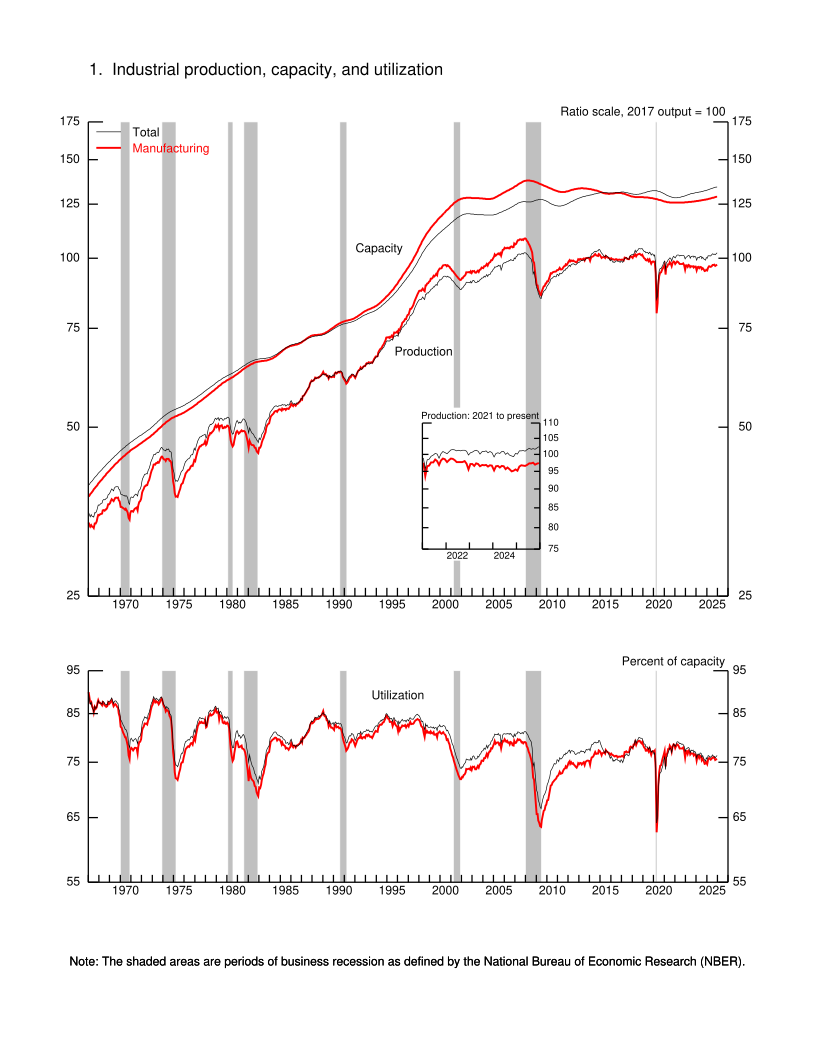
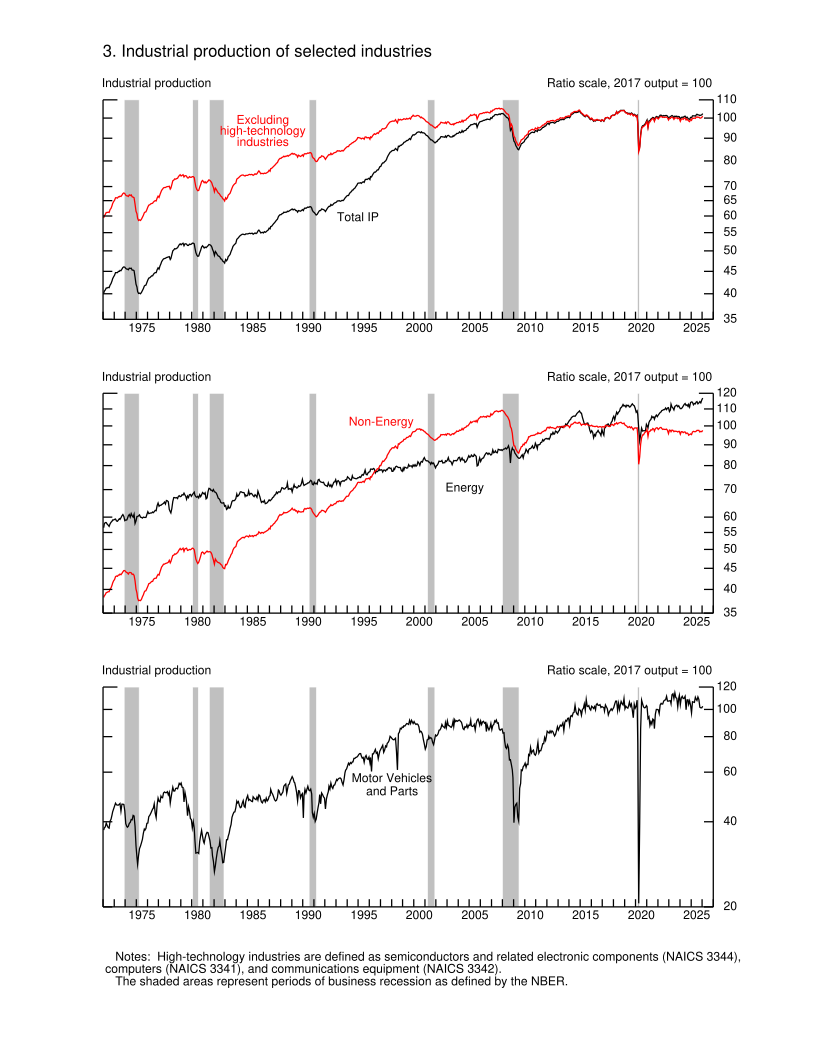
manufacturing output from 1919 to 2026 monthly is in Chart I-4 of the Board of
Governors of the Federal Reserve System. The second industrial revolution of
Jensen (1993) is quite evident in the acceleration of the rate of growth of
output given by the sharper slope in the 1980s and 1990s. Growth was robust
after the shallow recession of 2001 but dropped sharply during the global
recession after IVQ2007. Manufacturing output recovered sharply but has not
reached earlier levels and is losing momentum at the margin. There is cyclical
uncommonly slow growth in the US instead of allegations of secular stagnation. There is similar
behavior in manufacturing. There is classic research on analyzing deviations of
output from trend (see for example Schumpeter 1939, Hicks 1950, Lucas 1975,
Sargent and Sims 1977). The long-term trend is growth of manufacturing at average
2.9 percent per year from Jan 1919 to Jan 2026. Growth at 2.9 percent per year
would raise the NSA index of manufacturing output (SIC, Standard Industrial
Classification) from 106.8904 in Dec 2007 to 179.24607 in Jan 2026. The actual
index NSA in Jan 2026 is 97.4547 which is 45.6 percent below trend. The
underperformance of manufacturing in Mar-Nov 2020 originates partly in the
earlier global recession augmented by the global recession, with output in the
US reaching a high in Feb 2020 (https://www.nber.org/research/data/us-business-cycle-expansions-and-contractions), in the lockdown of economic activity in the COVID-19
event and the trough in Apr 2020 (https://www.nber.org/news/business-cycle-dating-committee-announcement-july-19-2021). Manufacturing
output grew at average 1.5 percent between Dec 1999 and Dec 2006. Using trend
growth of 1.5 percent per year, the index would increase to 139.9156 in Jan
2026. The output of manufacturing at 97.4547 in Jan 2026 is 30.3 percent below
trend under this alternative calculation. Using the NAICS (North American Industry Classification
System), manufacturing output fell from the high of 108.5201 in Jun 2007 to the
low of 84.8006 in Apr 2009 or 21.9 percent. The NAICS manufacturing index
increased from 84.8006 in Apr 2009 to 98.2351 in Jan 2026 or 15.8 percent. The
NAICS manufacturing index increased at the annual equivalent rate of 3.5
percent from Dec 1986 to Dec 2006. Growth at 3.5 percent would increase the
NAICS manufacturing output index from 104.8218 in Dec 2007 to 195.2641 in Jan
2026. The NAICS index at 98.2351 in Jan 2026 is 49.7 percent below trend. The
NAICS manufacturing output index grew at 1.7 percent annual equivalent from Dec
1999 to Dec 2006. Growth at 1.7 percent would raise the NAICS manufacturing
output index from 104.8218 in Dec 2007 to 142.1800 in Jan 2026. The NAICS index
at 98.2351in Jan 2026 is 30.9 percent below trend under this alternative
calculation.

Chart I-4, US, Manufacturing Output, 1919-2026
Source: Board of Governors of the Federal Reserve System
https://www.federalreserve.gov/releases/g17/Current/default.htm
Chart I-4B provides
the data for the period 2007-2026 SIC US Manufacturing. There has not been
recovery from the higher levels before the recession from Dec 2007 to Jan 2009
(https://www.nber.org/research/data/us-business-cycle-expansions-and-contractions).

Chart I-4B, US, Manufacturing Output, 2007-2026
htps://www.federalreserve.gov/releases/g17/Current/default.htm
Chart
I-7 of the Board of Governors of the Federal Reserve System shows that output
of durable manufacturing accelerated in the 1980s and 1990s with slower growth
in the 2000s perhaps because processes matured. Growth was robust after the
major drop during the global recession but appears to vacillate in the final
segment. There is sharp contraction in Mar-Apr 2020 in the global recession,
with output in the US reaching a high in Feb 2020 (https://www.nber.org/research/data/us-business-cycle-expansions-and-contractions), in the lockdown of economic activity in the COVID-19
event and the trough in Apr 2020 (https://www.nber.org/news/business-cycle-dating-committee-announcement-july-19-2021). There is initial recovery in May 2020-Oct 2022 with
deterioration/weakness and renewed oscillating growth in Nov 2022-Jan 2026.

Chart I-7, US, Output of Durable Manufacturing, 2007-2026
Source: Board of Governors of the Federal Reserve System
htps://www.federalreserve.gov/releases/g17/Current/default.htm
Chart I-7B provides NAICS Durable Manufacturing from 2007 to 2026. There has not been recovery from the higher levels before
the recession from Dec 2007 to Aug 2009 (https://www.nber.org/research/data/us-business-cycle-expansions-and-contractions).

Chart I-7B, US, Output of Durable Manufacturing, 2007-2026
Source: Board of Governors of the Federal Reserve System
htps://www.federalreserve.gov/releases/g17/Current/default.htm
Chart
V-3D provides the index of US manufacturing (NAICS) from Jan 1972 to Jan 2026.
The index continued increasing during the decline of manufacturing jobs after
the early 1980s. There are likely effects of changes in the composition of
manufacturing with also changes in productivity and trade. There is sharp
decline in the global recession,
with output in the US reaching a high in Feb 2020 (https://www.nber.org/research/data/us-business-cycle-expansions-and-contractions), in the lockdown of economic activity in the COVID-19
event and the trough in Apr 2020 (https://www.nber.org/news/business-cycle-dating-committee-announcement-july-19-2021).

Chart V-3D, United States Manufacturing (NAICS) NSA, Jan
1972 to Jan 2026
Source: Board of Governors of the Federal Reserve System
https://www.federalreserve.gov/releases/g17/Current/default.htmh
Chart V-3DB provides NAICS Manufacturing from 2007 to 2026. There has not been recovery from the higher levels before
the recession from Dec 2007 to Apr 2009 (https://www.nber.org/research/data/us-business-cycle-expansions-and-contractions).

Chart V-3DB, United States Manufacturing (NAICS) NSA, Jan
2007 to Jan 2026
Source: Board of Governors of the Federal Reserve System
https://www.federalreserve.gov/releases/g17/Current/default.htm
Chart VII-9 provides the fed funds rate and Three
Months, Two-Year and Ten-Year Treasury Constant Maturity Yields. Unconventional
monetary policy of near zero interest rates is typically followed by financial
and economic stress with sharp increases in interest rates.

Chart VII-9, US Fed Funds Rate and Three-Month, Two-Year
and Ten-Year Treasury Constant Maturity Yields, Jan 2, 1994 to 2022-2023
Source: Federal Reserve Board of the Federal Reserve System
https://www.federalreserve.gov/releases/h15/
Note: program does not download the
entire right-side of the chart.

Chart VII-9A, US Fed Funds Rate and Three-Month, Two-Year
and Ten-Year Treasury Constant Maturity Yields, Jan 2, 2022 to May 30,
2023
Source: Federal Reserve Board of the Federal Reserve System
https://www.federalreserve.gov/releases/h15/
Note: Chart is shortened of current dates in download.
Chart VI-14 provides the overnight fed funds rate, the
yield of the 10-year Treasury constant maturity bond, the yield of the 30-year
constant maturity bond and the conventional mortgage rate from Jan 1991 to Dec
1996. In Jan 1991, the fed funds rate was 6.91 percent, the 10-year Treasury
yield 8.09 percent, the 30-year Treasury yield 8.27 percent and the
conventional mortgage rate 9.64 percent. Before monetary policy tightening in
Oct 1993, the rates and yields were 2.99 percent for the fed funds, 5.33 percent
for the 10-year Treasury, 5.94 for the 30-year Treasury and 6.83 percent for
the conventional mortgage rate. After tightening in Nov 1994, the rates and
yields were 5.29 percent for the fed funds rate, 7.96 percent for the 10-year
Treasury, 8.08 percent for the 30-year Treasury and 9.17 percent for the
conventional mortgage rate.

Chart VI-14, US, Overnight Fed Funds Rate, 10-Year
Treasury Constant Maturity, 30-Year Treasury Constant Maturity and Conventional
Mortgage Rate, Monthly, Jan 1991 to Dec 1996
Source: Board of Governors of the Federal Reserve
System
http://www.federalreserve.gov/releases/h15/update/
Chart VI-15 of the Bureau of Labor Statistics provides
the all items consumer price index from Jan 1991 to Dec 1996. There does not
appear acceleration of consumer prices requiring aggressive tightening.

Chart VI-15, US, Consumer Price Index All Items, Jan
1991 to Dec 1996
Source: Bureau of Labor Statistics
https://www.bls.gov/cpi/data.htm
Chart IV-16 of the Bureau of Labor Statistics provides
12-month percentage changes of the all items consumer price index from Jan 1991
to Dec 1996. Inflation collapsed during the recession from Jul 1990 (III) and
Mar 1991 (I) and the end of the Kuwait War on Feb 25, 1991 that stabilized
world oil markets. CPI inflation remained almost the same and there is no valid
counterfactual that inflation would have been higher without monetary policy
tightening because of the long lag in effect of monetary policy on inflation
(see Culbertson 1960, 1961, Friedman 1961, Batini and Nelson 2002, Romer and
Romer 2004). Policy tightening had adverse collateral effects in the form of
emerging market crises in Mexico and Argentina and fixed income markets
worldwide.

Chart VI-16, US, Consumer Price Index All Items,
Twelve-Month Percentage Change, Jan 1991 to Dec 1996
Source: Bureau of Labor Statistics
https://www.bls.gov/cpi/data.htm
Chart USFX provides the exchange rate of US Dollars
per EURO from 2007 to 2023. Barry Eichengreen and Jeffrey Sachs, Exchange Rates
and Economic Recovery in the 1930s, The Journal of Economic History, Vol. 45, No. 4 (Dec 1985),
argue that foreign exchange “depreciation was clearly beneficial for initiating
countries” during the Great Depression of the 1930s and that it was no
equivalent to “beggar my neighbor” policies such as tariffs.

Chart USFX, Exchange Rate USD/EURO 2007-2023
Source: https://www.federalreserve.gov/releases/h10/current/

Chart USFX, Exchange Rate USD/EURO 2000-2023
Source: https://www.federalreserve.gov/releases/h10/current/
Federal Reserve Bank of St. Louis https://fred.stlouisfed.org/

Chart USFX, Exchange Rate USD/EURO 2018-2023
Source: https://www.federalreserve.gov/releases/h10/current/
Federal Reserve Bank of St. Louis https://fred.stlouisfed.org/
Table
USFX provides the rate of USD/EURO in selected months. The dollar appreciated
sharply from USD 1.2254 on Jan 4, 2021 to 1.0787 on Aug 25, 2023 and 1.1781 on Feb
20, 2026.
Table USFX, USD/EURO Selected Months
|
Date |
USD/EUR |
|
1/4/2021 |
1.2254 |
|
1/5/2021 |
1.2295 |
|
1/6/2021 |
1.229 |
|
1/7/2021 |
1.2265 |
|
1/8/2021 |
1.2252 |
|
1/11/2021 |
1.2169 |
|
1/12/2021 |
1.2168 |
|
1/13/2021 |
1.2159 |
|
1/14/2021 |
1.2156 |
|
1/15/2021 |
1.2099 |
|
1/31/2023 |
1.0858 |
|
2/1/2023 |
1.0917 |
|
2/2/2023 |
1.0918 |
|
2/3/2023 |
1.0825 |
|
2/6/2023 |
1.0722 |
|
2/7/2023 |
1.0705 |
|
2/8/2023 |
1.0734 |
|
2/9/2023 |
1.0761 |
|
2/10/2023 |
1.0670 |
|
2/13/2023 |
1.0718 |
|
2/14/2023 |
1.0722 |
|
2/15/2023 |
1.0683 |
|
2/16/2023 |
1.0684 |
|
2/17/2023 |
1.0678 |
|
2/24/2023 |
1.0545 |
|
3/03/2023 |
1.0616 |
|
3/10/2023 |
1.0659 |
|
3/17/2023 |
1.0647 |
|
3/24/2023 |
1.0762 |
|
3/31/2023 |
1.0872 |
|
4/7/2023 |
1.0913 |
|
4/14/2023 |
1.0980 |
|
4/21/2023 |
1.0973 |
|
4/28/2023 |
1.1040 |
|
5/5/2023 |
1.1026 |
|
5/26/2023 |
1.0713 |
|
6/2/2023 |
1.0724 |
|
6/9/2023 |
1.0749 |
|
6/16/2023 |
1.0925 |
|
6/23/2023 |
1.0887 |
|
6/30/2023 |
1.0920 |
|
7/7/2023 |
1.0964 |
|
7/14/2023 |
1.1237 |
|
7/21/2023 |
1.1120 |
|
7/28/2023 |
1.1039 |
|
8/4/2023 |
1.1036 |
|
8/11/2023 |
1.0957 |
|
8/18/2023 |
1.0875 |
|
8/25/2023 |
1.0787 |
|
9/1/223 |
1.0787 |
|
9/8/2023 |
1.0709 |
|
9/15/2023 |
1.0673 |
|
9/22/2023 |
1.0660 |
|
9/29/2023 |
1.0584 |
|
10/6/2023 |
1.0596 |
|
10/13/2023 |
1.0502 |
|
10/20/2023 |
1.0592 |
|
10/27/2023 |
1.0592 |
|
11/3/2023 |
1.0733 |
|
11/10/2023 |
1.0710 |
|
11/17/2023 |
1.0879 |
|
11/24/2023 |
1.0934 |
|
12/1/2023 |
1.0878 |
|
12/8/2023 |
1.0746 |
|
12/15/2023 |
1.0906 |
|
6/21/2024 |
1.0694 |
|
2/7/2025 |
1.0329 |
|
2/20/2026 |
1.1781 |
Source: https://www.federalreserve.gov/releases/h10/current/
|
US International Trade in Goods and Services, December
and Annual 2025
|
|

Next
release: March 12, 2026
The U.S. monthly international trade
deficit increased in December 2025 according to the U.S. Bureau of Economic
Analysis and the U.S. Census Bureau. The deficit increased from $53.0 billion
in November (revised) to $70.3 billion in December, as imports increased and
exports decreased. The goods deficit increased $15.7 billion in December to
$99.3 billion. The services surplus decreased $1.6 billion in December to $29.0
billion.
Source: https://www.bea.gov/data/intl-trade-investment/international-trade-goods-and-services [Data are not being updated during shutdown.]
A comprehensive analysis of the Mill-Bickerdike theorem and the Lerner
theorem on tariffs and international terms of trade with application to the
Brazilian coffee support program, the recovery of Brazil from the Great
Depression and Brazil’s industrialization is in Carlos Manuel Pelaez, História
da Industrialização Brasileira. Rio de Janeiro, APEC Editora, 1972.
Chart IID-1B provides the US terms of trade index, index of
terms of trade of nonpetroleum goods and index of terms of trade of goods with
the new base of 2017. The terms of trade of nonpetroleum goods dropped sharply
from the mid-1980s to 1995, recovering significantly until 2014, dropping and
then recovering again into 2021. There is relative stability in the terms of
trade of nonpetroleum goods from 1967 to 2025 but sharp deterioration in the
overall index and the index of goods.

Chart IID-1B, United States Terms of Trade Indexes
1967-2025, Quarterly
Source: Bureau of Economic Analysis
https://apps.bea.gov/iTable/index_nipa.cfm
[Data are not being updated during
shutdown.]
Percentage shares of net trade (exports less imports), exports and
imports in US Gross Domestic Product are in Chart IA1-14 from 1979 to 2025.
There is sharp trend of decline of exports and imports after the global
recession beginning in IVQ2007. Net trade has been subtracting from growth
since the stagflation of the 1970s.

Chart IA1-14, US, Percentage Shares of Net Trade, Exports
and Imports in Gross Domestic Product, Quarterly, 1979-2025
Source: US Bureau of Economic Analysis
https://apps.bea.gov/iTable/index_nipa.cfm
[Data are not being updated during shutdown.]
Table
B provides the exchange rate of Brazil and the trade balance from 1927 to 1939.
“Currency depreciation in the 1930s…benefitted the initiating countries…There
can be no presumption that depreciation was beggar-thy-neighbor…competitive
devaluation taken by a group of countries had they been even more widely
adopted and coordinated internationally would have hasted recovery from the
Great Depression,” Barry Eichengreen and Jeffrey Sachs, “Exchange Rates and
Economic Recovery in the1930s,” Journal of Economic History, Vol. 45,
No. 4 (Dec., 1985), pp.925-946.
Table B, Brazil, Exchange Rate and Trade Balance,
1927-1939
|
Year |
Exchange Rate Mil-Réis per £ |
Trade Balance 1000 Contos |
||
|
1927 |
40.6 |
370.9 |
||
|
1928 |
40.3 |
275.3 |
||
|
1929 |
40.6 |
332.7 |
||
|
1930 |
49.4 |
563.6 |
||
|
1931 |
62.4 |
1517.2 |
||
|
1932 |
48.1 |
1018.1 |
||
|
1933 |
52.6 |
655 |
||
|
1934 |
59.7 |
956.2 |
||
|
1935 |
57.9 |
248.1 |
||
|
1936 |
58.4 |
626.8 |
||
|
1937 |
56.9 |
-222.5 |
||
|
1938 |
57.6 |
-98.7 |
||
|
1939 |
71.1 |
631.9 |
Source: Carlos
Manuel Peláez, Análise Econômica do Programa Brasileiro de Sustentação do Café
1906-1945: Teoria, Política e Medição, Revista Brasileira de Economia,
Vol. 25, N 4, Out/Dez 1971, 5-213.
Christina D. Romer argues that growth of the money
stock was critical in the recovery of the United States from the Great
Depression (Christina D. Romer, What ended the Great Depression? The Journal of Economic
History,
Volume 52, Number 4, Dec 1992, pp 757-784).
Table C, Brazil, Yearly Percentage Changes of the Money
Stock, M1 and M2, Exchange Rate, Terms of Trade, Industrial Production, Real
Gross National Product and Real Gross Income Per Capita, 1930-1939
|
Period |
M1 |
M2 |
Exchange Rate |
Terms of Trade |
Industrial Production |
Real GNP |
Real Gross Income Per Capita |
|
1929/30 |
-9 |
-4 |
22 |
-34 |
-5 |
-1 |
-10 |
|
1930/31 |
4 |
1 |
26 |
-5 |
8 |
-3 |
-6 |
|
1931/32 |
15 |
7 |
-23 |
8 |
0 |
6 |
2 |
|
1932/33 |
10 |
4 |
10 |
-15 |
16 |
10 |
7 |
|
1933/34 |
5 |
6 |
13 |
5 |
13 |
7 |
5 |
|
1934/35 |
7 |
8 |
-3 |
-28 |
14 |
1 |
-4 |
|
1935/36 |
10 |
11 |
1 |
2 |
14 |
12 |
9 |
|
1936/37 |
10 |
9 |
-3 |
2 |
7 |
3 |
0 |
|
1937/38 |
19 |
13 |
1 |
-11 |
6 |
4 |
-1 |
|
1938/39 |
0 |
8 |
23 |
-12 |
14 |
4 |
2 |
Source: Carlos
Manuel Peláez and Wilson Suzigan, História Monetária do Brasil. Segunda
Edição Revisada e Ampliada. Coleção
Temas Brasileiros, Universidade de
Brasília, 1981.
“In
the period of the free coffee market 1857-1906, international coffee prices
fluctuated in cycles of increasing amplitude. British export prices decreased
at a low average rate, and physical exports of coffee by Brazil increased at
the average rate of 2.9 percent per year. The income terms of trade of the
coffee economy of Brazil improved at the average compound rate of 4.0 percent
per year. But the actual rate must have been much higher because of drastic
improvements in the quality of manufactures while the quality of coffee
remained relatively constant,” Carlos Manuel Peláez, “The Theory and Reality of
Imperialism in the Coffee Economy of Nineteenth-Century Brazil,” The
Economic History Review, Second Series, Volume XXIX, No. 2, May 1976.
276-290. See Carlos Manuel Peláez, “A Comparison of Long-Term Monetary Behavior
and Institutions in Brazil, Europe and the United States,” The Journal of
European Economic History, Volume 5, Number 2, Fall 1976, 439-450,
Presented at the Sixth International Congress of Economic History, Section
on Monetary Inflation in Historical Perspective, Copenhagen, 22 Aug
1974.
In his classic restatement of the Keynesian demand
function in terms of “liquidity preference as behavior toward risk,” James
Tobin (http://www.nobelprize.org/nobel_prizes/economic-sciences/laureates/1981/tobin-bio.html) identifies the risks of low interest rates in terms
of portfolio allocation (Tobin 1958, 86):
“The assumption that investors expect on balance no
change in the rate of interest has been adopted for the theoretical reasons
explained in section 2.6 rather than for reasons of realism. Clearly investors
do form expectations of changes in interest rates and differ from each other in
their expectations. For the purposes of dynamic theory and of analysis of
specific market situations, the theories of sections 2 and 3 are complementary
rather than competitive. The formal apparatus of section 3 will serve just as
well for a non-zero expected capital gain or loss as for a zero expected value
of g. Stickiness of interest rate expectations would mean that the expected
value of g is a function of the rate of interest r, going down when r goes down
and rising when r goes up. In addition to the rotation of the opportunity locus
due to a change in r itself, there would be a further rotation in the same
direction due to the accompanying change in the expected capital gain or loss. At
low interest rates expectation of capital loss may push the opportunity locus
into the negative quadrant, so that the optimal position is clearly no consols,
all cash. At the other extreme, expectation of capital gain at high
interest rates would increase sharply the slope of the opportunity locus and
the frequency of no cash, all consols positions, like that of Figure 3.3. The
stickier the investor's expectations, the more sensitive his demand for cash
will be to changes in the rate of interest (emphasis added).”
Tobin (1969) provides more elegant, complete analysis
of portfolio allocation in a general equilibrium model. The major point is
equally clear in a portfolio consisting of only cash balances and a perpetuity
or consol. Let g be the capital gain, r the rate of interest on
the consol and re the expected rate of interest. The rates
are expressed as proportions. The price of the consol is the inverse of the
interest rate, (1+re). Thus, g = [(r/re)
– 1]. The critical analysis of Tobin is that at extremely low interest rates
there is only expectation of interest rate increases, that is, dre>0,
such that there is expectation of capital losses on the consol, dg<0.
Investors move into positions combining only cash and no consols.
Valuations of risk financial assets would collapse in reversal of long
positions in carry trades with short exposures in a flight to cash. There is no
exit from a central bank created liquidity trap without risks of financial
crash and another global recession. The net worth of the economy depends on
interest rates. In theory, “income is generally defined as the amount a
consumer unit could consume (or believe that it could) while maintaining its
wealth intact” (Friedman 1957, 10). Income, Y, is a flow that is
obtained by applying a rate of return, r, to a stock of wealth, W,
or Y = rW (Friedman 1957). According to a subsequent statement:
“The basic idea is simply that individuals live for many years and that
therefore the appropriate constraint for consumption is the long-run expected
yield from wealth r*W. This yield was named permanent income: Y*
= r*W” (Darby 1974, 229), where * denotes permanent. The
simplified relation of income and wealth can be restated as:
W = Y/r (1)
Equation (1) shows that as r goes to zero, r→0,
W grows without bound, W→∞. Unconventional monetary policy lowers
interest rates to increase the present value of cash flows derived from
projects of firms, creating the impression of long-term increase in net worth.
An attempt to reverse unconventional monetary policy necessarily causes
increases in interest rates, creating the opposite perception of declining net
worth. As r→∞, W = Y/r →0. There is no exit from
unconventional monetary policy without increasing interest rates with resulting
pain of financial crisis and adverse effects on production, investment and
employment.
Inflation and unemployment in the period 1966 to 1985
is analyzed by Cochrane (2011Jan, 23) by means of a Phillips circuit joining
points of inflation and unemployment. Chart VI-1B for Brazil in Pelaez (1986,
94-5) was reprinted in The Economist in the issue of Jan 17-23, 1987 as
updated by the author. Cochrane (2011Jan, 23) argues that the Phillips circuit
shows the weakness in Phillips curve correlation. The explanation is by a shift
in aggregate supply, rise in inflation expectations or loss of anchoring. The
case of Brazil in Chart VI-1B cannot be explained without taking into account
the increase in the fed funds rate that reached 22.36 percent on Jul 22, 1981 (http://www.federalreserve.gov/releases/h15/data.htm) in the Volcker Fed that precipitated the stress on a
foreign debt bloated by financing balance of payments deficits with bank loans
in the 1970s. The loans were used in projects, many of state-owned enterprises
with low present value in long gestation. The combination of the insolvency of
the country because of debt higher than its ability of repayment and the huge
government deficit with declining revenue as the economy contracted caused
adverse expectations on inflation and the economy. This interpretation is
consistent with the case of the 24 emerging market economies analyzed by
Reinhart and Rogoff (2010GTD, 4), concluding that “higher debt levels are
associated with significantly higher levels of inflation in emerging markets.
Median inflation more than doubles (from less than seven percent to 16 percent)
as debt rises frm the low (0 to 30 percent) range to above 90 percent. Fiscal
dominance is a plausible interpretation of this pattern.”
The reading of the Phillips circuits of the 1970s by
Cochrane (2011Jan, 25) is doubtful about the output gap and inflation
expectations:
“So, inflation is caused by ‘tightness’ and deflation
by ‘slack’ in the economy. This is not just a cause and forecasting
variable, it is the cause, because given ‘slack’ we apparently do not
have to worry about inflation from other sources, notwithstanding the weak
correlation of [Phillips circuits]. These statements [by the Fed] do mention
‘stable inflation expectations. How does the Fed know expectations are ‘stable’
and would not come unglued once people look at deficit numbers? As I read Fed
statements, almost all confidence in ‘stable’ or ‘anchored’ expectations comes
from the fact that we have experienced a long period of low inflation (adaptive
expectations). All these analyses ignore the stagflation experience in the
1970s, in which inflation was high even with ‘slack’ markets and little
‘demand, and ‘expectations’ moved quickly. They ignore the experience of
hyperinflations and currency collapses, which happen in economies well below
potential.”
Yellen (2014Aug22) states that “Historically, slack has
accounted for only a small portion of the fluctuations in inflation. Indeed,
unusual aspects of the current recovery may have shifted the lead-lag
relationship between a tightening labor market and rising inflation pressures
in either direction.”
Chart VI-1B provides the tortuous Phillips Circuit of
Brazil from 1963 to 1987. There were no reliable consumer price index and
unemployment data in Brazil for that period. Chart VI-1B used the more reliable
indicator of inflation, the wholesale price index, and idle capacity of
manufacturing as a proxy of unemployment in large urban centers.

Chart VI1-B, Brazil, Phillips Circuit, 1963-1987
Source:
©Carlos Manuel Pelaez, O Cruzado e o Austral: Análise das Reformas
Monetárias do Brasil e da Argentina. São
Paulo: Editora Atlas, 1986, pages 94-5. Reprinted in: Brazil. Tomorrow’s Italy,
The Economist, 17-23 January 1987, page 25.
© Carlos M.
Pelaez, 2009, 2010, 2011, 2012, 2013, 2014, 2015, 2016, 2017, 2018, 2019, 2020,
2021, 2022, 2023, 2024, 2025, 2026.
CPI prices increased 2.4 percent in
the 12 months ending in Jan 2026. The Annual Equivalent rate in Jan 2026 was 3.0
percent in the episode of shifting energy sources; and the monthly inflation
rate of 0.2 percent annualizes at 2.4 percent. Energy Services
Prices increased 7.2 Percent in 12 Months ending in Jan 2026, Increased at
Annual Equivalent 7.4 Percent in Nov 2025-Jan 2026 and increased 0.2 Percent in
Jan 2026 or 2.4 percent Annual Equivalent. Consumer at Home Food Prices
increased 2.1 Percent in 12 Months Ending in Jan 2026 and increased at Annual
Equivalent 4.9 Percent in Nov 2025-Jan 2026 and increased 0.2 Percent in Jan
2026 that annualizes at 2.4 Percent, Stagflation, Financial Repression, Recession Risk, Worldwide Fiscal, Monetary and External
Imbalances, World Cyclical Slow Growth, and Government Intervention in
Globalization
I D Current US
Inflation. Unconventional monetary policy of zero interest rates and
large-scale purchases of long-term securities for the balance sheet of the
central bank is proposed to prevent deflation. The data of CPI inflation of all
goods and CPI inflation excluding food and energy for the past six decades does
not show even one negative change, as shown in Table CPIEX. There is
acceleration in 2021 with 3.6 percent, 2022 with 6.2 percent and slower in 2023
with 4.8 percent, slower in 2024 with 3.4 percent and decreasing to 2.8 percent
in 2025.
Table CPIEX, Annual Percentage Changes of the CPI All
Items Excluding Food and Energy
|
Year |
Annual ∆% |
|
1958 |
2.4 |
|
1959 |
2.0 |
|
1960 |
1.3 |
|
1961 |
1.3 |
|
1962 |
1.3 |
|
1963 |
1.3 |
|
1964 |
1.6 |
|
1965 |
1.2 |
|
1966 |
2.4 |
|
1967 |
3.6 |
|
1968 |
4.6 |
|
1969 |
5.8 |
|
1970 |
6.3 |
|
1971 |
4.7 |
|
1972 |
3.0 |
|
1973 |
3.6 |
|
1974 |
8.3 |
|
1975 |
9.1 |
|
1976 |
6.5 |
|
1977 |
6.3 |
|
1978 |
7.4 |
|
1979 |
9.8 |
|
1980 |
12.4 |
|
1981 |
10.4 |
|
1982 |
7.4 |
|
1983 |
4.0 |
|
1984 |
5.0 |
|
1985 |
4.3 |
|
1986 |
4.0 |
|
1987 |
4.1 |
|
1988 |
4.4 |
|
1989 |
4.5 |
|
1990 |
5.0 |
|
1991 |
4.9 |
|
1992 |
3.7 |
|
1993 |
3.3 |
|
1994 |
2.8 |
|
1995 |
3.0 |
|
1996 |
2.7 |
|
1997 |
2.4 |
|
1998 |
2.3 |
|
1999 |
2.1 |
|
2000 |
2.4 |
|
2001 |
2.6 |
|
2002 |
2.4 |
|
2003 |
1.4 |
|
2004 |
1.8 |
|
2005 |
2.2 |
|
2006 |
2.5 |
|
2007 |
2.3 |
|
2008 |
2.3 |
|
2009 |
1.7 |
|
2010 |
1.0 |
|
2011 |
1.7 |
|
2012 |
2.1 |
|
2013 |
1.8 |
|
2014 |
1.7 |
|
2015 |
1.8 |
|
2016 |
2.2 |
|
2017 |
1.8 |
|
2018 |
2.1 |
|
2019 |
2.2 |
|
2020 |
1.7 |
|
2021 |
3.6 |
|
2022 |
6.2 |
|
2023 |
4.8 |
|
2024 |
3.4 |
|
2025 |
2.8 |
Source: US Bureau of Labor Statistics https://www.bls.gov/cpi/data.htm
Table I-2 provides annual percentage changes of United
States consumer price inflation from 1914 to 2025. There have been only cases
of annual declines of the CPI after wars:
- World War I minus 10.5 percent in 1921 and minus 6.1
percent in 1922 following cumulative increases of 83.5 percent in four
years from 1917 to 1920 at the average of 16.4 percent per year
- World War II: minus 1.2 percent in 1949 following
cumulative 33.9 percent in three years from 1946 to 1948 at average 10.2
percent per year
- Minus 0.4 percent in 1955 two years after the end of
the Korean War
- Minus 0.4 percent in 2009.
The
decline of 0.4 percent in 2009 followed an increase of 3.8 percent in 2008 and
is explained by the reversal of speculative carry trades into commodity futures
that were created in 2008 as monetary policy rates were driven to zero. The
reversal occurred after misleading statement on toxic assets in banks in the
proposal for TARP (Cochrane and Zingales 2009). There were declines of 1.7
percent in both 1927 and 1928 during the episode of revival of rules of the
gold standard. The only persistent deflationary period since 1914 was during
the Great Depression in the years from 1930 to 1933 and again in 1938-1939.
Consumer prices increased only 0.1 percent in 2015 because of the collapse of
commodity prices from artificially high levels induced by zero interest rates.
Consumer prices increased 1.3 percent in 2016, increasing at 2.1 percent in
2017. Consumer prices increased 2.4 percent in 2018, increasing 1.8 percent in
2019. Consumer prices increased 1.2 percent in 2020. Consumer prices increased
4.7 percent in 2021 during fiscal, monetary, and external imbalances. Consumer
prices increased 8.0 percent in 2022 in a combination of energy policies with
fiscal and monetary imbalance. Consumer prices increased 4.1 percent in 2023
and increased 2.9 percent in 2024. Consumer prices increased 2.6 percent in
2025. Fear of deflation based on that experience does not justify
unconventional monetary policy of zero interest rates that has failed to stop
deflation in Japan. Financial repression causes far more adverse effects on
allocation of resources by distorting the calculus of risk/returns than alleged
employment-creating effects or there would not be current recovery without jobs
and hiring after zero interest rates since Dec 2008 and intended forever in a
self-imposed forecast growth and employment mandate of monetary policy.
Unconventional monetary policy drives wide swings in allocations of positions
into risk financial assets that generate instability instead of intended
pursuit of prosperity without inflation. There is insufficient knowledge and
imperfect tools to maintain the gap of actual relative to potential output
constantly at zero while restraining inflation in an open interval of (1.99,
2.0). Symmetric targets appear to have been abandoned in favor of a self-imposed
single jobs mandate of easing monetary policy even with the economy growing at
or close to potential output that is actually a target of growth forecast. The
impact on the overall economy and the financial system of errors of policy are
magnified by large-scale policy doses of trillions of dollars of quantitative
easing and zero interest rates. The US economy has been experiencing financial
repression as a result of negative real rates of interest during nearly a
decade and programmed in monetary policy statements until 2015 or, for
practical purposes, forever. The essential calculus of risk/return in capital
budgeting and financial allocations has been distorted. If economic
perspectives are doomed until 2015 such as to warrant zero interest rates and
open-ended bond-buying by “printing” digital bank reserves (http://cmpassocregulationblog.blogspot.com/2010/12/is-fed-printing-money-what-are.html; see Shultz et al
2012), rational investors and consumers will not invest and consume until just
before interest rates are likely to increase. Monetary policy statements on
intentions of zero interest rates for another three years or recently virtually
forever discourage investment and consumption or aggregate demand that can
increase economic growth and generate more hiring and opportunities to increase
wages and salaries. The doom scenario used to justify monetary policy
accentuates adverse expectations on discounted future cash flows of potential
economic projects that can revive the economy and create jobs. If it were
possible to project the future with the central tendency of the monetary policy
scenario and monetary policy tools do exist to reverse this adversity, why the
tools have not worked before and even prevented the financial crisis? If there
is such thing as “monetary policy science”, why it has such poor record and
current inability to reverse production and employment adversity? There is no excuse
of arguing that additional fiscal measures are needed because they were
deployed simultaneously with similar ineffectiveness. Jon Hilsenrath, writing
on “New view into Fed’s response to crisis,” on Feb 21, 2014, published in the
Wall Street Journal (http://online.wsj.com/news/articles/SB10001424052702303775504579396803024281322?mod=WSJ_hp_LEFTWhatsNewsCollection), analyzes 1865 pages of transcripts of eight formal
and six emergency policy meetings at the Fed in 2008 (http://www.federalreserve.gov/monetarypolicy/fomchistorical2008.htm). If there were an infallible science of central
banking, models and forecasts would provide accurate information to
policymakers on the future course of the economy in advance. Such forewarning
is essential to central bank science because of the long lag between the actual
impulse of monetary policy and the actual full effects on income and prices
many months and even years ahead (Romer and Romer 2004, Friedman 1961, 1953,
Culbertson 1960, 1961, Batini and Nelson 2002). Jon Hilsenrath, writing on “New
view into Fed’s response to crisis,” on Feb 21, 2014, published in the Wall
Street Journal (http://online.wsj.com/news/articles/SB10001424052702303775504579396803024281322?mod=WSJ_hp_LEFTWhatsNewsCollection), analyzed 1865 pages of transcripts of eight formal
and six emergency policy meetings at the Fed in 2008 (http://www.federalreserve.gov/monetarypolicy/fomchistorical2008.htm). Jon Hilsenrath demonstrates that Fed policymakers
frequently did not understand the current state of the US economy in 2008 and
much less the direction of income and prices. The conclusion of Friedman (1953)
that monetary impulses increase financial and economic instability because of
lags in anticipating needs of policy, taking policy decisions and effects of
decisions. This a fortiori true when untested unconventional monetary policy in
gargantuan doses shocks the economy and financial markets.
Table I-2, US, Annual CPI Inflation ∆% 1914-2025
|
Year |
Annual ∆% |
|
1914 |
1.0 |
|
1915 |
1.0 |
|
1916 |
7.9 |
|
1917 |
17.4 |
|
1918 |
18.0 |
|
1919 |
14.6 |
|
1920 |
15.6 |
|
1921 |
-10.5 |
|
1922 |
-6.1 |
|
1923 |
1.8 |
|
1924 |
0.0 |
|
1925 |
2.3 |
|
1926 |
1.1 |
|
1927 |
-1.7 |
|
1928 |
-1.7 |
|
1929 |
0.0 |
|
1930 |
-2.3 |
|
1931 |
-9.0 |
|
1932 |
-9.9 |
|
1933 |
-5.1 |
|
1934 |
3.1 |
|
1935 |
2.2 |
|
1936 |
1.5 |
|
1937 |
3.6 |
|
1938 |
-2.1 |
|
1939 |
-1.4 |
|
1940 |
0.7 |
|
1941 |
5.0 |
|
1942 |
10.9 |
|
1943 |
6.1 |
|
1944 |
1.7 |
|
1945 |
2.3 |
|
1946 |
8.3 |
|
1947 |
14.4 |
|
1948 |
8.1 |
|
1949 |
-1.2 |
|
1950 |
1.3 |
|
1951 |
7.9 |
|
1952 |
1.9 |
|
1953 |
0.8 |
|
1954 |
0.7 |
|
1955 |
-0.4 |
|
1956 |
1.5 |
|
1957 |
3.3 |
|
1958 |
2.8 |
|
1959 |
0.7 |
|
1960 |
1.7 |
|
1961 |
1.0 |
|
1962 |
1.0 |
|
1963 |
1.3 |
|
1964 |
1.3 |
|
1965 |
1.6 |
|
1966 |
2.9 |
|
1967 |
3.1 |
|
1968 |
4.2 |
|
1969 |
5.5 |
|
1970 |
5.7 |
|
1971 |
4.4 |
|
1972 |
3.2 |
|
1973 |
6.2 |
|
1974 |
11.0 |
|
1975 |
9.1 |
|
1976 |
5.8 |
|
1977 |
6.5 |
|
1978 |
7.6 |
|
1979 |
11.3 |
|
1980 |
13.5 |
|
1981 |
10.3 |
|
1982 |
6.2 |
|
1983 |
3.2 |
|
1984 |
4.3 |
|
1985 |
3.6 |
|
1986 |
1.9 |
|
1987 |
3.6 |
|
1988 |
4.1 |
|
1989 |
4.8 |
|
1990 |
5.4 |
|
1991 |
4.2 |
|
1992 |
3.0 |
|
1993 |
3.0 |
|
1994 |
2.6 |
|
1995 |
2.8 |
|
1996 |
3.0 |
|
1997 |
2.3 |
|
1998 |
1.6 |
|
1999 |
2.2 |
|
2000 |
3.4 |
|
2001 |
2.8 |
|
2002 |
1.6 |
|
2003 |
2.3 |
|
2004 |
2.7 |
|
2005 |
3.4 |
|
2006 |
3.2 |
|
2007 |
2.8 |
|
2008 |
3.8 |
|
2009 |
-0.4 |
|
2010 |
1.6 |
|
2011 |
3.2 |
|
2012 |
2.1 |
|
2013 |
1.5 |
|
2014 |
1.6 |
|
2015 |
0.1 |
|
2016 |
1.3 |
|
2017 |
2.1 |
|
2018 |
2.4 |
|
2019 |
1.8 |
|
2020 |
1.2 |
|
2021 |
4.7 |
|
2022 |
8.0 |
|
2023 |
4.1 |
|
2024 |
2.9 |
|
2025 |
2.6 |
Source: US Bureau of Labor Statistics https://www.bls.gov/cpi/data.htm
Chart I-12 provides the
consumer price index from 1913 to 2026. There is an upward trend after the
1960s and sharp upward trend recently with current moderation.

Chart I-12, US, Consumer Price Index, NSA, 1913-2026
Source: US Bureau of Labor Statistics https://www.bls.gov/cpi/data.htm
Chart I-13 provides 12-month percentage changes of the
consumer price index from 1914 to 2026. The only episode of deflation after
1950 is in 2009, which is explained by the reversal of speculative commodity
futures carry trades that were induced by interest rates driven to zero in a
shock of monetary policy in 2008. The only persistent case of deflation is from
1930 to 1933, which has little if any relevance to the contemporary United
States economy. There are actually three waves of inflation in the second half
of the 1960s, in the mid-1970s and again in the late 1970s. Inflation rates
then stabilized in a range with only two episodes above 5 percent. There are higher
rates of inflation followed by moderation.

Chart I-13, US, Consumer Price Index, All Items, 12-
Month Percentage Change 1914-2026
Source: US Bureau of Labor Statistics https://www.bls.gov/cpi/data.htm
Chart I-14 provides the consumer price index excluding
food and energy from 1957 to 2026. There is long-term inflation in the US
without episodes of persistent deflation.

Chart I-14, US, Consumer Price Index Excluding Food and
Energy, NSA, 1957-2026
Source: US Bureau of Labor Statistics https://www.bls.gov/cpi/data.htm
Chart I-15 provides 12-month percentage changes of the
consumer price index excluding food and energy from 1958 to 2026. There are
three waves of inflation in the 1970s during the Great Inflation. There is no
episode of deflation. There is renewed inflation followed by moderation.

Chart I-15, US, Consumer Price Index Excluding Food and
Energy, 12-Month Percentage Change, NSA, 1958-2026
Source: US Bureau of Labor Statistics https://www.bls.gov/cpi/data.htm
ID Current US Inflation.
Consumer price inflation has fluctuated in recent months. Table I-3 provides
12-month consumer price inflation in Jan 2026 and Annual Equivalent percentage
changes for the month Nov 2025 to Jan 2026 of the CPI, the core CPI and major
segments. There are more complete monthly data for gasoline such that this item
is the only one that shows annual equivalent inflation for Nov 2025 to Jan 2026.
The final column provides inflation from Dec 2025 to Jan 2026. CPI prices
increased 2.4 percent in the 12 months ending in Jan 2026. The Annual
Equivalent rate in Jan 2026 was 3.0 percent in the episode of shifting energy
sources; and the monthly inflation rate of 0.2 percent annualizes at 2.4
percent. Energy Services Prices increased 7.2
Percent in 12 Months ending in Jan 2026, Increased at Annual Equivalent 7.4
Percent in Nov 2025-Jan 2026 and increased 0.2 Percent in Jan 2026 or 2.4
percent Annual Equivalent. Consumer at Home Food Prices increased 2.1 Percent
in 12 Months Ending in Jan 2026 and increased at Annual Equivalent 4.9 Percent
in Nov 2025-Jan 2026 and increased 0.2 Percent in Jan 2026 that annualizes at 2.4
Percent. Prior
inflation rates fluctuate in accordance with inducement of risk appetite or
frustration by risk aversion of carry trades from zero interest rates to
commodity futures. At the margin, the decline in commodity prices in sharp
recent risk aversion in commodities markets caused lower inflation worldwide
(with return in some countries in Dec 2012 and Jan-Feb 2013) that followed a
jump in Aug-Sep 2012 because of the relaxed risk aversion resulting from the
bond-buying program of the European Central Bank or Outright Monetary
Transactions (OMT) (https://www.ecb.europa.eu/press/pr/date/2012/html/pr120906_1.en.html). Carry trades moved away
from commodities into stocks with resulting weaker commodity prices and
stronger equity valuations. There is reversal of exposures in commodities but
with preferences of equities by investors. Geopolitical events in Eastern Europe
and the Middle East together with economic conditions worldwide are inducing
risk concerns in commodities at the margin magnified by policies shifting
energy sources. With zero or very low interest rates, commodity prices would
increase again in an environment of risk appetite, as shown in past oscillating
inflation. Excluding food and energy, core CPI inflation was 2.5 percent in the
12 months ending in Jan 2026, 3.0 percent in Annual Equivalent from Nov 2025 to
Jan 2026 and 0.3 percent in Jan 2026, which annualizes at 3.7 percent. There is
no deflation in the US economy that could justify further unconventional
monetary policy open-ended or forever with very low interest rates and
cessation of bond-buying by the central bank but with reinvestment of interest
and principal, or QE→∞ even
if the economy grows back to potential. The FOMC engaged in increases in the
Fed balance sheet. Financial repression of very low interest rates constituted
protracted distortion of resource allocation by clouding risk/return decisions,
preventing the economy from expanding along its optimal growth path. On
Aug 22, 2025, the Federal Open Market Committee changed its Longer-Run Goals
and Monetary Policy Strategy, including the following (https://www.federalreserve.gov/monetarypolicy/monetary-policy-strategy-tools-and-communications-statement-on-longer-run-goals-monetary-policy-strategy-2025.htm):
“Durably achieving maximum employment
fosters broad-based economic opportunities and benefits for all Americans. The
Committee views maximum employment as the highest level of employment that can
be achieved on a sustained basis in a context of price stability. The maximum
level of employment is not directly measurable and changes over time owing
largely to nonmonetary factors that affect the structure and dynamics of the
labor market. Consequently, it would not be appropriate to specify a fixed goal
for employment; rather, the Committee's policy decisions must be informed by
assessments of the maximum level of employment, recognizing that such
assessments are necessarily uncertain and subject to revision. The Committee
considers a wide range of indicators in making these assessments.
Price stability is essential for a sound and stable
economy and supports the well-being of all Americans. The inflation rate over
the longer run is primarily determined by monetary policy, and hence the
Committee can specify a longer-run goal for inflation. The Committee reaffirms
its judgment that inflation at the rate of 2 percent, as measured by the annual
change in the price index for personal consumption expenditures, is most
consistent over the longer run with the Federal Reserve's statutory maximum employment
and price stability mandates. The Committee judges that longer-term inflation
expectations that are well anchored at 2 percent foster price stability and
moderate long-term interest rates and enhance the Committee's ability to
promote maximum employment in the face of significant economic disturbances.
The Committee is prepared to act forcefully to ensure that longer-term
inflation expectations remain well anchored.
” emphasis added).
The statement of the FOMC at the conclusion of its
meeting on Dec 12, 2012, revealed policy intentions (http://www.federalreserve.gov/newsevents/press/monetary/20121212a.htm). The FOMC updated in the statement at its meeting on
Dec 16, 2015 with maintenance of the current level of the balance sheet and
liftoff of interest rates (http://www.federalreserve.gov/newsevents/press/monetary/20151216a.htm) followed by the statement of Jan 28, 2026 (https://www.federalreserve.gov/newsevents/pressreleases/monetary20260128a.htm):
“Available indicators suggest that economic
activity has been expanding at a solid pace. Job gains have remained low, and
the unemployment rate has shown some signs of stabilization. Inflation remains
somewhat elevated.
The
Committee seeks to achieve maximum employment and inflation at the rate of 2
percent over the longer run. Uncertainty about the economic outlook remains
elevated. The Committee is attentive to the risks to both sides of its dual
mandate.
In
support of its goals, the Committee decided to maintain the target range for
the federal funds rate at 3‑1/2 to 3‑3/4 percent. In considering the extent and
timing of additional adjustments to the target range for the federal funds
rate, the Committee will carefully assess incoming data, the evolving outlook,
and the balance of risks. The Committee is strongly committed to supporting
maximum employment and returning inflation to its 2 percent objective.
In
assessing the appropriate stance of monetary policy, the Committee will
continue to monitor the implications of incoming information for the economic
outlook. The Committee would be prepared to adjust the stance of monetary
policy as appropriate if risks emerge that could impede the attainment of the
Committee's goals. The Committee's assessments will take into account a wide
range of information, including readings on labor market conditions, inflation
pressures and inflation expectations, and financial and international
developments.
Voting
for the monetary policy action were Jerome H. Powell, Chair; John C. Williams,
Vice Chair; Michael S. Barr; Michelle W. Bowman; Lisa D. Cook; Beth M. Hammack;
Philip N. Jefferson; Neel Kashkari; Lorie K. Logan; and Anna Paulson. Voting
against this action were Stephen I. Miran and Christopher J. Waller, who
preferred to lower the target range for the federal funds rate by 1/4
percentage point at this meeting.
For
media inquiries, please email media@frb.gov or
call 202-452-2955.
Implementation Note issued January 28, 2026
Last
Update: January 28, 2026”Emphasis added.
Tobin (1969) provides more elegant, complete analysis
of portfolio allocation in a general equilibrium model. The major point is
equally clear in a portfolio consisting of only cash balances and a perpetuity
or consol. Let g be the capital gain, r the rate of interest on
the consol and re the expected rate of interest. The rates
are expressed as proportions. The price of the consol is the inverse of the
interest rate, (1+re). Thus, g = [(r/re)
– 1]. The critical analysis of Tobin is that at extremely low interest rates
there is only expectation of interest rate increases, that is, dre>0,
such that there is expectation of capital losses on the consol, dg<0.
Investors move into positions combining only cash and no consols.
Valuations of risk financial assets would collapse in reversal of long
positions in carry trades with short exposures in a flight to cash. There is no
exit from a central bank created liquidity trap without risks of financial
crash and another global recession. The net worth of the economy depends on
interest rates. In theory, “income is generally defined as the amount a
consumer unit could consume (or believe that it could) while maintaining its
wealth intact” (Friedman 1957, 10). Income, Y, is a flow that is
obtained by applying a rate of return, r, to a stock of wealth, W,
or Y = rW (Friedman 1957). According to a subsequent statement:
“The basic idea is simply that individuals live for many years and that
therefore the appropriate constraint for consumption is the long-run expected
yield from wealth r*W. This yield was named permanent income: Y*
= r*W” (Darby 1974, 229), where * denotes permanent. The
simplified relation of income and wealth can be restated as:
W = Y/r (1)
Equation (1) shows that
as r goes to zero, r→0, W grows without bound, W→∞.
Unconventional monetary policy lowers interest rates to increase the present
value of cash flows derived from projects of firms, creating the impression of
long-term increase in net worth. An attempt to reverse unconventional monetary
policy necessarily causes increases in interest rates, creating the opposite
perception of declining net worth. As r→∞, W = Y/r
→0. There is no exit from unconventional monetary policy without increasing
interest rates with resulting pain of financial crisis and adverse effects on
production, investment and employment.
Table I-3, US, Consumer Price Index Percentage Changes
12 months NSA and Annual Equivalent ∆%
|
|
% RI Dec
2025 |
∆% 12 Month Jan 2026/Jan |
∆% Annual Equivalent Nov 2025 to Jan 2026 SA* |
∆% Jan 2026/Dec 2025 SA |
|
CPI All Items |
100.000 |
2.4 |
3.0 |
0.2 |
|
CPI ex Food and Energy |
79.919 |
2.5 |
3.0 |
0.3 |
|
Food at Home |
8.325 |
2.1 |
4.9 |
0.2 |
|
Energy |
6.383 |
-0.1 |
-7.0 |
-1.5 |
|
Gasoline* |
2.895 |
-7.5 |
-3.5 |
-3.2 |
|
Energy Services |
3.262 |
7.2 |
7.4 |
0.2 |
|
Electricity |
2.489 |
6.3 |
0.6 |
-0.1 |
|
Utility Gas |
0.773 |
9.8 |
32.0 |
1.0 |
|
Shelter |
35.625 |
3.0 |
3.7 |
0.2 |
|
Medical Care Services |
6.935 |
3.9 |
4.3 |
0.3 |
|
Transportation Services |
6.315 |
1.3 |
11.3 |
1.4 |
% RI: Percent Relative Importance [Not updated because
of shutdown.]
*Gasoline data available for Oct, Nov, Dec 2025, Jan
2026. For other items data are only available for Dec 2025.
Source: US Bureau of Labor Statistics https://www.bls.gov/cpi/
Table I-4 provides
relative important components of the consumer price index. The relative
important weights for Dec 2025 are in Table I-3.
Table I-4, US, Relative Importance, 2009-2010 Weights,
of Components in the Consumer Price Index, US City Average, Dec 2012
|
All Items |
100.000 |
|
Food and Beverages |
15.261 |
|
Food |
14.312 |
|
Food at home |
8.898 |
|
Food away from home |
5.713 |
|
Housing |
41.021 |
|
Shelter |
31.681 |
|
Rent of primary residence |
6.545 |
|
Owners’ equivalent rent |
22.622 |
|
Apparel |
3.564 |
|
Transportation |
16.846 |
|
Private Transportation |
15.657 |
|
New vehicles |
3.189 |
|
Used cars and trucks |
1.844 |
|
Motor fuel |
5.462 |
|
Gasoline |
5.274 |
|
Medical Care |
7.163 |
|
Medical care commodities |
1.714 |
|
Medical care services |
5.448 |
|
Recreation |
5.990 |
|
Education and Communication |
6.779 |
|
Other Goods and Services |
3.376 |
Refers to all urban consumers, covering approximately
87 percent of the US population (see http://www.bls.gov/cpi/cpiovrvw.htm#item1). Source: US Bureau of Labor Statistics http://www.bls.gov/cpi/cpiri2011.pdf http://www.bls.gov/cpi/cpiriar.htm http://www.bls.gov/cpi/cpiri2012.pdf
Chart I-18 provides the US consumer price index for
housing from 2001 to 2026. Housing prices rose sharply during the decade until
the bump of the global recession and increased again in 2011-2012 with some
stabilization in 2013. There is renewed increase in 2014 followed by
stabilization and renewed increase in 2015-2026. The CPI excluding housing
could show much higher inflation. The commodity carry trades resulting from
unconventional monetary policy have compressed income remaining after paying
for indispensable shelter. Housing prices increased recently.

Chart
I-18, US, Consumer Price Index, Housing, NSA, 2001-2026
Source: US Bureau of Labor Statistics https://www.bls.gov/cpi/data.htm
Chart I-19 provides 12-month
percentage changes of the housing CPI. Percentage changes collapsed during the
global recession but have been rising into positive territory in 2011 and
2012-2013 but with the rate declining then increasing into 2014. There is
decrease into 2015 followed by stability and marginal increase in 2016-2019
followed by initial decline in the global recession, with output in the US
reaching a high in Feb 2020 (https://www.nber.org/research/data/us-business-cycle-expansions-and-contractions), in the lockdown of economic activity in the COVID-19 event
and then trough in Apr 2020 (https://www.nber.org/news/business-cycle-dating-committee-announcement-july-19-2021) with sharp recovery.

Chart I-19, US, Consumer Price Index, Housing, 12-Month
Percentage Change, NSA, 2001-2025
Source: US Bureau of Labor Statistics https://www.bls.gov/cpi/data.htm
There have been waves of consumer
price inflation in the US in 2011 and into 2026 (https://cmpassocregulationblog.blogspot.com/2022/03/accelerating-inflation-throughout-world.html and earlier https://cmpassocregulationblog.blogspot.com/2022/02/us-gdp-growing-at-saar-of-70-percent-in.html) that are illustrated in Table I-5. The first wave
occurred in Jan-Apr 2011 and was caused by the carry trade of commodity prices
induced by unconventional monetary policy of zero interest rates. Cheap money
at zero opportunity cost in environment of risk appetite was channeled into
financial risk assets, causing increases in commodity prices. The annual
equivalent rate of increase of the all-items CPI in Jan-Apr 2011 was 4.9
percent and the CPI excluding food and energy increased at annual equivalent
rate of 1.8 percent. The second wave occurred during the collapse of the
carry trade from zero interest rates to exposures in commodity futures because
of risk aversion in financial markets created by the sovereign debt crisis in
Europe. The annual equivalent rate of increase of the all-items CPI dropped to
1.8 percent in May-Jun 2011 while the annual equivalent rate of the CPI
excluding food and energy increased at 2.4 percent. In the third wave in
Jul-Sep 2011, annual equivalent CPI inflation rose to 3.2 percent while the
core CPI increased at 2.4 percent. The fourth wave occurred in the form
of increase of the CPI all-items annual equivalent rate to 1.8 percent in
Oct-Nov 2011 with the annual equivalent rate of the CPI excluding food and
energy remaining at 2.4 percent. The fifth wave occurred in Dec 2011 to
Jan 2012 with annual equivalent headline inflation of 1.8 percent and core
inflation of 2.4 percent. In the sixth wave, headline CPI inflation
increased at annual equivalent 2.4 percent in Feb-Apr 2012 and 2.0 percent for
the core CPI. The seventh wave in May-Jul occurred with annual
equivalent inflation of minus 1.2 percent for the headline CPI in May-Jul 2012
and 2.0 percent for the core CPI. The eighth wave is with annual
equivalent inflation of 6.8 percent in Aug-Sep 2012 but 5.7 percent including
Oct and 2.0 percent for the core CPI. In the ninth wave, annual
equivalent inflation in Nov 2012 was minus 2.4 percent under the new shock of
risk aversion and 0.0 percent in Dec 2012 with annual equivalent of 0.0 percent
in Nov 2012-Jan 2013 and 2.0 percent for the core CPI. In the tenth wave,
annual equivalent of the headline CPI was 6.2 percent in Feb 2013 and 1.2
percent for the core CPI. In the eleventh wave, annual equivalent
inflation was minus 3.0 percent in Mar-Apr 2013 and 0.6 percent for the core
index. In the twelfth wave, annual equivalent inflation was 1.4 percent
in May-Sep 2013 and 2.2 percent for the core CPI. In the thirteenth wave,
annual equivalent CPI inflation in Oct-Nov 2013 was 1.8 percent and 1.8 percent
for the core CPI. Inflation returned in the fourteenth wave at 2.4
percent for the headline CPI index and 1.8 percent for the core CPI in annual
equivalent for Dec 2013 to Mar 2014. In the fifteenth wave, inflation
moved to annual equivalent 1.8 percent for the headline index in Apr-Jul 2014
and 2.1 percent for the core index. In the sixteenth wave, annual
equivalent inflation was 0.0 percent in Aug 2014 and 1.2 percent for the core
index. In the seventeenth wave, annual equivalent inflation was 0.0
percent for the headline CPI and 2.4 percent for the core in Sep-Oct 2014. In
the eighteenth wave, annual equivalent inflation was minus 4.3 percent
for the headline index in Nov 2014-Jan 2015 and 1.2 percent for the core. In
the nineteenth wave, annual equivalent inflation was 3.2 percent for the
headline index and 2.2 percent for the core index in Feb-Jun 2015. In the twentieth
wave, annual equivalent inflation was at 2.4 percent in Jul 2015 for the
headline and core indexes. In the twenty-first wave, headline consumer
prices decreased at 1.2 percent in annual equivalent in Aug-Sep 2015 while core
prices increased at annual equivalent 1.8 percent. In the twenty-second wave,
consumer prices increased at annual equivalent 1.2 percent for the central
index and 2.4 percent for the core in Oct-Nov 2015. In the twenty-third wave,
annual equivalent inflation was minus 0.6 percent for the headline CPI in Dec
2015 to Jan 2016 and 1.8 percent for the core. In the twenty-fourth wave,
annual equivalent was minus 1.2 percent and 2.4 percent for the core in Feb
2016. In the twenty-fifth wave, annual equivalent inflation was at 4.3
percent for the central index in Mar-Apr 2016 and at 3.0 percent for the core
index. In the twenty-sixth wave, annual equivalent inflation was 3.0
percent for the central CPI in May-Jun 2016 and 2.4 percent for the core CPI.
In the twenty-seventh wave, annual equivalent inflation was minus 1.2
percent for the central CPI and 1.2 percent for the core in Jul 2016. In the twenty-eighth
wave, annual equivalent inflation was 2.4 percent for the headline CPI in
Aug 2016 and 2.4 percent for the core. In the twenty-ninth wave, CPI
prices increased at annual equivalent 3.0 percent in Sep-Oct 2016 while the
core CPI increased at 1.8 percent. In the thirtieth wave, annual
equivalent CPI prices increased at 2.4 percent in Nov-Dec 2016 while the core
CPI increased at 1.8 percent. In the thirty-first wave, CPI prices
increased at annual equivalent 4.9 percent in Jan 2017 while the core index
increased at 2.4 percent. In the thirty-second wave, CPI prices changed
at annual equivalent 2.4 percent in Feb 2017 while the core increased at 2.4
percent. In the thirty-third wave, CPI prices changed at annual
equivalent 0.0 percent in Mar 2017 while the core index changed at 0.0 percent.
In the thirty-fourth wave, CPI prices increased at 1.2 percent annual
equivalent in Apr 2017 while the core index increased at 1.2 percent. In the thirty-fifth
wave, CPI prices changed at 0.0 annual equivalent in May-Jun 2017 while
core prices increased at 1.2 percent. In the thirty-sixth wave, CPI
prices changed at annual equivalent 0.0 percent in Jul 2017 while core prices
increased at 1.2 percent. In the thirty-seventh wave, CPI prices
increased at annual equivalent 5.5 percent in Aug-Sep 2017 while core prices
increased at 1.8 percent. In the thirty-eighth wave, CPI prices
increased at 2.4 percent annual equivalent in Oct-Nov 2017 while core prices
increased at 2.4 percent. In the thirty-ninth wave, CPI prices increased
at 3.7 percent annual equivalent in Dec 2017-Feb 2018 while core prices
increased at 2.8 percent. In the fortieth wave, CPI prices changed at
0.0 percent annual equivalent in Mar 2018 while core prices increased at 2.4
percent. In the forty-first wave, CPI prices increased at 3.0 percent
annual equivalent in Apr-May 2018 while core prices increased at 1.8 percent.
In the forty-second wave, CPI prices increased at 1.8 percent in Jun-Sep
2018 while core prices increased at 1.5 percent. In the forty-third wave,
CPI prices increased at annual equivalent 2.4 percent in Oct 2018 while core
prices increased at 2.4 percent. In the forty-fourth wave, CPI prices
decreased at 0.4 percent annual equivalent in Nov 2018-Jan 2019 while core
prices increased at 2.8 percent. In the forty-fifth wave, CPI prices
increased at 4.5 percent annual equivalent in Feb-Apr 2019 while core prices
increased at 2.0 percent. In the forty-sixth wave, CPI prices changed at
0.0 percent annual equivalent in May-Jun 2019 while core prices increased at
1.8 percent. In the forty-seventh wave, CPI prices increased at 2.4
percent annual equivalent in Jul 2019 while core prices increased at 2.4
percent. In the forty-eighth wave, CPI prices increased at 1.8 percent
annual equivalent in Aug-Sep 2019 while core prices increased at 2.4 percent.
In the forty-ninth wave, CPI prices increased at 3.7 percent annual
equivalent in Oct-Dec 2019 while core prices increased at 2.4 percent. In the fiftieth
wave, CPI prices increased at 1.2 percent annual equivalent in Jan-Feb 2020
and core prices at 3.0 percent. In the fifty-first wave, CPI prices
decreased at annual equivalent 5.5 percent in Mar-May 2020 while core prices
decreased at 2.8 percent. In the fifty-second wave, CPI prices increased
at 6.2 percent annual equivalent in Jun-Jul 2020 and core prices increased at
4.9 percent. In the fifty-third wave, CPI prices increased at annual
equivalent 4.3 percent and core prices increased at 3.7 percent in Aug-Sep
2020. In the fifty-fourth wave, CPI prices increased at 1.2 percent
annual equivalent and core prices at 1.2 percent in Oct 2020. In the fifty-fifth
wave, CPI prices increased at 4.9 percent annual equivalent in Nov 2020-Jan
2021 and core prices at 2.4 percent. In the fifty-sixth wave, CPI prices
increased at annual equivalent 4.9 percent in Feb-Mar 2021 and core prices at
2.4 percent. In the fifty-seventh wave, CPI prices increased at annual
equivalent 8.7 percent in Apr-Jun 2021 and core prices at 9.6 percent. In the fifty-eighth
wave, CPI prices increased at annual equivalent 5.3 percent in Jul-Sep 2021
and core prices at 3.2 percent. In the fifty-ninth wave, CPI prices increased
at annual equivalent 12.0 percent in Oct-Nov 2021 while core prices increased
at 8.1 percent. In the sixtieth wave, CPI prices increased at annual
equivalent 8.7 percent and core prices increased at 7.0 percent in Dec 2021-Feb
2022. In the sixty-first wave, CPI prices increased at annual equivalent
14.0 percent and core prices at 3.7 percent in Mar 2022. In the sixty-second
wave, CPI prices increased at annual equivalent 3.7 percent in Apr 2022 and
core prices at 6.2 percent. In the sixty-third wave, CPI prices
increased at annual equivalent 14.0 percent in May-Jun 2022 and core prices at
7.4 percent. In the sixty-fourth wave, CPI prices changed at annual
equivalent 0.0 percent in Jul 2022 and core prices increased at 4.9 percent
annual equivalent. In the sixty-fifth wave, CPI prices increased at
annual equivalent 1.2 percent in Aug 2022 and core prices at 6.2 percent annual
equivalent. In the sixty-sixth wave, CPI prices increased at annual
equivalent 6.2 percent in Sep-Oct 2022 and core prices at 6.2 percent. In the sixty-seventh
wave, CPI prices increased at annual equivalent 3.7 percent in Nov 2022 and
core prices at 3.7 percent. In the sixty-eighth wave, CPI prices changed
at annual equivalent 0.0 percent while core prices increased at 4.9 percent in
Dec 2022. In the sixty-ninth wave, CPI prices increased at 4.9 percent
annual equivalent in Jan-Feb 2023 and core prices at 5.5 percent. In the seventieth
wave, CPI prices increased at annual equivalent 1.2 percent and core prices
at 3.7 percent in Mar 2023. In the seventy-first wave, CPI prices
increased at annual equivalent 3.7 percent in Apr 2023 while core prices
increased at 6.2 percent. In the seventy-second wave, CPI prices
increased at 2.4 percent annual equivalent in May 2023 while core prices
increased at 4.9 percent. In the seventy-third wave, CPI prices
increased at 2.4 percent annual equivalent in Jun-Jul 2023 while core prices
increased at 2.4 percent. In the seventy-fourth wave, CPI prices increased
at annual equivalent 6.2 percent in Aug 2023 while core prices increased at 2.4
percent. In the seventy-fifth wave, CPI prices increased at annual
equivalent 4.9 percent in Sep 2023 while core prices increased at 3.7 percent.
In the seventy-sixth wave, CPI prices increased at 1.2 percent annual
equivalent in Oct-Nov 2023 while core prices increased at 3.7 percent. In the seventy-eighth
wave, CPI prices increased at 2.4 percent annual equivalent in Dec 2023
while core prices increased at 3.7 percent. In the seventy-ninth wave,
CPI prices increased at 4.5 percent annual equivalent in Jan-Mar 2024 while
core prices increased at 4.9 percent. In the eightieth wave, CPI prices
increased at 2.4 percent annual equivalent in Apr 2024 while core prices
increased at 3.7 percent. In the eighty-first
wave, CPI prices changed at 0.0 percent annual equivalent in May 2024 while
core prices increased at 1.2 percent. In the eighty-second wave, CPI
prices changed at 0.0 percent annual equivalent in Jun 2024 while core prices
increased at 1.2 percent. In the eighty-third wave, CPI prices increased
at 2.7 percent annual equivalent in Jul-Oct 2024 while core prices increased at
3.4 percent. In the eighty-ninth wave, CPI prices increased at 3.7
percent annual equivalent in Nov-Dec 2024 while core prices increased at 3.0
percent. In the nineteenth wave, CPI prices increased at 4.9 percent
annual equivalent in Jan 2025 while core prices increased at 4.9 percent. In
the twentieth wave, CPI prices increased at 2.4 percent annual equivalent
in Feb 2025 while core prices increased at 3.7 percent. In the twenty-first
wave, CPI prices changed at 0.0 percent annual equivalent in Mar 2025 while
core prices increased at 1.2 percent. In the twenty-second wave, CPI
prices increased at 1.8 percent annual equivalent in Apr-May 2025 while core
prices increased at 1.8 percent. In the twenty-third wave, CPI prices
increased at 3.0 percent annual equivalent in Jun-Jul 2025 while core prices
increased at 3.0 percent. In the twenty-fourth
wave, CPI prices increased at 3.7 percent annual equivalent in Aug-Sep 2025
while core prices increased at 3.0 percent. There are no observations for Oct
2025 and Nov 2025 during the appropriations shutdown. The only available
observations for Nov 2025 are increase of 2.7 percent in Nov 2025 in the
all-items index relative to a year earlier and 2.6 percent in the core index.
In the twenty-fifth wave, consumer prices increased at 3.0 percent
annual equivalent in Dec 2025-Jan 2026 while core prices increased at 3.0
percent. The conclusion is that inflation accelerates and decelerates in
unpredictable fashion because of shocks or risk aversion and portfolio
reallocations in carry trades from zero interest rates to commodity
derivatives. There are recent increases in shifting sources of energy.
Table I-5, US, Headline and Core CPI Inflation Monthly
SA and 12 Months NSA ∆%
|
|
All Items SA Month |
All Items NSA 12 month |
Core SA |
Core NSA |
|
Jan 2026 |
0.2 |
2.4 |
0.3 |
2.5 |
|
Dec 2025 |
0.3 |
2.7 |
0.2 |
2.6 |
|
AE Dec
2025-Jan 2026 |
3.0 |
|
3.0 |
|
|
Nov |
NA |
2.7 |
NA |
2.6 |
|
Oct |
NA |
NA |
NA |
NA |
|
Sep |
0.3 |
3.0 |
0.2 |
3.0 |
|
Aug |
0.3 |
2.9 |
0.3 |
3.1 |
|
AE Aug-Sep 2025 |
3.7 |
|
3.0 |
|
|
Jul |
0.2 |
2.7 |
0.3 |
3.1 |
|
Jun |
0.3 |
2.7 |
0.2 |
2.9 |
|
AE Jun-Jul 2025 |
3.0 |
|
3.0 |
|
|
May |
0.1 |
2.4 |
0.1 |
2.8 |
|
Apr |
0.2 |
2.3 |
0.2 |
2.8 |
|
AE Apr-May 2025 |
1.8 |
|
1.8 |
|
|
Mar |
0.0 |
2.4 |
0.1 |
2.8 |
|
AE Mar 2025 |
0.0 |
|
1.2 |
|
|
Feb |
0.2 |
2.8 |
0.3 |
3.1 |
|
AE Feb 2025 |
2.4 |
|
3.7 |
|
|
Jan |
0.4 |
3.0 |
0.4 |
3.3 |
|
AE Jan 2025 |
4.9 |
|
4.9 |
|
|
Dec |
0.3 |
2.9 |
0.2 |
3.2 |
|
Nov |
0.3 |
2.7 |
0.3 |
3.3 |
|
AE Nov-Dec 2024 |
3.7 |
|
3.0 |
|
|
Oct |
0.3 |
2.6 |
0.3 |
3.3 |
|
Sep |
0.2 |
2.4 |
0.3 |
3.3 |
|
Aug |
0.2 |
2.5 |
0.3 |
3.2 |
|
Jul |
0.2 |
2.9 |
0.2 |
3.2 |
|
AE Jul-Oct 2024 |
2.7 |
|
3.4 |
|
|
Jun |
0.0 |
3.0 |
0.1 |
3.3 |
|
AE Jun 2024 |
0.0 |
|
1.2 |
|
|
May |
0.0 |
3.3 |
0.1 |
3.4 |
|
AE May 2024 |
0.0 |
|
1.2 |
|
|
Apr |
0.2 |
3.4 |
0.3 |
3.6 |
|
AE Apr 2024 |
2.4 |
|
3.7 |
|
|
Mar |
0.4 |
3.5 |
0.4 |
3.8 |
|
Feb |
0.4 |
3.2 |
0.4 |
3.8 |
|
Jan |
0.3 |
3.1 |
0.4 |
3.9 |
|
AE Jan-Mar 2024 |
4.5 |
|
4.9 |
|
|
Dec 2023 |
0.2 |
3.4 |
0.3 |
3.9 |
|
AE Dec 2023 |
2.4 |
|
3.7 |
|
|
Nov |
0.1 |
3.1 |
0.3 |
4.0 |
|
Oct |
0.1 |
3.2 |
0.3 |
4.0 |
|
AE Oct-Nov |
1.2 |
|
3.7 |
|
|
Sep |
0.4 |
3.7 |
0.3 |
4.1 |
|
AE Sep |
4.9 |
|
3.7 |
|
|
Aug |
0.5 |
3.7 |
0.2 |
4.3 |
|
AE Aug |
6.2 |
|
2.4 |
|
|
Jul |
0.2 |
3.2 |
0.2 |
4.7 |
|
Jun |
0.2 |
3.0 |
0.2 |
4.8 |
|
AE Jun-Jul |
2.4 |
|
2.4 |
|
|
May |
0.2 |
4.0 |
0.4 |
5.3 |
|
AE May |
2.4 |
|
4.9 |
|
|
Apr |
0.3 |
4.9 |
0.5 |
5.5 |
|
AE Apr |
3.7 |
|
6.2 |
|
|
Mar |
0.1 |
5.0 |
0.3 |
5.6 |
|
AE Mar |
1.2 |
|
3.7 |
|
|
Feb |
0.3 |
6.0 |
0.5 |
5.5 |
|
Jan |
0.5 |
6.4 |
0.4 |
5.6 |
|
AE Jan-Feb |
4.9 |
|
5.5 |
|
|
Dec 2022 |
0.0 |
6.5 |
0.4 |
5.7 |
|
AE Dec |
0.0 |
|
4.9 |
|
|
Nov |
0.3 |
7.1 |
0.3 |
6.0 |
|
AE Nov |
3.7 |
|
3.7 |
|
|
Oct |
0.6 |
7.7 |
0.4 |
6.3 |
|
Sep |
0.4 |
8.2 |
0.6 |
6.6 |
|
AE Sep-Oct |
6.2 |
|
6.2 |
|
|
Aug |
0.1 |
8.3 |
0.5 |
6.3 |
|
AE Aug |
1.2 |
|
6.2 |
|
|
Jul |
0.0 |
8.5 |
0.4 |
5.9 |
|
AE Jul |
0.0 |
|
4.9 |
|
|
Jun |
1.3 |
9.1 |
0.7 |
5.9 |
|
May |
0.9 |
8.6 |
0.5 |
6.0 |
|
AE May-Jun |
14.0 |
|
7.4 |
|
|
Apr |
0.3 |
8.3 |
0.5 |
6.2 |
|
AE Apr |
3.7 |
|
6.2 |
|
|
Mar |
1.1 |
8.5 |
0.3 |
6.5 |
|
AE Mar |
14.0 |
|
3.7 |
|
|
Feb |
0.7 |
7.9 |
0.5 |
6.4 |
|
Jan |
0.6 |
7.5 |
0.6 |
6.0 |
|
Dec 2021 |
0.7 |
7.0 |
0.6 |
5.5 |
|
AE Dec-Feb |
8.7 |
|
7.0 |
|
|
Nov |
0.9 |
6.8 |
0.6 |
4.9 |
|
Oct |
1.0 |
6.2 |
0.7 |
4.6 |
|
AE Oct-Nov |
12.0 |
|
8.1 |
|
|
Sep |
0.5 |
5.4 |
0.3 |
4.0 |
|
Aug |
0.3 |
5.3 |
0.1 |
4.0 |
|
Jul |
0.5 |
5.4 |
0.4 |
4.3 |
|
AE Jul-Sep |
5.3 |
|
3.2 |
|
|
Jun |
0.8 |
5.4 |
0.8 |
4.5 |
|
May |
0.7 |
5.0 |
0.7 |
3.8 |
|
Apr |
0.6 |
4.2 |
0.8 |
3.0 |
|
AE Apr-Jun |
8.7 |
|
9.6 |
|
|
Mar |
0.5 |
2.6 |
0.2 |
1.6 |
|
Feb |
0.3 |
1.7 |
0.2 |
1.3 |
|
AE ∆% Feb-Mar |
4.9 |
|
2.4 |
|
|
Jan |
0.2 |
1.4 |
0.0 |
1.4 |
|
Dec 2020 |
0.4 |
1.4 |
0.1 |
1.6 |
|
Nov |
0.2 |
1.2 |
0.3 |
1.6 |
|
AE ∆% Nov-Jan |
3.2 |
|
1.6 |
|
|
Oct |
0.1 |
1.2 |
0.1 |
1.6 |
|
AE ∆% Oct |
1.2 |
|
1.2 |
|
|
Sep |
0.3 |
1.4 |
0.2 |
1.7 |
|
Aug |
0.4 |
1.3 |
0.4 |
1.7 |
|
AE ∆% Aug-Sep |
4.3 |
|
3.7 |
|
|
Jul |
0.5 |
1.0 |
0.6 |
1.6 |
|
Jun |
0.5 |
0.6 |
0.2 |
1.2 |
|
AE ∆% Jun-Jul |
6.2 |
|
4.9 |
|
|
May |
-0.1 |
0.1 |
-0.1 |
1.2 |
|
Apr |
-0.8 |
0.3 |
-0.5 |
1.4 |
|
Mar |
-0.5 |
1.5 |
-0.1 |
2.1 |
|
AE ∆% Mar-May |
-5.5 |
|
-2.8 |
|
|
Feb |
0.0 |
2.3 |
0.2 |
2.4 |
|
Jan |
0.2 |
2.5 |
0.3 |
2.3 |
|
AE ∆% Jan-Feb |
1.2 |
|
3.0 |
|
|
Dec 2019 |
0.3 |
2.3 |
0.2 |
2.3 |
|
Nov |
0.3 |
2.1 |
0.2 |
2.3 |
|
Oct |
0.3 |
1.8 |
0.2 |
2.3 |
|
AE ∆% Oct-Dec |
3.7 |
|
2.4 |
|
|
Sep |
0.2 |
1.7 |
0.2 |
2.4 |
|
Aug |
0.1 |
1.7 |
0.2 |
2.4 |
|
AE ∆% Aug-Sep |
1.8 |
|
2.4 |
|
|
Jul |
0.2 |
1.8 |
0.2 |
2.2 |
|
AE ∆% Jul |
2.4 |
|
2.4 |
|
|
Jun |
0.0 |
1.6 |
0.2 |
2.1 |
|
May |
0.0 |
1.8 |
0.1 |
2.0 |
|
AE ∆% May-Jun |
0.0 |
|
1.8 |
|
|
Apr |
0.4 |
2.0 |
0.2 |
2.1 |
|
Mar |
0.4 |
1.9 |
0.1 |
2.0 |
|
Feb |
0.3 |
1.5 |
0.2 |
2.1 |
|
AE ∆% Feb-Apr |
4.5 |
|
2.0 |
|
|
Jan |
-0.1 |
1.6 |
0.3 |
2.2 |
|
Dec 2018 |
0.1 |
1.9 |
0.2 |
2.2 |
|
Nov |
-0.1 |
2.2 |
0.2 |
2.2 |
|
AE ∆% Nov-Jan |
-0.4 |
|
2.8 |
|
|
Oct |
0.2 |
2.5 |
0.2 |
2.1 |
|
AE ∆% Oct |
2.4 |
|
2.4 |
|
|
Sep |
0.2 |
2.3 |
0.2 |
2.2 |
|
Aug |
0.2 |
2.7 |
0.1 |
2.2 |
|
Jul |
0.1 |
2.9 |
0.1 |
2.4 |
|
Jun |
0.1 |
2.9 |
0.1 |
2.3 |
|
AE ∆% Jun-Sep |
1.8 |
|
1.5 |
|
|
May |
0.2 |
2.8 |
0.2 |
2.2 |
|
Apr |
0.3 |
2.5 |
0.1 |
2.1 |
|
AE ∆% Apr-May |
3.0 |
|
1.8 |
|
|
Mar |
0.0 |
2.4 |
0.2 |
2.1 |
|
AE ∆% Mar |
0.0 |
|
2.4 |
|
|
Feb |
0.3 |
2.2 |
0.2 |
1.8 |
|
Jan |
0.4 |
2.1 |
0.3 |
1.8 |
|
Dec 2017 |
0.2 |
2.1 |
0.2 |
1.8 |
|
AE ∆% Dec-Feb |
3.7 |
|
2.8 |
|
|
Nov |
0.3 |
2.2 |
0.1 |
1.7 |
|
Oct |
0.1 |
2.0 |
0.3 |
1.8 |
|
AE ∆% Oct-Nov |
2.4 |
|
2.4 |
|
|
Sep |
0.5 |
2.2 |
0.1 |
1.7 |
|
Aug |
0.4 |
1.9 |
0.2 |
1.7 |
|
AE ∆% Aug-Sep |
5.5 |
|
1.8 |
|
|
Jul |
0.0 |
1.7 |
0.1 |
1.7 |
|
AE ∆% Jul |
0.0 |
|
1.2 |
|
|
Jun |
0.1 |
1.6 |
0.1 |
1.7 |
|
May |
-0.1 |
1.9 |
0.1 |
1.7 |
|
AE ∆% May-Jun |
0.0 |
|
1.2 |
|
|
Apr |
0.1 |
2.2 |
0.1 |
1.9 |
|
AE ∆% Apr |
1.2 |
|
1.2 |
|
|
Mar |
0.0 |
2.4 |
0.0 |
2.0 |
|
AE ∆% Mar |
0.0 |
|
0.0 |
|
|
Feb |
0.2 |
2.7 |
0.2 |
2.2 |
|
AE ∆% Feb |
2.4 |
|
2.4 |
|
|
Jan |
0.4 |
2.5 |
0.2 |
2.3 |
|
AE ∆% Jan |
4.9 |
|
2.4 |
|
|
Dec 2016 |
0.3 |
2.1 |
0.2 |
2.2 |
|
Nov |
0.1 |
1.7 |
0.1 |
2.1 |
|
AE ∆% Nov-Dec |
2.4 |
|
1.8 |
|
|
Oct |
0.2 |
1.6 |
0.1 |
2.1 |
|
Sep |
0.3 |
1.5 |
0.2 |
2.2 |
|
AE ∆% Sep-Oct |
3.0 |
|
1.8 |
|
|
Aug |
0.2 |
1.1 |
0.2 |
2.3 |
|
AE ∆ Aug |
2.4 |
|
2.4 |
|
|
Jul |
-0.1 |
0.8 |
0.1 |
2.2 |
|
AE ∆% Jul |
-1.2 |
|
1.2 |
|
|
Jun |
0.3 |
1.0 |
0.2 |
2.2 |
|
May |
0.2 |
1.0 |
0.2 |
2.2 |
|
AE ∆% May-Jun |
3.0 |
|
2.4 |
|
|
Apr |
0.4 |
1.1 |
0.3 |
2.1 |
|
Mar |
0.3 |
0.9 |
0.2 |
2.2 |
|
AE ∆% Mar-Apr |
4.3 |
|
3.0 |
|
|
Feb |
-0.1 |
1.0 |
0.2 |
2.3 |
|
AE ∆% Feb |
-1.2 |
|
2.4 |
|
|
Jan |
0.0 |
1.4 |
0.2 |
2.2 |
|
Dec 2015 |
-0.1 |
0.7 |
0.1 |
2.1 |
|
AE ∆% Dec-Jan |
-0.6 |
|
1.8 |
|
|
Nov |
0.1 |
0.5 |
0.2 |
2.0 |
|
Oct |
0.1 |
0.2 |
0.2 |
1.9 |
|
AE ∆% Oct-Nov |
1.2 |
|
2.4 |
|
|
Sep |
-0.2 |
0.0 |
0.2 |
1.9 |
|
Aug |
0.0 |
0.2 |
0.1 |
1.8 |
|
AE ∆% Aug-Sep |
-1.2 |
|
1.8 |
|
|
Jul |
0.2 |
0.2 |
0.2 |
1.8 |
|
AE ∆% Jul |
2.4 |
|
2.4 |
|
|
Jun |
0.3 |
0.1 |
0.2 |
1.8 |
|
May |
0.3 |
0.0 |
0.1 |
1.7 |
|
Apr |
0.1 |
-0.2 |
0.2 |
1.8 |
|
Mar |
0.3 |
-0.1 |
0.2 |
1.8 |
|
Feb |
0.3 |
0.0 |
0.2 |
1.7 |
|
AE ∆% Feb-Jun |
3.2 |
|
2.2 |
|
|
Jan |
-0.6 |
-0.1 |
0.1 |
1.6 |
|
Dec 2014 |
-0.3 |
0.8 |
0.1 |
1.6 |
|
Nov |
-0.2 |
1.3 |
0.1 |
1.7 |
|
AE ∆% Nov-Jan |
-4.3 |
|
1.2 |
|
|
Oct |
0.0 |
1.7 |
0.2 |
1.8 |
|
Sep |
0.0 |
1.7 |
0.2 |
1.7 |
|
AE ∆% Sep-Oct |
0.0 |
|
2.4 |
|
|
Aug |
0.0 |
1.7 |
0.1 |
1.7 |
|
AE ∆% Aug |
0.0 |
|
1.2 |
|
|
Jul |
0.1 |
2.0 |
0.2 |
1.9 |
|
Jun |
0.1 |
2.1 |
0.1 |
1.9 |
|
May |
0.2 |
2.1 |
0.2 |
2.0 |
|
Apr |
0.2 |
2.0 |
0.2 |
1.8 |
|
AE ∆% Apr-Jul |
1.8 |
|
2.1 |
|
|
Mar |
0.2 |
1.5 |
0.2 |
1.7 |
|
Feb |
0.1 |
1.1 |
0.1 |
1.6 |
|
Jan |
0.2 |
1.6 |
0.1 |
1.6 |
|
Dec 2013 |
0.3 |
1.5 |
0.2 |
1.7 |
|
AE ∆% Dec-Mar |
2.4 |
|
1.8 |
|
|
Nov |
0.2 |
1.2 |
0.2 |
1.7 |
|
Oct |
0.1 |
1.0 |
0.1 |
1.7 |
|
AE ∆% Oct-Nov |
1.8 |
|
1.8 |
|
|
Sep |
0.0 |
1.2 |
0.2 |
1.7 |
|
Aug |
0.2 |
1.5 |
0.2 |
1.8 |
|
Jul |
0.2 |
2.0 |
0.2 |
1.7 |
|
Jun |
0.2 |
1.8 |
0.2 |
1.6 |
|
May |
0.0 |
1.4 |
0.1 |
1.7 |
|
AE ∆% May-Sep |
1.4 |
|
2.2 |
|
|
Apr |
-0.2 |
1.1 |
0.0 |
1.7 |
|
Mar |
-0.3 |
1.5 |
0.1 |
1.9 |
|
AE ∆% Mar-Apr |
-3.0 |
|
0.6 |
|
|
Feb |
0.5 |
2.0 |
0.1 |
2.0 |
|
AE ∆% Feb |
6.2 |
|
1.2 |
|
|
Jan |
0.2 |
1.6 |
0.2 |
1.9 |
|
Dec 2012 |
0.0 |
1.7 |
0.2 |
1.9 |
|
Nov |
-0.2 |
1.8 |
0.1 |
1.9 |
|
AE ∆% Nov-Jan |
0.0 |
|
2.0 |
|
|
Oct |
0.3 |
2.2 |
0.2 |
2.0 |
|
Sep |
0.5 |
2.0 |
0.2 |
2.0 |
|
Aug |
0.6 |
1.7 |
0.1 |
1.9 |
|
AE ∆% Aug-Oct |
5.7 |
|
2.0 |
|
|
Jul |
0.0 |
1.4 |
0.2 |
2.1 |
|
Jun |
-0.1 |
1.7 |
0.2 |
2.2 |
|
May |
-0.2 |
1.7 |
0.1 |
2.3 |
|
AE ∆% May-Jul |
-1.2 |
|
2.0 |
|
|
Apr |
0.2 |
2.3 |
0.2 |
2.3 |
|
Mar |
0.2 |
2.7 |
0.2 |
2.3 |
|
Feb |
0.2 |
2.9 |
0.1 |
2.2 |
|
AE ∆% Feb-Apr |
2.4 |
|
2.0 |
|
|
Jan |
0.3 |
2.9 |
0.2 |
2.3 |
|
Dec 2011 |
0.0 |
3.0 |
0.2 |
2.2 |
|
AE ∆% Dec-Jan |
1.8 |
|
2.4 |
|
|
Nov |
0.2 |
3.4 |
0.2 |
2.2 |
|
Oct |
0.1 |
3.5 |
0.2 |
2.1 |
|
AE ∆% Oct-Nov |
1.8 |
|
2.4 |
|
|
Sep |
0.2 |
3.9 |
0.1 |
2.0 |
|
Aug |
0.3 |
3.8 |
0.3 |
2.0 |
|
Jul |
0.3 |
3.6 |
0.2 |
1.8 |
|
AE ∆% Jul-Sep |
3.2 |
|
2.4 |
|
|
Jun |
0.0 |
3.6 |
0.2 |
1.6 |
|
May |
0.3 |
3.6 |
0.2 |
1.5 |
|
AE ∆% May-Jun |
1.8 |
|
2.4 |
|
|
Apr |
0.5 |
3.2 |
0.1 |
1.3 |
|
Mar |
0.5 |
2.7 |
0.1 |
1.2 |
|
Feb |
0.3 |
2.1 |
0.2 |
1.1 |
|
Jan |
0.3 |
1.6 |
0.2 |
1.0 |
|
AE ∆% Jan-Apr |
4.9 |
|
1.8 |
|
|
Dec 2010 |
0.4 |
1.5 |
0.1 |
0.8 |
|
Nov |
0.3 |
1.1 |
0.1 |
0.8 |
|
Oct |
0.3 |
1.2 |
0.1 |
0.6 |
|
Sep |
0.2 |
1.1 |
0.1 |
0.8 |
|
Aug |
0.1 |
1.1 |
0.1 |
0.9 |
|
Jul |
0.2 |
1.2 |
0.1 |
0.9 |
|
Jun |
0.0 |
1.1 |
0.1 |
0.9 |
|
May |
-0.1 |
2.0 |
0.1 |
0.9 |
|
Apr |
0.0 |
2.2 |
0.0 |
0.9 |
|
Mar |
0.0 |
2.3 |
0.0 |
1.1 |
|
Feb |
-0.1 |
2.1 |
0.0 |
1.3 |
|
Jan |
0.1 |
2.6 |
-0.1 |
1.6 |
Note: Core: excluding food and energy; AE: annual
equivalent
Source: US Bureau of Labor Statistics https://www.bls.gov/cpi/
Chart I-18 provides the US
consumer price index for housing from 2001 to 2026. Housing prices rose sharply
during the decade until the bump of the global recession and increased again in
2011-2012 with some stabilization in 2013. There is renewed increase in 2014
followed by stabilization and renewed increase in 2015-2026. The CPI excluding
housing could show much higher inflation. The commodity carry trades resulting
from unconventional monetary policy have compressed income remaining after
paying for indispensable shelter.

Chart
I-18, US, Consumer Price Index, Housing, NSA, 2001-2026
Source: US Bureau of Labor Statistics https://www.bls.gov/cpi/data.htm
Chart I-19 provides
12-month percentage changes of the housing CPI. Percentage changes collapsed
during the global recession but have been rising into positive territory in
2011 and 2012-2013 but with the rate declining then increasing into 2014. There
is decrease into 2015 followed by stability and marginal increase in 2016-2019
followed by initial decline in the global recession, with output in the US
reaching a high in Feb 2020 (https://www.nber.org/research/data/us-business-cycle-expansions-and-contractions), in the lockdown of economic activity in the COVID-19 event
and then trough in Apr 2020 (https://www.nber.org/news/business-cycle-dating-committee-announcement-july-19-2021) with sharp recovery. There is decline recently.

Chart I-19, US, Consumer Price Index, Housing, 12-Month
Percentage Change, NSA, 2001-2026
Source: US Bureau of Labor Statistics https://www.bls.gov/cpi/data.htm
The behavior of the
US consumer price index NSA from 2001 to 2025 is in Chart I-20. Inflation in
the US is very dynamic without deflation risks that would justify symmetric
inflation targets. The hump in 2008 originated in the carry trade from interest
rates dropping to zero into commodity futures. There is no other explanation
for the increase of the Cushing OK Crude Oil Future Contract 1 from
$55.64/barrel on Jan 9, 2007 to $145.29/barrel on July 3, 2008 during deep
global recession, collapsing under a panic of flight into government
obligations and the US dollar to $37.51/barrel on Feb 13, 2009 and then rising
by carry trades to $113.93/barrel on Apr 29, 2012, collapsing again and then
recovering again to $105.23/barrel, all during mediocre economic recovery with
peaks and troughs influenced by bouts of risk appetite and risk aversion (data
from the US Energy Information Administration EIA, https://www.eia.gov/). The unwinding of the carry trade with the TARP
announcement of toxic assets in banks channeled cheap money into government
obligations (see Cochrane and Zingales 2009). There is sharp increase in 2021
and into 2022-2026.

Chart I-20, US, Consumer Price Index, NSA, 2001-2026
Source: US Bureau of Labor Statistics https://www.bls.gov/cpi/data.htm
Twelve-month
percentage changes of the consumer price index NSA area in Chart I-21. There is
recent high inflation with current moderation.

Chart I-21, US, Consumer Price Index, 12-Month Percentage
Change, NSA, 2001-2026
Source: US Bureau of Labor Statistics https://www.bls.gov/cpi/data.htm
The trend of
increase of the consumer price index excluding food and energy in Chart I-22
does not reveal any threat of deflation that would justify symmetric inflation
targets. There are mild oscillations in a neat upward trend.

Chart I-22, US, Consumer Price Index Excluding Food and
Energy, NSA, 2001-2026
Source: US Bureau of Labor Statistics
https://www.bls.gov/cpi/data.htm
Chart I-23 provides
12-month percentage changes of the consumer price of the United States
excluding food and energy. There is sharp increase after 2021 followed by
oscillating reduction.

Chart I-23, US, Consumer Price Index Excluding Food and
Energy, 12-Month Percentage Change, NSA, 2001-2026
Source: US Bureau of Labor Statistics
https://www.bls.gov/cpi/data.htm
The Consumer
Price index of the United States in Chart CPI-H increased 2.4 percent in Jan
2026 Relative to a Year Earlier, The Tenth Highest Since 8.9 percent in Dec
1981 was Followed by the Highest of 9.1 percent in Jun 2022, the Second Highest
of 8.6 percent in May 2022, 8.5 percent in both Jul 2022 and Mar 2022, 8.3
percent in both Apr and Aug 2022, 8.2 percent in Sep 2022, 7.9 percent in
February 2022, 7.5 percent in Jan 2022, 7.7 percent in Oct 2022, 7.1 percent in
Nov 2022, 6.5 percent in Dec 2022, 6.4 percent in Jan 2023, 6.0 percent in Feb
2023, 5.0 percent in Mar 2023, 4.9 percent in Apr 2023, 4.0 percent in May
2023, 3.0 percent in Jun 2023, 3.2 percent in Jul 2023, 3.7 percent in Aug
2023, 3.7 percent in Sep 2023, 3.2 percent in Oct 2023, 3.1 percent in Nov
2023, 3.4 percent in Dec 2023, 3.1 percent in Jan 2024, 3.2 percent in Feb
2024, 3.5 percent in Mar 2024, 3.4 percent in Apr 2024, 3.3 percent in May
2024, 3.0 in Jun 2024, 2.9 percent in Jul 2024, 2.5 percent in Aug 2024, 2.4
percent in Sep 2024, 2.6 percent in Oct 2024, 2.7 percent in Nov 2024, 2.9
percent in Dec 2024, 3.0 percent in Jan 2025, 2.8 percent in Feb 2025, 2.4
percent in Mar 2025, 2.3 percent in Apr 2025, 2.4 percent in May 2025, 2.7
percent in Jun 2025, 2.7 percent in Jul 2025, 2.9 percent in Aug 2025, 3.0
percent in Sep 2025, no observations available (NA) for Oct 2025 during the
shutdown, 2.7 percent in Nov 2025, 2.7 percent in Dec 2025 and 2.4 percent in
Jan 2026.

Chart CPI-H, US, Consumer Price Index, 12-Month
Percentage Change, NSA, 1981-2026
Source: US Bureau of Labor Statistics https://www.bls.gov/cpi/data.htm
Table CPI-H, US,
Consumer Price Index, 12-Month Percentage Change, NSA,
1981-1983, 2019-2026
|
Year |
Jan |
Feb |
Mar |
Apr |
May |
Jun |
|
1981 |
11.8 |
11.4 |
10.5 |
10.0 |
9.8 |
9.6 |
|
1982 |
8.4 |
7.6 |
6.8 |
6.5 |
6.7 |
7.1 |
|
1983 |
3.7 |
3.5 |
3.6 |
3.9 |
3.5 |
2.6 |
|
1984 |
4.2 |
4.6 |
4.8 |
4.6 |
4.2 |
4.2 |
|
2019 |
1.6 |
1.5 |
1.9 |
2.0 |
1.8 |
1.6 |
|
2020 |
2.5 |
2.3 |
1.5 |
0.3 |
0.1 |
0.6 |
|
2021 |
1.4 |
1.7 |
2.6 |
4.2 |
5.0 |
5.4 |
|
2022 |
7.5 |
7.9 |
8.5 |
8.3 |
8.6 |
9.1 |
|
2023 |
6.4 |
6.0 |
5.0 |
4.9 |
4.0 |
3.0 |
|
2024 |
3.1 |
3.2 |
3.5 |
3.4 |
3.3 |
3.0 |
|
2025 |
3.0 |
2.8 |
2.4 |
2.3 |
2.4 |
2.7 |
|
2026 |
2.4 |
|
Year |
Jul |
Aug |
Sep |
Oct |
Nov |
Dec |
|
1981 |
10.8 |
10.8 |
11.0 |
10.1 |
9.6 |
8.9 |
|
1982 |
6.4 |
5.9 |
5.0 |
5.1 |
4.6 |
3.8 |
|
1983 |
2.5 |
2.6 |
2.9 |
2.9 |
3.3 |
3.8 |
|
1984 |
4.2 |
4.3 |
4.3 |
4.3 |
4.1 |
3.9 |
|
2019 |
1.8 |
1.7 |
1.7 |
1.8 |
2.1 |
2.3 |
|
2020 |
1.0 |
1.3 |
1.4 |
1.2 |
1.2 |
1.4 |
|
2021 |
5.4 |
5.3 |
5.4 |
6.2 |
6.8 |
7.0 |
|
2022 |
8.5 |
8.3 |
8.2 |
7.7 |
7.1 |
6.5 |
|
2023 |
3.2 |
3.7 |
3.7 |
3.2 |
3.1 |
3.4 |
|
2024 |
2.9 |
2.5 |
2.4 |
2.6 |
2.7 |
2.9 |
|
2025 |
2.7 |
2.9 |
3.0 |
2.7 |
2.7 |
|
|
2026 |
Note: NA because of interruption of
appropriations.
Source: US Bureau of Labor Statistics https://www.bls.gov/cpi/data.htm
© Carlos M. Pelaez, 2009, 2010, 2011, 2012, 2013, 2014,
2015, 2016, 2017, 2018, 2019, 2020, 2021, 2022, 2023, 2024, 2025, 2026.
Output of manufacturing (SIC) in Jan 2026 at 45.6 percent
below long-term trend since 1919 and at 30.3 percent below trend measured from
1999 to 2006. Output of manufacturing (NAICS) at 49.7 percent below trend
measured from 1986 to 2006 and 30.9 percent below trend measured from 1999 to
2006, US Manufacturing Underperforming Below Trend in the Lost Economic Cycle of the Global Recession with
Economic Growth Underperforming Below Trend Worldwide, Stagflation, Global
Recession Risk, Worldwide Fiscal, Monetary and
External Imbalances, World Cyclical Slow Growth, and Government Intervention in
Globalization
I Industrial Production
There is socio-economic stress in the combination of
adverse events and cyclical performance:
- Mediocre economic growth below
potential and long-term trend, resulting in idle productive resources with
GDP four trillion dollars below trend.
US GDP grew at the average rate of
3.2 percent per year from 1929 to 2024 (https://cmpassocregulationblog.blogspot.com/2026/02/mediocre-cyclical-united-states.html and earlier https://cmpassocregulationblog.blogspot.com/2026/01/mediocre-economic-growth-below.html), with similar performance in
whole cycles of contractions and expansions, but only at 1.5 percent per
year on average from 2007 to 2020 and 2.0 percent from 2007 to 2024. GDP
in IIIQ2025 is 15.9 percent lower than it would have been had it grown at
trend of 3.0 percent.
- Private fixed investment stagnating initially followed by growth at
4.4 percent SAAR in IIQ2025 but only 0.8 percent in IIIQ2025 (https://cmpassocregulationblog.blogspot.com/2026/02/ and earlier https://cmpassocregulationblog.blogspot.com/2026/01/mediocre-economic-growth-below.html and earlier https://cmpassocregulationblog.blogspot.com/2025/10/us-gdp-grew-at-38-percent-saar-in.html).
- Twenty-Six million or 14.3 percent of the effective
labor force unemployed or
underemployed in involuntary part-time jobs with cyclically
stagnating or declining real wages (https://cmpassocregulationblog.blogspot.com/2026/02/in-jan-2026-of-nonfarm-payroll-jobs-by.html and earlier https://cmpassocregulationblog.blogspot.com/2025/12/ia1-hr5371-continuing-appropriations.html and earlier https://cmpassocregulationblog.blogspot.com/2025/11/nonfarm-payroll-jobs-grew-119-thousand.html and earlier https://cmpassocregulationblog.blogspot.com/2025/08/increase-in-jul-2025-of-nonfarm-payroll.html and earlier https://cmpassocregulationblog.blogspot.com/2025/06/us-gdp-contracted-at-real-seasonally.html and earlier https://cmpassocregulationblog.blogspot.com/2025/05/us-gdp-contracted-at-real-seasonally_30.html and earlier https://cmpassocregulationblog.blogspot.com/2025/05/us-gdp-contracted-at-real-seasonally.html and earlier https://cmpassocregulationblog.blogspot.com/2025/03/us-gdp-contracted-at-real-seasonally.html
and earlier https://cmpassocregulationblog.blogspot.com/2025/02/increase-in-jan-2025-of-nonfarm-payroll.html and earlier https://cmpassocregulationblog.blogspot.com/2025/01/the-consumer-price-index-of-united.html and earlier https://cmpassocregulationblog.blogspot.com/2024/12/recent-indicators-suggest-that-economic.html and earlier https://cmpassocregulationblog.blogspot.com/2024/11/increase-in-oct-2024-of-nonfarm-payroll.html and earlier https://cmpassocregulationblog.blogspot.com/2024/10/increase-in-sep-2024-of-nonfarm-payroll.html and earlier https://cmpassocregulationblog.blogspot.com/2024/09/us-gdp-contracted-at-real-seasonally.html and earlier https://cmpassocregulationblog.blogspot.com/2024/08/increase-in-jul-2024-of-nonfarm-payroll.html and earlier https://cmpassocregulationblog.blogspot.com/2024/07/increase-in-jun-2024-of-nonfarm-payroll.html and earlier https://cmpassocregulationblog.blogspot.com/2024/06/increase-in-may-2024-of-nonfarm-payroll.html and earlier https://cmpassocregulationblog.blogspot.com/2024/05/increase-in-apr-2024-of-nonfarm-payroll.html and earlier https://cmpassocregulationblog.blogspot.com/2024/04/us-gdp-contracted-at-real-seasonally_26.html and earlier https://cmpassocregulationblog.blogspot.com/2024/03/the-fomc-maintains-fed-funds-rate.html and earlier https://cmpassocregulationblog.blogspot.com/2024/02/the-consumer-price-index-of-united.html and earlier https://cmpassocregulationblog.blogspot.com/2024/01/increase-in-dec-2023-of-nonfarm-payroll.html and earlier https://cmpassocregulationblog.blogspot.com/2023/12/increase-in-nov-2023-of-nonfarm-payroll.html and earlier https://cmpassocregulationblog.blogspot.com/2023/11/increase-in-oct-2023-of-nonfarm-payroll.html and earlier https://cmpassocregulationblog.blogspot.com/2023/10/increase-in-sep-2023-of-nonfarm-payroll.html and earlier https://cmpassocregulationblog.blogspot.com/2023/09/the-federal-open-market-committee-fomc.html and earlier https://cmpassocregulationblog.blogspot.com/2023/08/increase-in-jul-2023-of-nonfarm-payroll.html and earlier https://cmpassocregulationblog.blogspot.com/2023/07/increase-in-jun-2023-of-nonfarm-payroll.html and earlier https://cmpassocregulationblog.blogspot.com/2023/06/federal-open-market-committee-fomc-of.html and earlier https://cmpassocregulationblog.blogspot.com/2023/05/increase-in-apr-2023-of-nonfarm-payroll.html and earlier https://cmpassocregulationblog.blogspot.com/2023/04/increase-in-mar-2023-of-nonfarm-payroll.html and earlier https://cmpassocregulationblog.blogspot.com/2023/03/the-consumer-price-index-of-united.html and earlier https://cmpassocregulationblog.blogspot.com/2023/02/the-consumer-price-index-of-united.html and earlier https://cmpassocregulationblog.blogspot.com/2023/01/the-consumer-price-index-of-united.html and earlier https://cmpassocregulationblog.blogspot.com/2022/12/federal-open-market-committee-fomc-of.html and earlier https://cmpassocregulationblog.blogspot.com/2022/11/the-consumer-price-index-of-united.html and earlier https://cmpassocregulationblog.blogspot.com/2022/10/the-consumer-price-index-of-united.html and earlier https://cmpassocregulationblog.blogspot.com/2022/09/us-consumer-price-increased-83-percent.html and earlier https://cmpassocregulationblog.blogspot.com/2022/08/increase-in-jul-2022-of-nonfarm-payroll.html and earlier https://cmpassocregulationblog.blogspot.com/2022/07/increase-in-jun-2022-of-nonfarm-payroll.html and earlier https://cmpassocregulationblog.blogspot.com/2022/06/federal-open-market-committee-fomc-of.html and earlier https://cmpassocregulationblog.blogspot.com/2022/05/us-consumer-prices-increase-83-percent.html and earlier https://cmpassocregulationblog.blogspot.com/2022/04/increase-in-mar-2022-of-nonfarm-payroll.html and earlier https://cmpassocregulationblog.blogspot.com/2022/03/increase-in-feb-2022-of-nonfarm-payroll.html and earlier https://cmpassocregulationblog.blogspot.com/2022/02/increase-in-jan-2022-of-nonfarm-payroll.html and earlier https://cmpassocregulationblog.blogspot.com/2022/01/increase-in-dec-2021-of-nonfarm-payroll.html and earlier https://cmpassocregulationblog.blogspot.com/2021/12/increase-in-nov-2021-of-nonfarm-payroll.html and earlier https://cmpassocregulationblog.blogspot.com/2021/11/increase-in-oct-2021-of-nonfarm-payroll.html and earlier https://cmpassocregulationblog.blogspot.com/2021/10/increase-in-sep-2021-of-nonfarm-payroll.html and earlier https://cmpassocregulationblog.blogspot.com/2021/09/increase-in-aug-2021-of-nonfarm-payroll.html and earlier https://cmpassocregulationblog.blogspot.com/2021/08/increase-in-jul-2021-of-nonfarm-payroll.html and earlier https://cmpassocregulationblog.blogspot.com/2021/07/increase-in-jun-2021-of-nonfarm-payroll.html and earlier https://cmpassocregulationblog.blogspot.com/2021/06/increase-in-may-2021-of-nonfarm-payroll.html and earlier https://cmpassocregulationblog.blogspot.com/2021/05/increase-in-apr-2021-of-nonfarm-payroll.html and earlier https://cmpassocregulationblog.blogspot.com/2021/04/increase-in-apr-2021-of-nonfarm-payroll.html and earlier https://cmpassocregulationblog.blogspot.com/2021/04/increase-in-apr-2021-of-nonfarm-payroll.html and earlier https://cmpassocregulationblog.blogspot.com/2021/03/increase-in-feb-2021-of-nonfarm-payroll.html and earlier https://cmpassocregulationblog.blogspot.com/2021/02/increasing-valuations-of-risks.html and earlier https://cmpassocregulationblog.blogspot.com/2021/01/decrease-in-dec-2020-of-nonfarm-payroll.html and earlier https://cmpassocregulationblog.blogspot.com/2020/12/dollar-devaluation-increasing.html and earlier https://cmpassocregulationblog.blogspot.com/2020/11/increase-in-oct-2020-of-nonfarm-payroll.html and earlier https://cmpassocregulationblog.blogspot.com/2020/10/increasingvaluations-of-risk-financial.html and earlier https://cmpassocregulationblog.blogspot.com/2020/09/exchange-rate-fluctuations-1.html and earlier https://cmpassocregulationblog.blogspot.com/2020/08/thirty-eight-million-unemployed-or.html and earlier https://cmpassocregulationblog.blogspot.com/2020/07/increase-of-total-nonfarm-payroll-jobs.html and earlier https://cmpassocregulationblog.blogspot.com/2020/06/creation-of-three-million-private.html and earlier https://cmpassocregulationblog.blogspot.com/2020/05/fifty-two-million-unemployed-or.html and earlier https://cmpassocregulationblog.blogspot.com/2020/04/lockdown-of-economic-activity-in.html and earlier https://cmpassocregulationblog.blogspot.com/2020/03/stress-of-world-financial-markets-fomc.html and earlier https://cmpassocregulationblog.blogspot.com/2020/02/increasing-valuations-of-risk-financial.html and earlier https://cmpassocregulationblog.blogspot.com/2020/01/rising-valuations-of-risk-financial.html and earlier https://cmpassocregulationblog.blogspot.com/2019/12/increase-in-valuations-of-risk.html
and earlier https://cmpassocregulationblog.blogspot.com/2019/11/increasing-valuations-of-risk-financial.html and earlier https://cmpassocregulationblog.blogspot.com/2019/10/volatility-of-valuations-of-risk.html and earlier https://cmpassocregulationblog.blogspot.com/2019/09/increase-in-valuations-of-risk.html and earlier https://cmpassocregulationblog.blogspot.com/2019/08/dollar-appreciation-contraction-of.html and earlier https://cmpassocregulationblog.blogspot.com/2019/07/twenty-million-unemployed-or.html and earlier https://cmpassocregulationblog.blogspot.com/2019/06/increase-of-valuations-of-risk.html and earlier https://cmpassocregulationblog.blogspot.com/2019/05/fluctuating-valuations-of-risk.html and earlier https://cmpassocregulationblog.blogspot.com/2019/04/flattening-yield-curve-of-treasury.html and earlier https://cmpassocregulationblog.blogspot.com/2019/03/dollar-revaluation-twenty-one-million.html
and earlier https://cmpassocregulationblog.blogspot.com/2019/02/wait-and-see-patient-forecast-dependent.html and earlier https://cmpassocregulationblog.blogspot.com/2019/01/the-fed-will-be-patient-adjusting.html and earlier https://cmpassocregulationblog.blogspot.com/2018/12/fluctuation-of-valuations-of-risk.html and earlier https://cmpassocregulationblog.blogspot.com/2018/11/fluctuations-of-valuations-of-risk.html and earlier https://cmpassocregulationblog.blogspot.com/2018/10/twenty-one-million-unemployed-or.html and earlier https://cmpassocregulationblog.blogspot.com/2018/09/twenty-on00000000e-million-unemployed-or.html and earlier https://cmpassocregulationblog.blogspot.com/2018/08/fomc-policy-rate-unchanged-competitive.html and earlier https://cmpassocregulationblog.blogspot.com/2018/07/twenty-one-million-unemployed-or.html and earlier https://cmpassocregulationblog.blogspot.com/2018/06/twenty-one-million-unemployed-or.html
and earlier https://cmpassocregulationblog.blogspot.com/2018/05/twenty-one-million-unemployed-or.html and earlier https://cmpassocregulationblog.blogspot.com/2018/04/twenty-two-million-unemployed-or.html and earlier https://cmpassocregulationblog.blogspot.com/2018/03/twenty-three-million-unemployed-or.html and earlier https://cmpassocregulationblog.blogspot.com/2018/02/twenty-four-million-unemployed-or.html and earlier https://cmpassocregulationblog.blogspot.com/2018/01/twenty-three-million-unemployed-or.html and earlier https://cmpassocregulationblog.blogspot.com/2017/12/twenty-one-million-unemployed-or.html and earlier https://cmpassocregulationblog.blogspot.com/2017/11/unchanged-fomc-policy-rate-gradual.html and earlier https://cmpassocregulationblog.blogspot.com/2017/10/twenty-one-million-unemployed-or.html and earlier https://cmpassocregulationblog.blogspot.com/2017/09/twenty-two-million-unemployed-or.html and earlier https://cmpassocregulationblog.blogspot.com/2017/08/data-dependent-monetary-policy-with.html and earlier https://cmpassocregulationblog.blogspot.com/2017/07/rising-yields-twenty-two-million.html and earlier https://cmpassocregulationblog.blogspot.com/2017/06/twenty-two-million-unemployed-or.html and earlier https://cmpassocregulationblog.blogspot.com/2017/05/twenty-two-million-unemployed-or.html and earlier https://cmpassocregulationblog.blogspot.com/2017/04/twenty-three-million-unemployed-or.html and earlier https://cmpassocregulationblog.blogspot.com/2017/03/increasing-interest-rates-twenty-four.html and earlier https://cmpassocregulationblog.blogspot.com/2017/02/twenty-six-million-unemployed-or.html and earlier http://cmpassocregulationblog.blogspot.com/2017/01/twenty-four-million-unemployed-or.html and earlier http://cmpassocregulationblog.blogspot.com/2016/12/rising-yields-and-dollar-revaluation.html and earlier http://cmpassocregulationblog.blogspot.com/2016/11/the-case-for-increase-in-federal-funds.html and earlier http://cmpassocregulationblog.blogspot.com/2016/10/twenty-four-million-unemployed-or.html and earlier http://cmpassocregulationblog.blogspot.com/2016/09/interest-rates-and-valuations-of-risk.html and earlier http://cmpassocregulationblog.blogspot.com/2016/08/global-competitive-easing-or.html and earlier http://cmpassocregulationblog.blogspot.com/2016/07/fluctuating-valuations-of-risk.html and earlier http://cmpassocregulationblog.blogspot.com/2016/06/financial-turbulence-twenty-four.html and earlier http://cmpassocregulationblog.blogspot.com/2016/05/twenty-four-million-unemployed-or.html and earlier http://cmpassocregulationblog.blogspot.com/2016/04/proceeding-cautiously-in-monetary.html and earlier http://cmpassocregulationblog.blogspot.com/2016/03/twenty-five-million-unemployed-or.html and earlier http://cmpassocregulationblog.blogspot.com/2016/02/fluctuating-risk-financial-assets-in.html and earlier http://cmpassocregulationblog.blogspot.com/2016/01/weakening-equities-with-exchange-rate.html and earlier (http://cmpassocregulationblog.blogspot.com/2015/12/liftoff-of-fed-funds-rate-followed-by.html and earlier http://cmpassocregulationblog.blogspot.com/2015/11/live-possibility-of-interest-rates.html and earlier http://cmpassocregulationblog.blogspot.com/2015/10/labor-market-uncertainty-and-interest.html and earlier http://cmpassocregulationblog.blogspot.com/2015/09/interest-rate-policy-dependent-on-what.html and earlier http://cmpassocregulationblog.blogspot.com/2015/08/fluctuating-risk-financial-assets.html and earlier http://cmpassocregulationblog.blogspot.com/2015/07/turbulence-of-financial-asset.html)
- Stagnating real disposable income per person or income
per person after inflation and taxes (https://cmpassocregulationblog.blogspot.com/2026/02/disposable-income-or-personal-income.html
and earlier https://cmpassocregulationblog.blogspot.com/2025/06/although-swings-in-net-exports-have.html and earlier https://cmpassocregulationblog.blogspot.com/2025/05/real-disposable-income-or-personal.html and earlier https://cmpassocregulationblog.blogspot.com/2025/04/real-disposable-income-or-personal.html and earlier https://cmpassocregulationblog.blogspot.com/2025/03/the-consumer-price-index-of-united.html and earlier https://cmpassocregulationblog.blogspot.com/2025/02/the-consumer-price-index-of-united.html and earlier https://cmpassocregulationblog.blogspot.com/2025/01/real-disposable-income-or-personal.html and earlier https://cmpassocregulationblog.blogspot.com/2025/01/real-disposable-income-or-personal.html and earlier https://cmpassocregulationblog.blogspot.com/2024/12/the-consumer-price-index-of-united.html and earlier https://cmpassocregulationblog.blogspot.com/2024/11/the-consumer-price-index-of-united.html and earlier https://cmpassocregulationblog.blogspot.com/2024/10/real-disposable-income-or-personal.html and earlier https://cmpassocregulationblog.blogspot.com/2024/09/in-light-of-progress-on-inflation-and.html and https://cmpassocregulationblog.blogspot.com/2024/08/the-consumer-price-index-of-united.html
and earlier https://cmpassocregulationblog.blogspot.com/2024/07/the-consumer-price-index-of-united.html and earlier https://cmpassocregulationblog.blogspot.com/2024/06/in-support-of-its-goals-committee.html and earlier https://cmpassocregulationblog.blogspot.com/2024/05/the-consumer-price-index-of-united.html and earlier https://cmpassocregulationblog.blogspot.com/2024/04/real-disposable-income-or-personal.html and earlier https://cmpassocregulationblog.blogspot.com/2024/03/the-consumer-price-index-of-united.html and earlier https://cmpassocregulationblog.blogspot.com/2024/02/real-disposable-income-or-personal.html and earlier https://cmpassocregulationblog.blogspot.com/2024/01/the-consumer-price-index-of-united.html and earlier https://cmpassocregulationblog.blogspot.com/2023/12/the-fomc-maintains-fed-funds-rate.html and earlier https://cmpassocregulationblog.blogspot.com/2023/11/the-consumer-price-index-of-united.html and earlier https://cmpassocregulationblog.blogspot.com/2023/10/the-consumer-price-index-of-united.html and earlier https://cmpassocregulationblog.blogspot.com/2023/09/the-consumer-price-index-of-united.html and earlier https://cmpassocregulationblog.blogspot.com/2023/08/the-consumer-price-index-of-united.html and earlier https://cmpassocregulationblog.blogspot.com/2023/07/real-disposable-income-or-personal.html and earlier https://cmpassocregulationblog.blogspot.com/2023/06/real-disposable-income-or-personal.html and earlier https://cmpassocregulationblog.blogspot.com/2023/05/the-consumer-price-index-of-united.html and earlier https://cmpassocregulationblog.blogspot.com/2023/04/the-consumer-price-index-of-united.html and earlier https://cmpassocregulationblog.blogspot.com/2023/03/real-disposable-income-or-personal.html and earlier https://cmpassocregulationblog.blogspot.com/2023/02/real-disposable-income-or-personal.html and earlier https://cmpassocregulationblog.blogspot.com/2023/01/real-disposable-income-or-personal.html and earlier https://cmpassocregulationblog.blogspot.com/2022/12/us-gdp-grew-at-seasonally-adjusted_24.html and earlier https://cmpassocregulationblog.blogspot.com/2022/11/real-disposable-income-or-personal.html and earlier https://cmpassocregulationblog.blogspot.com/2022/10/real-disposable-income-or-personal.html and earlier https://cmpassocregulationblog.blogspot.com/2022/09/federal-open-market-committee-fomc-of.html and earlier https://cmpassocregulationblog.blogspot.com/2022/08/real-disposable-income-or-personal.html and earlier https://cmpassocregulationblog.blogspot.com/2022/07/consumer-prices-of-theunited-states.html and earlier https://cmpassocregulationblog.blogspot.com/2022/06/consumer-prices-of-theunited-states.html and earlier https://cmpassocregulationblog.blogspot.com/2022/04/increase-in-mar-2022-of-nonfarm-payroll.html and earlier https://cmpassocregulationblog.blogspot.com/2022/03/increase-in-feb-2022-of-nonfarm-payroll.html and earlier https://cmpassocregulationblog.blogspot.com/2022/02/increase-in-jan-2022-of-nonfarm-payroll.html and earlier https://cmpassocregulationblog.blogspot.com/2022/01/real-disposable-income-decreasing-02.html and earlier https://cmpassocregulationblog.blogspot.com/2021/12/increase-in-nov-2021-of-nonfarm-payroll.html and earlier https://cmpassocregulationblog.blogspot.com/2021/11/increase-in-oct-2021-of-nonfarm-payroll.html and earlier https://cmpassocregulationblog.blogspot.com/2021/10/increase-in-sep-2021-of-nonfarm-payroll.html and earlier https://cmpassocregulationblog.blogspot.com/2021/09/increase-in-aug-2021-of-nonfarm-payroll.html and earlier https://cmpassocregulationblog.blogspot.com/2021/08/increase-in-jul-2021-of-nonfarm-payroll.html and earlier https://cmpassocregulationblog.blogspot.com/2021/07/increase-in-jun-2021-of-nonfarm-payroll.html and earlier https://cmpassocregulationblog.blogspot.com/2021/06/increase-in-may-2021-of-nonfarm-payroll.html and earlier https://cmpassocregulationblog.blogspot.com/2021/05/increase-in-apr-2021-of-nonfarm-payroll.html and earlier https://cmpassocregulationblog.blogspot.com/2021/04/increase-in-apr-2021-of-nonfarm-payroll.html and earlier https://cmpassocregulationblog.blogspot.com/2021/03/increase-in-feb-2021-of-nonfarm-payroll.html and earlier https://cmpassocregulationblog.blogspot.com/2021/02/increasing-valuations-of-risks.html and earlier https://cmpassocregulationblog.blogspot.com/2021/01/recovering-gdp-of-major-world-economies.html and earlier https://cmpassocregulationblog.blogspot.com/2020/12/dollar-devaluation-increasing.html and earlier https://cmpassocregulationblog.blogspot.com/2020/11/increase-in-oct-2020-of-nonfarm-payroll.html and earlier https://cmpassocregulationblog.blogspot.com/2020/10/increasingvaluations-of-risk-financial.html and earlier https://cmpassocregulationblog.blogspot.com/2020/09/exchange-rate-fluctuations-1.html and earlier https://cmpassocregulationblog.blogspot.com/2020/08/thirty-eight-million-unemployed-or.html and earlier https://cmpassocregulationblog.blogspot.com/2020/07/increase-of-total-nonfarm-payroll-jobs.html and earlier https://cmpassocregulationblog.blogspot.com/2020/06/creation-of-three-million-private.html and earlier https://cmpassocregulationblog.blogspot.com/2020/05/fifty-two-million-unemployed-or.html and earlier https://cmpassocregulationblog.blogspot.com/2020/04/lockdown-of-economic-activity-in.html and earlier https://cmpassocregulationblog.blogspot.com/2020/03/stress-of-world-financial-markets-fomc.html and earlier https://cmpassocregulationblog.blogspot.com/2020/02/increasing-valuations-of-risk-financial.html and earlier https://cmpassocregulationblog.blogspot.com/2020/01/increasing-valuations-of-risk-financial.html and earlier https://cmpassocregulationblog.blogspot.com/2019/12/increase-in-valuations-of-risk.html and earlier https://cmpassocregulationblog.blogspot.com/2019/11/increasing-valuations-of-risk-financial.html and earlier https://cmpassocregulationblog.blogspot.com/2019/10/volatility-of-valuations-of-risk.html and earlier https://cmpassocregulationblog.blogspot.com/2019/09/increase-in-valuations-of-risk.html and earlier https://cmpassocregulationblog.blogspot.com/2019/08/dollar-appreciation-contraction-of.html and earlier https://cmpassocregulationblog.blogspot.com/2019/07/twenty-million-unemployed-or.html and earlier https://cmpassocregulationblog.blogspot.com/2019/06/increase-of-valuations-of-risk.html and earlier https://cmpassocregulationblog.blogspot.com/2019/05/fluctuating-valuations-of-risk.html and earlier https://cmpassocregulationblog.blogspot.com/2019/04/flattening-yield-curve-of-treasury.html and earlier https://cmpassocregulationblog.blogspot.com/2019/03/dollar-revaluation-twenty-one-million.html and earlier https://cmpassocregulationblog.blogspot.com/2018/12/mediocre-cyclical-united-states.html and earlier https://cmpassocregulationblog.blogspot.com/2018/12/fluctuation-of-valuations-of-risk.html and earlier https://cmpassocregulationblog.blogspot.com/2018/11/fluctuations-of-valuations-of-risk.html and earlier https://cmpassocregulationblog.blogspot.com/2018/09/fomc-increases-policy-interest-rate.html and earlier https://cmpassocregulationblog.blogspot.com/2018/09/revision-of-united-states-national.html and earlier https://cmpassocregulationblog.blogspot.com/2018/09/twenty-one-million-unemployed-or.html and earlier https://cmpassocregulationblog.blogspot.com/2018/08/revision-of-united-states-national.html and earlier https://cmpassocregulationblog.blogspot.com/2018/08/fomc-policy-rate-unchanged-competitive.html and earlier https://cmpassocregulationblog.blogspot.com/2018/07/twenty-one-million-unemployed-or.html and earlier https://cmpassocregulationblog.blogspot.com/2018/06/stronger-dollar-mediocre-cyclical.html and earlier https://cmpassocregulationblog.blogspot.com/2018/05/twenty-one-million-unemployed-or.html and earlier https://cmpassocregulationblog.blogspot.com/2018/04/twenty-two-million-unemployed-or.html and earlier https://cmpassocregulationblog.blogspot.com/2018/04/twenty-two-million-unemployed-or.html and earlier https://cmpassocregulationblog.blogspot.com/2018/03/twenty-three-million-unemployed-or.html and earlier https://cmpassocregulationblog.blogspot.com/2018/02/twenty-four-million-unemployed-or.html and earlier https://cmpassocregulationblog.blogspot.com/2017/12/dollar-devaluation-cyclically.html and earlier https://cmpassocregulationblog.blogspot.com/2017/12/twenty-one-million-unemployed-or.html and earlier https://cmpassocregulationblog.blogspot.com/2017/11/unchanged-fomc-policy-rate-gradual.html and earlier https://cmpassocregulationblog.blogspot.com/2017/10/twenty-one-million-unemployed-or.html and earlier https://cmpassocregulationblog.blogspot.com/2017/09/twenty-two-million-unemployed-or.html and earlier https://cmpassocregulationblog.blogspot.com/2017/08/data-dependent-monetary-policy-with.html and earlier https://cmpassocregulationblog.blogspot.com/2017/07/rising-yields-twenty-two-million.html and earlier https://cmpassocregulationblog.blogspot.com/2017/06/twenty-two-million-unemployed-or.html and earlier https://cmpassocregulationblog.blogspot.com/2017/05/twenty-two-million-unemployed-or.html and earlier https://cmpassocregulationblog.blogspot.com/2017/04/twenty-three-million-unemployed-or.html and earlier https://cmpassocregulationblog.blogspot.com/2017/03/rising-valuations-of-risk-financial.html and earlier https://cmpassocregulationblog.blogspot.com/2017/02/twenty-six-million-unemployed-or.html and earlier http://cmpassocregulationblog.blogspot.com/2017/01/twenty-four-million-unemployed-or.html and earlier http://cmpassocregulationblog.blogspot.com/2016/12/rising-yields-and-dollar-revaluation.html and earlier http://cmpassocregulationblog.blogspot.com/2016/12/mediocre-cyclical-united-states.html and earlier http://cmpassocregulationblog.blogspot.com/2016/12/rising-yields-and-dollar-revaluation.html and earlier http://cmpassocregulationblog.blogspot.com/2016/11/the-case-for-increase-in-federal-funds.html and earlier http://cmpassocregulationblog.blogspot.com/2016/11/the-case-for-increase-in-federal-funds.html and earlier http://cmpassocregulationblog.blogspot.com/2016/10/twenty-four-million-unemployed-or.html and earlier http://cmpassocregulationblog.blogspot.com/2016/09/interest-rates-and-valuations-of-risk.html and earlier http://cmpassocregulationblog.blogspot.com/2016/08/global-competitive-easing-or.html and earlier (http://cmpassocregulationblog.blogspot.com/2016/07/financial-asset-values-rebound-from.html and earlier http://cmpassocregulationblog.blogspot.com/2016/06/financial-turbulence-twenty-four.html and earlier http://cmpassocregulationblog.blogspot.com/2016/05/twenty-four-million-unemployed-or.html and earlier http://cmpassocregulationblog.blogspot.com/2016/04/proceeding-cautiously-in-monetary.html and earlier http://cmpassocregulationblog.blogspot.com/2016/03/twenty-five-million-unemployed-or.html and earlier http://cmpassocregulationblog.blogspot.com/2016/03/twenty-five-million-unemployed-or.html and earlier http://cmpassocregulationblog.blogspot.com/2016/02/fluctuating-risk-financial-assets-in.html and earlier http://cmpassocregulationblog.blogspot.com/2015/12/dollar-revaluation-and-decreasing.html and earlier http://cmpassocregulationblog.blogspot.com/2015/11/dollar-revaluation-constraining.html and earlier http://cmpassocregulationblog.blogspot.com/2015/11/dollar-revaluation-constraining.html and earlier http://cmpassocregulationblog.blogspot.com/2015/11/live-possibility-of-interest-rates.html and earlier http://cmpassocregulationblog.blogspot.com/2015/10/labor-market-uncertainty-and-interest.html and earlier http://cmpassocregulationblog.blogspot.com/2015/09/interest-rate-policy-dependent-on-what.html and earlier http://cmpassocregulationblog.blogspot.com/2015/08/fluctuating-risk-financial-assets.html and earlier http://cmpassocregulationblog.blogspot.com/2015/06/international-valuations-of-financial.html and earlier http://cmpassocregulationblog.blogspot.com/2015/06/higher-volatility-of-asset-prices-at.html and earlier http://cmpassocregulationblog.blogspot.com/2015/05/dollar-devaluation-and-carry-trade.html and earlier http://cmpassocregulationblog.blogspot.com/2015/04/volatility-of-valuations-of-financial.html)
- Depressed hiring that does not afford an opportunity for reducing
unemployment/underemployment and moving to better-paid jobs (https://cmpassocregulationblog.blogspot.com/2022/03/us-consumer-price-index-increased-79.html and earlier https://cmpassocregulationblog.blogspot.com/2022/02/us-consumer-price-index-increased-75.html and earlier https://cmpassocregulationblog.blogspot.com/2022/01/united-states-consumer-prices-increase.html and earlier https://cmpassocregulationblog.blogspot.com/2022/01/increase-in-dec-2021-of-nonfarm-payroll.html and earlier https://cmpassocregulationblog.blogspot.com/2021/12/recovery-without-hiring-in-lost.html and earlier https://cmpassocregulationblog.blogspot.com/2021/11/total-nonfarm-hires-move-from-4986.html and earlier https://cmpassocregulationblog.blogspot.com/2021/10/total-nonfarm-hires-move-from-4986.html and earlier https://cmpassocregulationblog.blogspot.com/2021/09/total-nonfarm-hires-move-from-4986.html and earlier https://cmpassocregulationblog.blogspot.com/2021/08/total-nonfarm-hires-move-from-4986.html and earlier https://cmpassocregulationblog.blogspot.com/2021/07/total-nonfarm-hires-move-from-4986.html and earlier https://cmpassocregulationblog.blogspot.com/2021/06/total-nonfarm-hires-move-from-4986.html and earlier https://cmpassocregulationblog.blogspot.com/2021/05/accelerating-inflation-with-deepening.html and earlier https://cmpassocregulationblog.blogspot.com/2021/04/increase-in-valuations-of-risk.html and earlier https://cmpassocregulationblog.blogspot.com/2021/03/increase-in-valuations-of-risk.html and earlier https://cmpassocregulationblog.blogspot.com/2021/02/total-nonfarm-hires-move-from-5864.html and earlier https://cmpassocregulationblog.blogspot.com/2021/01/total-nonfarm-hires-jump-from-5864.html and earlier https://cmpassocregulationblog.blogspot.com/2020/12/total-nonfarm-hires-jump-from-5864.html and earlier https://cmpassocregulationblog.blogspot.com/2020/11/total-nonfarm-hires-jump-from-5864.html and earlier https://cmpassocregulationblog.blogspot.com/2020/10/total-nonfarm-hires-jump-from-5864.html and earlier https://cmpassocregulationblog.blogspot.com/2020/09/new-nonfarm-hires-of-6.html and earlier https://cmpassocregulationblog.blogspot.com/2020/08/nonfarm-hires-jump-64.html and earlier https://cmpassocregulationblog.blogspot.com/2020/07/collapse-of-united-states-dynamism-of.html and earlier https://cmpassocregulationblog.blogspot.com/2020/06/global-recession-with-output-in-us.html and earlier https://cmpassocregulationblog.blogspot.com/2020/05/recovery-without-hiring-twenty-million.html and earlier https://cmpassocregulationblog.blogspot.com/2020/04/united-states-imbalances-of-internal.html and earlier https://cmpassocregulationblog.blogspot.com/2020/03/sharp-contraction-of-valuations-of-risk.html and earlier https://cmpassocregulationblog.blogspot.com/2020/02/recovery-without-hiring-in-lost.html and earlier https://cmpassocregulationblog.blogspot.com/2020/01/declining-valuations-of-risk-financial.html and earlier https://cmpassocregulationblog.blogspot.com/2019/12/oscillating-valuations-of-risk.html and earlier https://cmpassocregulationblog.blogspot.com/2019/11/increasing-valuations-of-risk-financial_16.html and earlier https://cmpassocregulationblog.blogspot.com/2019/10/increasing-valuations-of-risk-financial.html and earlier https://cmpassocregulationblog.blogspot.com/2019/09/competitive-exchange-rate-and-interest.html and earlier https://cmpassocregulationblog.blogspot.com/2019/08/competitive-exchange-rate-policies.html and earlier https://cmpassocregulationblog.blogspot.com/2019/07/fomc-uncertain-outlook-frank-h-knights.html and earlier https://cmpassocregulationblog.blogspot.com/2019/06/recovery-without-hiring-ten-million.html and earlier https://cmpassocregulationblog.blogspot.com/2019/05/contracting-valuations-of-risk.html and earlier https://cmpassocregulationblog.blogspot.com/2019/04/recovery-without-hiring-labor.html and earlier https://cmpassocregulationblog.blogspot.com/2019/03/inverted-yield-curve-of-treasury.html and earlier https://cmpassocregulationblog.blogspot.com/2019/02/dollar-revaluation-with-increases-in.html and earlier https://cmpassocregulationblog.blogspot.com/2019/01/recovery-without-hiring-labor.html and earlier https://cmpassocregulationblog.blogspot.com/2018/12/mediocre-cyclical-united-states.html and earlier https://cmpassocregulationblog.blogspot.com/2018/12/slowing-world-economic-growth-and.html and earlier https://cmpassocregulationblog.blogspot.com/2018/11/oscillation-of-valuations-of-risk.html and earlier https://cmpassocregulationblog.blogspot.com/2018/10/oscillation-of-valuations-of-risk.html and earlier https://cmpassocregulationblog.blogspot.com/2018/09/recovery-without-hiring-in-lost.html and earlier https://cmpassocregulationblog.blogspot.com/2018/08/dollar-revaluation-recovery-without.html and earlier https://cmpassocregulationblog.blogspot.com/2018/07/recovery-without-hiring-ten-million.html and earlier https://cmpassocregulationblog.blogspot.com/2018/06/twenty-one-million-unemployed-or.html and earlier https://cmpassocregulationblog.blogspot.com/2018/05/recovery-without-hiring-ten-million.html and earlier https://cmpassocregulationblog.blogspot.com/2018/04/rising-yields-world-inflation-waves.html and earlier https://cmpassocregulationblog.blogspot.com/2018/03/decreasing-valuations-of-risk-financial.html and earlier https://cmpassocregulationblog.blogspot.com/2018/02/collateral-effects-of-unwinding.html and earlier https://cmpassocregulationblog.blogspot.com/2018/01/dollar-devaluation-and-rising.html and earlier https://cmpassocregulationblog.blogspot.com/2017/12/fomc-increases-interest-rates-with.html and earlier https://cmpassocregulationblog.blogspot.com/2017/11/recovery-without-hiring-ten-million.html and earlier https://cmpassocregulationblog.blogspot.com/2017/10/increasing-valuations-of-risk-financial.html and earlier https://cmpassocregulationblog.blogspot.com/2017/09/dollar-devaluation-world-inflation.html and earlier https://cmpassocregulationblog.blogspot.com/2017/08/recovery-without-hiring-ten-million_40.html and earlier https://cmpassocregulationblog.blogspot.com/2017/07/dollar-devaluation-and-valuation-of.html and earlier https://cmpassocregulationblog.blogspot.com/2017/06/flattening-us-treasury-yield-curve.html and earlier https://cmpassocregulationblog.blogspot.com/2017/05/recovery-without-hiring-ten-million_14.html and earlier https://cmpassocregulationblog.blogspot.com/2017/04/world-inflation-waves-united-states.html and earlier https://cmpassocregulationblog.blogspot.com/2017/03/recovery-without-hiring-ten-million.html and earlier https://cmpassocregulationblog.blogspot.com/2017/02/recovery-without-hiring-ten-million.html and earlier http://cmpassocregulationblog.blogspot.com/2017/01/unconventional-monetary-policy-and.html and earlier http://cmpassocregulationblog.blogspot.com/2016/12/rising-values-of-risk-financial-assets.html and earlier http://cmpassocregulationblog.blogspot.com/2016/11/dollar-revaluation-and-valuations-of.html and earlier http://cmpassocregulationblog.blogspot.com/2016/10/imf-view-of-world-economy-and-finance.html and earlier http://cmpassocregulationblog.blogspot.com/2016/09/interest-rate-uncertainty-and-valuation.html and earlier http://cmpassocregulationblog.blogspot.com/2016/08/rising-valuations-of-risk-financial.html and earlier http://cmpassocregulationblog.blogspot.com/2016/07/oscillating-valuations-of-risk.html and earlier http://cmpassocregulationblog.blogspot.com/2016/06/considerable-uncertainty-about-economic.html and earlier http://cmpassocregulationblog.blogspot.com/2016/05/recovery-without-hiring-ten-million.html and earlier http://cmpassocregulationblog.blogspot.com/2016/04/proceeding-cautiously-in-reducing.html and earlier http://cmpassocregulationblog.blogspot.com/2016/03/contraction-of-united-states-corporate.html and earlier http://cmpassocregulationblog.blogspot.com/2016/02/subdued-foreign-growth-and-dollar.html and earlier http://cmpassocregulationblog.blogspot.com/2016/01/unconventional-monetary-policy-and.html and earlier http://cmpassocregulationblog.blogspot.com/2015/12/liftoff-of-interest-rates-with-volatile_17.html and earlier http://cmpassocregulationblog.blogspot.com/2015/11/interest-rate-policy-conundrum-recovery.html and earlier http://cmpassocregulationblog.blogspot.com/2015/10/impact-of-monetary-policy-on-exchange.html and earlier http://cmpassocregulationblog.blogspot.com/2015/09/interest-rate-policy-dependent-on-what_13.html and earlier http://cmpassocregulationblog.blogspot.com/2015/08/exchange-rate-and-financial-asset.html and earlier http://cmpassocregulationblog.blogspot.com/2015/07/oscillating-valuations-of-risk.html and earlier http://cmpassocregulationblog.blogspot.com/2015/06/volatility-of-financial-asset.html and earlier http://cmpassocregulationblog.blogspot.com/2015/06/volatility-of-financial-asset.html and earlier http://cmpassocregulationblog.blogspot.com/2015/05/fluctuating-valuations-of-financial.html and earlier http://cmpassocregulationblog.blogspot.com/2015/04/dollar-revaluation-recovery-without.html and earlier http://cmpassocregulationblog.blogspot.com/2015/03/global-exchange-rate-struggle-recovery.html and earlier (http://cmpassocregulationblog.blogspot.com/2015/02/g20-monetary-policy-recovery-without.html)
- Productivity growth fell from 2.1 percent per year on
average from 1947 to 2019 and average 2.3 percent per year from 1947 to
2007 to 1.4 percent per year on average from 2007 to 2019, deteriorating
future growth and prosperity (https://cmpassocregulationblog.blogspot.com/2022/03/accelerating-inflation-throughout-world.html and earlier https://cmpassocregulationblog.blogspot.com/2021/11/united-states-high-inflation-theory-and.html and earlier https://cmpassocregulationblog.blogspot.com/2021/09/world-inflation-waves-high-inflation.html and earlier https://cmpassocregulationblog.blogspot.com/2021/08/us-gdp-growing-at-66-saar-in-iiq2021-in.html and earlier https://cmpassocregulationblog.blogspot.com/2021/06/total-nonfarm-hires-move-from-4986.html and earlier https://cmpassocregulationblog.blogspot.com/2021/05/cumulative-growth-of-us-manufacturing.html and earlier https://cmpassocregulationblog.blogspot.com/2021/02/cumulative-growth-of-us-manufacturing.html and earlier https://cmpassocregulationblog.blogspot.com/2021/01/recovering-gdp-of-major-world-economies.html and earlier https://cmpassocregulationblog.blogspot.com/2020/11/cumulative-growth-of-us-manufacturing.html and earlier https://cmpassocregulationblog.blogspot.com/2020/05/united-states-inflation-rules.html and earlier https://cmpassocregulationblog.blogspot.com/2020/03/financial-markets-stress-in.html and earlier https://cmpassocregulationblog.blogspot.com/2020/02/recovery-without-hiring-in-lost.html and earlier https://cmpassocregulationblog.blogspot.com/2019/12/increase-in-valuations-of-risk_14.html and earlier https://cmpassocregulationblog.blogspot.com/2019/11/fluctuating-valuations-of-risk.html and earlier https://cmpassocregulationblog.blogspot.com/2019/09/uncertain-fomc-outlook-of-monetary.html and earlier (https://cmpassocregulationblog.blogspot.com/2019/08/contraction-of-valuations-of-risk.html and earlier https://cmpassocregulationblog.blogspot.com/2019/06/recovery-without-hiring-ten-million.html and earlier https://cmpassocregulationblog.blogspot.com/2019/03/increasing-valuations-of-risk-financial.html
and earlier https://cmpassocregulationblog.blogspot.com/2018/12/increase-of-interest-rates-by-monetary.html and earlier https://cmpassocregulationblog.blogspot.com/2018/11/weaker-world-economic-growth-with.html and earlier https://cmpassocregulationblog.blogspot.com/2018/09/recovery-without-hiring-in-lost.html and earlier https://cmpassocregulationblog.blogspot.com/2018/08/revision-of-united-states-national.html and earlier https://cmpassocregulationblog.blogspot.com/2018/06/fomc-increases-interest-rates-with.html and earlier (https://cmpassocregulationblog.blogspot.com/2018/05/recovery-without-hiring-ten-million.html and earlier https://cmpassocregulationblog.blogspot.com/2018/03/united-states-inflation-united-states.html and earlier https://cmpassocregulationblog.blogspot.com/2018/02/collateral-effects-of-unwinding.html and earlier (https://cmpassocregulationblog.blogspot.com/2017/12/fomc-increases-interest-rates-with.html and earlier (https://cmpassocregulationblog.blogspot.com/2017/11/recovery-without-hiring-ten-million.html and earlier https://cmpassocregulationblog.blogspot.com/2017/09/ii-rules-discretionary-authorities-and.html and earlier https://cmpassocregulationblog.blogspot.com/2017/08/recovery-without-hiring-ten-million_40.html and earlier https://cmpassocregulationblog.blogspot.com/2017/06/flattening-us-treasury-yield-curve.html and earlier https://cmpassocregulationblog.blogspot.com/2017/05/recovery-without-hiring-ten-million_14.html and earlier https://cmpassocregulationblog.blogspot.com/2017/03/increasing-interest-rates-twenty-four.html and earlier http://cmpassocregulationblog.blogspot.com/2016/12/rising-values-of-risk-financial-assets.html and earlier http://cmpassocregulationblog.blogspot.com/2016/11/the-case-for-increase-in-federal-funds.html and earlier http://cmpassocregulationblog.blogspot.com/2016/09/interest-rates-and-valuations-of-risk.html and earlier http://cmpassocregulationblog.blogspot.com/2016/08/rising-valuations-of-risk-financial.html and earlier http://cmpassocregulationblog.blogspot.com/2016/06/considerable-uncertainty-about-economic.html and earlier http://cmpassocregulationblog.blogspot.com/2016/05/twenty-four-million-unemployed-or.html and earlier http://cmpassocregulationblog.blogspot.com/2016/03/twenty-five-million-unemployed-or.html and earlier http://cmpassocregulationblog.blogspot.com/2016/01/closely-monitoring-global-economic-and.html and earlier http://cmpassocregulationblog.blogspot.com/2015/12/liftoff-of-fed-funds-rate-followed-by.html and earlier http://cmpassocregulationblog.blogspot.com/2015/11/live-possibility-of-interest-rates.html and earlier http://cmpassocregulationblogblogspot.com/2015/09/interest-rate-policy-dependent-on-what.html and earlier http://cmpassocregulationblog.blogspot.com/2015/08/exchange-rate-and-financial-asset.html and earlier http://cmpassocregulationblog.blogspot.com/2015/06/higher-volatility-of-asset-prices-at.html and earlier http://cmpassocregulationblog.blogspot.com/2015/05/quite-high-equity-valuations-and.html and earlier http://cmpassocregulationblog.blogspot.com/2015/03/global-competitive-devaluation-rules.html and earlier http://cmpassocregulationblog.blogspot.com/2015/02/job-creation-and-monetary-policy-twenty.html and earlier http://cmpassocregulationblog.blogspot.com/2014/12/financial-risks-twenty-six-million.html)
- Output of manufacturing (SIC) in Jan 2026 at 45.6
percent below long-term trend since 1919 and at 30.3 percent below trend
measured from 1999 to 2006. Output of manufacturing (NAICS) at 49.7
percent below trend measured from 1986 to 2006 and 30.9 percent below
trend measured from 1999 to 2006 (Section I and earlier https://cmpassocregulationblog.blogspot.com/2026/01/ia-on-january-28-2026-in-support-of-its.html and earlier https://cmpassocregulationblog.blogspot.com/2025/07/manufacturing-increased-cumulatively-14.html and earlier https://cmpassocregulationblog.blogspot.com/2025/07/manufacturing-increased-cumulatively-14.html and earlier and
earlier https://cmpassocregulationblog.blogspot.com/2025/07/manufacturing-increased-cumulatively-14.html and earlier https://cmpassocregulationblog.blogspot.com/2025/06/manufacturingand
earlier -increased-cumulatively-16.html and earlier https://cmpassocregulationblog.blogspot.com/2025/05/although-swings-in-net-exports-have.html and earlier https://cmpassocregulationblog.blogspot.com/2025/04/the-consumer-price-index-of-united_11.html and earlier https://cmpassocregulationblog.blogspot.com/2025/03/manufacturing-increased-cumulatively-02.html and earlier https://cmpassocregulationblog.blogspot.com/2025/01/ and earlier https://cmpassocregulationblog.blogspot.com/2024/12/us-gdp-contracted-at-real-seasonally.html and earlier https://cmpassocregulationblog.blogspot.com/2024/11/us-gdp-contracted-at-real-seasonally_29.html and earlier https://cmpassocregulationblog.blogspot.com/2024/11/us-gdp-contracted-at-real-seasonally.html and earlier https://cmpassocregulationblog.blogspot.com/2024/09/manufacturing-increased-cumulatively-16.html and earlier https://cmpassocregulationblog.blogspot.com/2024/08/in-support-of-its-goals-committee.html and earlier https://cmpassocregulationblog.blogspot.com/2024/06/us-gdp-contracted-at-real-seasonally.html and earlier https://cmpassocregulationblog.blogspot.com/2024/05/us-gdp-contracted-at-real-seasonally.html and earlier https://cmpassocregulationblog.blogspot.com/2024/05/in-support-of-its-goals-committee.html and earlier https://cmpassocregulationblog.blogspot.com/2024/04/us-gdp-contracted-at-real-seasonally.html and earlier https://cmpassocregulationblog.blogspot.com/2024/03/us-gdp-contracted-at-real-seasonally.html and earlier https://cmpassocregulationblog.blogspot.com/2024/01/us-gdp-contracted-at-real-seasonally.html and earlier https://cmpassocregulationblog.blogspot.com/2023/12/us-gdp-contracted-at-real-seasonally_29.html and earlier https://cmpassocregulationblog.blogspot.com/2023/12/us-gdp-contracted-at-real-seasonally.html and earlier https://cmpassocregulationblog.blogspot.com/2023/11/the-federal-open-market-committee-fomc.html and earlier https://cmpassocregulationblog.blogspot.com/2023/09/us-gdp-grew-at-seasonally-adjusted_29.html and earlier https://cmpassocregulationblog.blogspot.com/2023/09/us-gdp-grew-at-seasonally-adjusted.html and earlier https://cmpassocregulationblog.blogspot.com/2023/07/us-gdp-grew-at-seasonally-adjusted.html and earlier https://cmpassocregulationblog.blogspot.com/2023/07/us-gdp-grew-at-seasonally-adjusted.html and earlier https://cmpassocregulationblog.blogspot.com/2023/05/us-gdp-grew-at-seasonally-adjusted.html and earlier https://cmpassocregulationblog.blogspot.com/2023/04/us-gdp-grew-at-seasonally-adjusted_29.html and earlier https://cmpassocregulationblog.blogspot.com/2023/04/us-gdp-grew-at-seasonally-adjusted.html and earlier https://cmpassocregulationblog.blogspot.com/2023/02/us-gdp-grew-at-seasonally-adjusted.html and earlier https://cmpassocregulationblog.blogspot.com/2023/01/us-gdp-grew-at-seasonally-adjusted.html and earlier https://cmpassocregulationblog.blogspot.com/2022/12/us-gdp-grew-at-seasonally-adjusted_31.html and earlier https://cmpassocregulationblog.blogspot.com/2022/12/us-gdp-grew-at-seasonally-adjusted.html and earlier https://cmpassocregulationblog.blogspot.com/2022/10/us-gdp-grew-at-seasonally-adjusted.html and earlier https://cmpassocregulationblog.blogspot.com/2022/10/us-gdp-contracted-at-seasonally.html and earlier https://cmpassocregulationblog.blogspot.com/2022/09/us-gdp-contracted-at-seasonally.html and earlier https://cmpassocregulationblog.blogspot.com/2022/08/cumulative-growth-of-us-manufacturing.html and earlier https://cmpassocregulationblog.blogspot.com/2022/07/cumulative-growth-of-us-manufacturing.html and earlier https://cmpassocregulationblog.blogspot.com/2022/05/cumulative-growth-of-us-manufacturing.html and earlier https://cmpassocregulationblog.blogspot.com/2022/04/inflation-accelerating-worldwide.html and earlier https://cmpassocregulationblog.blogspot.com/2022/03/the-fomc-decided-to-raise-target-range.html and earlier https://cmpassocregulationblog.blogspot.com/2022/02/united-states-producer-prices-of.html and earlier https://cmpassocregulationblog.blogspot.com/2022/01/united-states-producer-prices-of.html and earlier https://cmpassocregulationblog.blogspot.com/2021/12/cumulative-growth-of-us-manufacturing.html and earlier https://cmpassocregulationblog.blogspot.com/2021/11/total-nonfarm-hires-move-from-4986.html and earlier https://cmpassocregulationblog.blogspot.com/2021/10/cumulative-growth-of-us-manufacturing.html and earlier https://cmpassocregulationblog.blogspot.com/2021/09/cumulative-growth-of-us-manufacturing.html and earlier https://cmpassocregulationblog.blogspot.com/2021/08/cumulative-growth-of-us-manufacturing.html and earlier https://cmpassocregulationblog.blogspot.com/2021/07/cumulative-growth-of-us-manufacturing.html and earlier https://cmpassocregulationblog.blogspot.com/2021/06/unchanged-fomc-target-fed-funds-rate.html and earlier https://cmpassocregulationblog.blogspot.com/2021/05/cumulative-growth-of-us-manufacturing.html and earlier https://cmpassocregulationblog.blogspot.com/2021/04/cumulative-growth-of-us-manufacturing.html and earlier https://cmpassocregulationblog.blogspot.com/2021/03/unchanged-fomc-target-fed-funds-rate.html and earlier https://cmpassocregulationblog.blogspot.com/2021/02/cumulative-growth-of-us-manufacturing.html and earlier https://cmpassocregulationblog.blogspot.com/2021/01/cumulative-growth-of-us-manufacturing.html and earlier https://cmpassocregulationblog.blogspot.com/2020/12/cumulative-growth-of-us-manufacturing.html and earlier https://cmpassocregulationblog.blogspot.com/2020/11/cumulative-growth-of-us-manufacturing.html and earlier (https://cmpassocregulationblog.blogspot.com/2020/10/cumulative-growth-of-us-manufacturing.html and earlier https://cmpassocregulationblog.blogspot.com/2020/09/federal-open-market-committee-leaves.html and earlier https://cmpassocregulationblog.blogspot.com/2020/08/us-industrial-production-increased-3.html and earlier https://cmpassocregulationblog.blogspot.com/2020/07/growth-of-industrial-production-of-54.html and earlier https://cmpassocregulationblog.blogspot.com/2020/06/recovery-in-jun-2020-of-manufacturing.html and earlier https://cmpassocregulationblog.blogspot.com/2020/05/recovery-without-hiring-twenty-million.html and earlier https://cmpassocregulationblog.blogspot.com/2020/04/contraction-of-united-states.html and earlier https://cmpassocregulationblog.blogspot.com/2020/03/sharp-contraction-of-valuations-of-risk.html and earlier https://cmpassocregulationblog.blogspot.com/2020/02/declining-valuations-of-risk-financial.html and earlier https://cmpassocregulationblog.blogspot.com/2020/01/declining-valuations-of-risk-financial.html and earlier https://cmpassocregulationblog.blogspot.com/2019/12/diverging-economic-conditions-and.html and earlier https://cmpassocregulationblog.blogspot.com/2019/11/oscillating-risk-financial-assets-world.html and earlier https://cmpassocregulationblog.blogspot.com/2019/10/increasing-valuations-of-risk-financial_26.html and earlier https://cmpassocregulationblog.blogspot.com/2019/09/uncertain-fomc-outlook-of-monetary.html and earlier https://cmpassocregulationblog.blogspot.com/2019/08/global-decline-of-yields-of-government.html and earlier https://cmpassocregulationblog.blogspot.com/2019/07/global-manufacturing-stress-world.html and earlier https://cmpassocregulationblog.blogspot.com/2019/07/global-manufacturing-stress-world.html and earlier https://cmpassocregulationblog.blogspot.com/2019/06/fomc-outlook-uncertainty-central-bank.html and earlier https://cmpassocregulationblog.blogspot.com/2019/05/decreasing-valuations-of-risk-financial.html and earlier https://cmpassocregulationblog.blogspot.com/2019/04/increasing-valuations-of-risk-financial.html and earlier https://cmpassocregulationblog.blogspot.com/2019/03/inverted-yield-curve-of-treasury.html and earlier (https://cmpassocregulationblog.blogspot.com/2019/02/revaluation-of-yuanus-dollar-exchange.html and earlier https://cmpassocregulationblog.blogspot.com/2019/01/delays-in-updating-united-states.html and earlier https://cmpassocregulationblog.blogspot.com/2018/12/increase-of-interest-rates-by-monetary.html and earlier https://cmpassocregulationblog.blogspot.com/2018/11/weaker-world-economic-growth-with.html and earlier https://cmpassocregulationblog.blogspot.com/2018/10/oscillation-of-valuations-of-risk.html and earlier https://cmpassocregulationblog.blogspot.com/2018/09/world-inflation-waves-united-states.html and earlier https://cmpassocregulationblog.blogspot.com/2018/08/world-inflation-waves-lost-economic.html and earlier https://cmpassocregulationblog.blogspot.com/2018/07/continuing-gradual-increases-in-fed.html and earlier (https://cmpassocregulationblog.blogspot.com/2018/06/world-inflation-waves-united-states.html and earlier https://cmpassocregulationblog.blogspot.com/2018/05/dollar-revaluation-united-states_24.html and earlier (https://cmpassocregulationblog.blogspot.com/2018/04/rising-yields-world-inflation-waves.html and earlier https://cmpassocregulationblog.blogspot.com/2018/03/united-states-inflation-united-states.html and earlier https://cmpassocregulationblog.blogspot.com/2018/02/world-inflation-waves-united-states.html and earlier https://cmpassocregulationblog.blogspot.com/2018/01/dollar-devaluation-and-increasing.html and earlier https://cmpassocregulationblog.blogspot.com/2017/12/mediocre-cyclical-united-states_23.html and earlier https://cmpassocregulationblog.blogspot.com/2017/11/the-lost-economic-cycle-of-global_25.html and earlier https://cmpassocregulationblog.blogspot.com/2017/10/world-inflation-waves-long-term-and.html and earlier) (https://cmpassocregulationblog.blogspot.com/2017/09/monetary-policy-of-reducing-central.html and earlier https://cmpassocregulationblog.blogspot.com/2017/08/fluctuating-valuations-of-risk.html and earlier (https://cmpassocregulationblog.blogspot.com/2017/07/rising-valuations-of-risk-financial.html and earlier https://cmpassocregulationblog.blogspot.com/2017/06/fomc-interest-rate-increase-planned.html and earlier https://cmpassocregulationblog.blogspot.com/2017/05/dollar-devaluation-world-inflation.html and earlier https://cmpassocregulationblog.blogspot.com/2017/04/united-states-commercial-banks-assets.html and earlier https://cmpassocregulationblog.blogspot.com/2017/03/fomc-increases-interest-rates-world.html and earlier https://cmpassocregulationblog.blogspot.com/2017/02/world-inflation-waves-united-states.html and earlier http://cmpassocregulationblog.blogspot.com/2017/01/world-inflation-waves-united-states.html and earlier http://cmpassocregulationblog.blogspot.com/2016/12/of-course-economic-outlook-is-highly.html and earlier http://cmpassocregulationblog.blogspot.com/2016/11/interest-rate-increase-could-well.html and earlier http://cmpassocregulationblog.blogspot.com/2016/10/dollar-revaluation-world-inflation.html and earlier http://cmpassocregulationblog.blogspot.com/2016/09/interest-rates-and-volatility-of-risk.html and earlier http://cmpassocregulationblog.blogspot.com/2016/08/interest-rate-policy-uncertainty-and.html and earlier (http://cmpassocregulationblog.blogspot.com/2016/07/unresolved-us-balance-of-payments.html and earlier http://cmpassocregulationblog.blogspot.com/2016/06/fomc-projections-world-inflation-waves.html and earlier (http://cmpassocregulationblog.blogspot.com/2016/05/most-fomc-participants-judged-that-if.html and earlier (http://cmpassocregulationblog.blogspot.com/2016/04/contracting-united-states-industrial.html and earlier (http://cmpassocregulationblog.blogspot.com/2016/03/monetary-policy-and-competitive.html and earlier http://cmpassocregulationblog.blogspot.com/2016/02/squeeze-of-economic-activity-by-carry.html and earlier http://cmpassocregulationblog.blogspot.com/2016/01/unconventional-monetary-policy-and.html and earlier http://cmpassocregulationblog.blogspot.com/2015/12/liftoff-of-interest-rates-with-monetary.html and earlier http://cmpassocregulationblog.blogspot.com/2015/11/interest-rate-liftoff-followed-by.html http://cmpassocregulationblog.blogspot.com/2015/10/interest-rate-policy-quagmire-world.html and earlier http://cmpassocregulationblog.blogspot.com/2015/09/interest-rate-increase-on-hold-because.html and earlier http://cmpassocregulationblog.blogspot.com/2015/08/exchange-rate-and-financial-asset.html
and earlier http://cmpassocregulationblog.blogspot.com/2015/07/fluctuating-risk-financial-assets.html and earlier http://cmpassocregulationblog.blogspot.com/2015/06/fluctuating-financial-asset-valuations.html and earlier http://cmpassocregulationblog.blogspot.com/2015/05/fluctuating-valuations-of-financial.html and earlier http://cmpassocregulationblog.blogspot.com/2015/04/global-portfolio-reallocations-squeeze.html and earlier http://cmpassocregulationblog.blogspot.com/2015/03/impatience-with-monetary-policy-of.html and earlier (http://cmpassocregulationblog.blogspot.com/2015/02/world-financial-turbulence-squeeze-of.html and earlier http://cmpassocregulationblog.blogspot.com/2015/01/exchange-rate-conflicts-squeeze-of.html and earlier http://cmpassocregulationblog.blogspot.com/2014/12/patience-on-interest-rate-increases.html and earlier http://cmpassocregulationblog.blogspot.com/2014/11/squeeze-of-economic-activity-by-carry.html and earlier http://cmpassocregulationblog.blogspot.com/2014/10/imf-view-squeeze-of-economic-activity.html and earlier http://cmpassocregulationblog.blogspot.com/2014/09/world-inflation-waves-squeeze-of.html)
- Unsustainable government deficit/debt and balance of
payments deficit (https://cmpassocregulationblog.blogspot.com/2018/10/global-contraction-of-valuations-of.html and earlier https://cmpassocregulationblog.blogspot.com/2017/04/mediocre-cyclical-economic-growth-with.html and earlier http://cmpassocregulationblog.blogspot.com/2017/01/twenty-four-million-unemployed-or.html and earlier http://cmpassocregulationblog.blogspot.com/2016/12/rising-yields-and-dollar-revaluation.html and earlier http://cmpassocregulationblog.blogspot.com/2016/07/unresolved-us-balance-of-payments.html and earlier http://cmpassocregulationblog.blogspot.com/2016/04/proceeding-cautiously-in-reducing.html and earlier http://cmpassocregulationblog.blogspot.com/2016/01/weakening-equities-and-dollar.html and earlier http://cmpassocregulationblog.blogspot.com/2015/09/monetary-policy-designed-on-measurable.html and earlier http://cmpassocregulationblog.blogspot.com/2015/06/fluctuating-financial-asset-valuations.html and earlier http://cmpassocregulationblog.blogspot.com/2015/03/impatience-with-monetary-policy-of.html and earlier http://cmpassocregulationblog.blogspot.com/2015/03/irrational-exuberance-mediocre-cyclical.html and earlier http://cmpassocregulationblog.blogspot.com/2014/12/patience-on-interest-rate-increases.html http://cmpassocregulationblog.blogspot.com/2014/09/world-inflation-waves-squeeze-of.html http://cmpassocregulationblog.blogspot.com/2014/08/monetary-policy-world-inflation-waves.html http://cmpassocregulationblog.blogspot.com/2014/06/valuation-risks-world-inflation-waves.html http://cmpassocregulationblog.blogspot.com/2014/02/theory-and-reality-of-cyclical-slow.html http://cmpassocregulationblog.blogspot.com/2014/03/interest-rate-risks-world-inflation.html http://cmpassocregulationblog.blogspot.com/2013/12/tapering-quantitative-easing-mediocre.html and earlier http://cmpassocregulationblog.blogspot.com/2013/09/duration-dumping-and-peaking-valuations.html) Section I and earlier https://cmpassocregulationblog.blogspot.com/2022/02/us-gdp-growing-at-saar-of-70-percent-in.html and earlier
- Worldwide waves of inflation (https://cmpassocregulationblog.blogspot.com/2022/04/inflation-accelerating-worldwide.html and earlier https://cmpassocregulationblog.blogspot.com/2022/03/accelerating-inflation-throughout-world.html and earlier https://cmpassocregulationblog.blogspot.com/2022/02/us-gdp-growing-at-saar-of-70-percent-in.html and earlier https://cmpassocregulationblog.blogspot.com/2022/01/fomc-states-with-inflation-well-above-2.html and earlier https://cmpassocregulationblog.blogspot.com/2022/01/real-disposable-income-decreasing-02.html and earlier https://cmpassocregulationblog.blogspot.com/2021/11/us-gdp-growing-at-21-saar-in-iiiq2021.html and earlier https://cmpassocregulationblog.blogspot.com/2021/10/cumulative-growth-of-us-manufacturing.html
and earlier https://cmpassocregulationblog.blogspot.com/2021/09/world-inflation-waves-high-inflation.html and earlier https://cmpassocregulationblog.blogspot.com/2021/08/cumulative-growth-of-us-manufacturing.html and earlier https://cmpassocregulationblog.blogspot.com/2021/07/cumulative-growth-of-us-manufacturing.html and earlier https://cmpassocregulationblog.blogspot.com/2021/06/us-gdp-growing-continuing-recovery-in.html and earlier https://cmpassocregulationblog.blogspot.com/2021/05/us-gdp-growing-at-saar-64-percent-in_29.html and earlier https://cmpassocregulationblog.blogspot.com/2021/04/rising-inflation-world-inflation-waves.html and earlier https://cmpassocregulationblog.blogspot.com/2021/03/us-gdp-growing-at-saar-43-percent-in.html and earlier https://cmpassocregulationblog.blogspot.com/2021/02/us-gdp-growing-at-saar-41-percent-in.html and earlier https://cmpassocregulationblog.blogspot.com/2021/01/us-gdp-growing-at-saar-40-percent-in.html and earlier https://cmpassocregulationblog.blogspot.com/2020/12/us-gdp-growing-at-saar-334-percent-in.html and earlier https://cmpassocregulationblog.blogspot.com/2020/11/dollar-devaluation-increasing.html and earlier https://cmpassocregulationblog.blogspot.com/2020/11/us-gdp-growing-at-saar-331-percent-in.html and earlier https://cmpassocregulationblog.blogspot.com/2020/09/wealth-of-households-and-nonprofit.html and earlier https://cmpassocregulationblog.blogspot.com/2020/08/d-ollar-devaluation-and-yuan.html and earlier https://cmpassocregulationblog.blogspot.com/2020/07/contraction-of-household-wealth-by-14.html and earlier https://cmpassocregulationblog.blogspot.com/2020/06/mediocre-cyclical-united-states.html and earlier https://cmpassocregulationblog.blogspot.com/2020/06/recovery-in-jun-2020-of-manufacturing.html and earlier https://cmpassocregulationblog.blogspot.com/2020/05/mediocre-cyclical-united-states_31.html and earlier https://cmpassocregulationblog.blogspot.com/2020/04/valuations-of-risk-financial-assets.html and earlier https://cmpassocregulationblog.blogspot.com/2020/03/weekly-rise-of-valuations-of-risk.html and earlier https://cmpassocregulationblog.blogspot.com/2020/02/sharp-worldwide-contraction-of.html and earlier https://cmpassocregulationblog.blogspot.com/2020/02/decreasing-valuations-of-risk-financial.html and earlier https://cmpassocregulationblog.blogspot.com/2019/12/diverging-economic-conditions-and.html and earlier https://cmpassocregulationblog.blogspot.com/2019/11/oscillating-risk-financial-assets-world.html and earlier https://cmpassocregulationblog.blogspot.com/2019/10/dollar-depreciation-fluctuating.html and earlier https://cmpassocregulationblog.blogspot.com/2019/09/uncertain-fomc-outlook-of-monetary.html and earlier https://cmpassocregulationblog.blogspot.com/2019/08/contraction-of-valuations-of-risk.html and earlier https://cmpassocregulationblog.blogspot.com/2019/07/global-manufacturing-stress-world.html and earlier https://cmpassocregulationblog.blogspot.com/2019/06/fomc-outlook-uncertainty-central-bank.html and earlier https://cmpassocregulationblog.blogspot.com/2019/05/contraction-of-risk-financial-assets.html and earlier https://cmpassocregulationblog.blogspot.com/2019/04/increasing-valuations-of-risk-financial.html and earlier https://cmpassocregulationblog.blogspot.com/2019/03/inverted-yield-curve-of-treasury.html and earlier https://cmpassocregulationblog.blogspot.com/2019/02/revaluation-of-yuanus-dollar-exchange.html and earlier https://cmpassocregulationblog.blogspot.com/2019/01/world-inflation-waves-world-financial_24.html and earlier https://cmpassocregulationblog.blogspot.com/2018/12/increase-of-interest-rates-by-monetary.html and earlier https://cmpassocregulationblog.blogspot.com/2018/11/weakening-gdp-growth-in-major-economies.html and earlier https://cmpassocregulationblog.blogspot.com/2018/10/oscillation-of-valuations-of-risk.html and earlier https://cmpassocregulationblog.blogspot.com/2018/09/world-inflation-waves-united-states.html and earlier https://cmpassocregulationblog.blogspot.com/2018/08/world-inflation-waves-lost-economic.html and earlier https://cmpassocregulationblog.blogspot.com/2018/07/continuing-gradual-increases-in-fed.html and earlier https://cmpassocregulationblog.blogspot.com/2018/06/world-inflation-waves-united-states.html and earlier https://cmpassocregulationblog.blogspot.com/2018/05/dollar-strengthening-world-inflation.htm and earlier https://cmpassocregulationblog.blogspot.com/2018/04/rising-yields-world-inflation-waves.html and earlier https://cmpassocregulationblog.blogspot.com/2018/03/decreasing-valuations-of-risk-financial.html and earlier https://cmpassocregulationblog.blogspot.com/2018/02/world-inflation-waves-united-states.html and earlier https://cmpassocregulationblog.blogspot.com/2018/01/dollar-devaluation-and-increasing.html and earlier https://cmpassocregulationblog.blogspot.com/2017/12/fomc-increases-interest-rates-with.html and earlier https://cmpassocregulationblog.blogspot.com/2017/11/dollar-devaluation-and-decline-of.html and earlier https://cmpassocregulationblog.blogspot.com/2017/10/world-inflation-waves-long-term-and.html and earlier https://cmpassocregulationblog.blogspot.com/2017/09/dollar-devaluation-world-inflation.html and earlier https://cmpassocregulationblog.blogspot.com/2017/08/fluctuating-valuations-of-risk.html and earlier https://cmpassocregulationblog.blogspot.com/2017/07/dollar-devaluation-and-valuation-of.html and earlier https://cmpassocregulationblog.blogspot.com/2017/06/fomc-interest-rate-increase-planned.html and earlier https://cmpassocregulationblog.blogspot.com/2017/05/dollar-devaluation-world-inflation.html and earlier https://cmpassocregulationblog.blogspot.com/2017/04/world-inflation-waves-united-states.html and earlier https://cmpassocregulationblog.blogspot.com/2017/03/fomc-increases-interest-rates-world.html and earlier https://cmpassocregulationblog.blogspot.com/2017/02/world-inflation-waves-united-states.html and earlier http://cmpassocregulationblog.blogspot.com/2017/01/world-inflation-waves-united-states.html and earlier http://cmpassocregulationblog.blogspot.com/2016/12/of-course-economic-outlook-is-highly.html and earlier http://cmpassocregulationblog.blogspot.com/2016/11/interest-rate-increase-could-well.html and earlier http://cmpassocregulationblog.blogspot.com/2016/10/dollar-revaluation-world-inflation.html and earlier (http://cmpassocregulationblog.blogspot.com/2016/09/interest-rates-and-volatility-of-risk.html and earlier http://cmpassocregulationblog.blogspot.com/2016/08/interest-rate-policy-uncertainty-and.html and earlier http://cmpassocregulationblog.blogspot.com/2016/07/oscillating-valuations-of-risk.html and earlier http://cmpassocregulationblog.blogspot.com/2016/06/fomc-projections-world-inflation-waves.html and earlier http://cmpassocregulationblog.blogspot.com/2016/05/most-fomc-participants-judged-that-if.html and earlier http://cmpassocregulationblog.blogspot.com/2016/04/contracting-united-states-industrial.html and earlier http://cmpassocregulationblog.blogspot.com/2016/03/monetary-policy-and-competitive.html and earlier http://cmpassocregulationblog.blogspot.com/2016/02/squeeze-of-economic-activity-by-carry.html and earlier http://cmpassocregulationblog.blogspot.com/2016/01/uncertainty-of-valuations-of-risk.html and earlier http://cmpassocregulationblog.blogspot.com/2015/12/liftoff-of-interest-rates-with-monetary.html and earlier http://cmpassocregulationblog.blogspot.com/2015/11/interest-rate-liftoff-followed-by.html and earlier http://cmpassocregulationblog.blogspot.com/2015/10/interest-rate-policy-quagmire-world.html and earlier http://cmpassocregulationblog.blogspot.com/2015/09/interest-rate-increase-on-hold-because.html and earlier http://cmpassocregulationblog.blogspot.com/2015/08/global-decline-of-values-of-financial.html and earlier http://cmpassocregulationblog.blogspot.com/2015/07/fluctuating-risk-financial-assets.html and earlier http://cmpassocregulationblog.blogspot.com/2015/06/fluctuating-financial-asset-valuations.html and earlier http://cmpassocregulationblog.blogspot.com/2015/05/interest-rate-policy-and-dollar.html and earlier http://cmpassocregulationblog.blogspot.com/2015/04/global-portfolio-reallocations-squeeze.html and earlier http://cmpassocregulationblog.blogspot.com/2015/03/dollar-revaluation-and-financial-risk.html and earlier http://cmpassocregulationblog.blogspot.com/2015/03/irrational-exuberance-mediocre-cyclical.html and earlier http://cmpassocregulationblog.blogspot.com/2015/01/competitive-currency-conflicts-world.html and earlier http://cmpassocregulationblog.blogspot.com/2014/12/patience-on-interest-rate-increases.html and earlier (http://cmpassocregulationblog.blogspot.com/2014/11/squeeze-of-economic-activity-by-carry.html and earlier http://cmpassocregulationblog.blogspot.com/2014/10/financial-oscillations-world-inflation.html http://cmpassocregulationblog.blogspot.com/2014/09/world-inflation-waves-squeeze-of.html and earlier http://cmpassocregulationblog.blogspot.com/2014/08/monetary-policy-world-inflation-waves.html http://cmpassocregulationblog.blogspot.com/2014/07/world-inflation-waves-united-states.html)
- Deteriorating terms of trade and net revenue margins
of production across countries in squeeze of economic activity by carry
trades induced by zero interest rates (https://cmpassocregulationblog.blogspot.com/2022/09/us-gdp-contracted-at-seasonally.html and earlier https://cmpassocregulationblog.blogspot.com/2022/03/the-fomc-decided-to-raise-target-range.html and earlier https://cmpassocregulationblog.blogspot.com/2022/02/united-states-producer-prices-of.html and earlier https://cmpassocregulationblog.blogspot.com/2022/01/united-states-producer-prices-of.html and earlier https://cmpassocregulationblog.blogspot.com/2021/12/cumulative-growth-of-us-manufacturing.html and earlier https://cmpassocregulationblog.blogspot.com/2021/11/total-nonfarm-hires-move-from-4986.html and earlier https://cmpassocregulationblog.blogspot.com/2021/10/cumulative-growth-of-us-manufacturing.html and earlier https://cmpassocregulationblog.blogspot.com/2021/09/cumulative-growth-of-us-manufacturing.html and earlier https://cmpassocregulationblog.blogspot.com/2021/08/cumulative-growth-of-us-manufacturing.html and earlier https://cmpassocregulationblog.blogspot.com/2021/07/cumulative-growth-of-us-manufacturing.html and earlier https://cmpassocregulationblog.blogspot.com/2021/06/unchanged-fomc-target-fed-funds-rate.html and earlier https://cmpassocregulationblog.blogspot.com/2021/05/cumulative-growth-of-us-manufacturing.html and earlier https://cmpassocregulationblog.blogspot.com/2021/04/cumulative-growth-of-us-manufacturing.html and earlier https://cmpassocregulationblog.blogspot.com/2021/03/unchanged-fomc-target-fed-funds-rate.html and earlier https://cmpassocregulationblog.blogspot.com/2021/02/cumulative-growth-of-us-manufacturing.html and earlier https://cmpassocregulationblog.blogspot.com/2021/01/cumulative-growth-of-us-manufacturing.html and earlier https://cmpassocregulationblog.blogspot.com/2020/12/cumulative-growth-of-us-manufacturing.html and earlier https://cmpassocregulationblog.blogspot.com/2020/11/cumulative-growth-of-us-manufacturing.html and earlier https://cmpassocregulationblog.blogspot.com/2020/10/cumulative-growth-of-us-manufacturing.html and earlier https://cmpassocregulationblog.blogspot.com/2020/09/federal-open-market-committee-leaves.html and earlier https://cmpassocregulationblog.blogspot.com/2020/08/us-industrial-production-increased-3.html and earlier https://cmpassocregulationblog.blogspot.com/2020/07/growth-of-industrial-production-of-54.html and earlier https://cmpassocregulationblog.blogspot.com/2020/06/recovery-in-jun-2020-of-manufacturing.html and earlier https://cmpassocregulationblog.blogspot.com/2020/05/recovery-without-hiring-twenty-million.html and earlier https://cmpassocregulationblog.blogspot.com/2020/04/contraction-of-united-states.html and earlier https://cmpassocregulationblog.blogspot.com/2020/03/sharp-contraction-of-valuations-of-risk.html and earlier https://cmpassocregulationblog.blogspot.com/2020/02/declining-valuations-of-risk-financial.html and earlier https://cmpassocregulationblog.blogspot.com/2020/01/declining-valuations-of-risk-financial.html and earlier https://cmpassocregulationblog.blogspot.com/2019/12/diverging-economic-conditions-and.html and earlier https://cmpassocregulationblog.blogspot.com/2019/11/oscillating-risk-financial-assets-world.html and earlier https://cmpassocregulationblog.blogspot.com/2019/10/increasing-valuations-of-risk-financial_26.html and earlier https://cmpassocregulationblog.blogspot.com/2019/09/uncertain-fomc-outlook-of-monetary.html and earlier https://cmpassocregulationblog.blogspot.com/2019/08/global-decline-of-yields-of-government.html and earlier https://cmpassocregulationblog.blogspot.com/2019/07/global-manufacturing-stress-world.html
and earlier https://cmpassocregulationblog.blogspot.com/2019/06/fomc-outlook-uncertainty-central-bank.html
and earlier https://cmpassocregulationblog.blogspot.com/2019/05/decreasing-valuations-of-risk-financial.html and earlier https://cmpassocregulationblog.blogspot.com/2019/04/increasing-valuations-of-risk-financial.html and earlier https://cmpassocregulationblog.blogspot.com/2019/03/inverted-yield-curve-of-treasury.html and earlier https://cmpassocregulationblog.blogspot.com/2019/02/revaluation-of-yuanus-dollar-exchange.html and earlier https://cmpassocregulationblog.blogspot.com/2019/01/delays-in-updating-united-states.html and earlier https://cmpassocregulationblog.blogspot.com/2018/12/increase-of-interest-rates-by-monetary.html and earlier https://cmpassocregulationblog.blogspot.com/2018/11/weaker-world-economic-growth-with.html and earlier https://cmpassocregulationblog.blogspot.com/2018/10/oscillation-of-valuations-of-risk.html and earlier https://cmpassocregulationblog.blogspot.com/2018/09/world-inflation-waves-united-states.html and earlier https://cmpassocregulationblog.blogspot.com/2018/08/world-inflation-waves-lost-economic.html and earlier https://cmpassocregulationblog.blogspot.com/2018/07/continuing-gradual-increases-in-fed.html and earlier https://cmpassocregulationblog.blogspot.com/2018/06/world-inflation-waves-united-states.html and earlier https://cmpassocregulationblog.blogspot.com/2018/05/dollar-revaluation-united-states_24.html and earlier https://cmpassocregulationblog.blogspot.com/2018/04/rising-yields-world-inflation-waves.html and earlier https://cmpassocregulationblog.blogspot.com/2018/03/decreasing-valuations-of-risk-financial.html and earlier https://cmpassocregulationblog.blogspot.com/2018/03/united-states-inflation-united-states.html and earlier https://cmpassocregulationblog.blogspot.com/2018/02/world-inflation-waves-united-states.html and earlier https://cmpassocregulationblog.blogspot.com/2018/01/dollar-devaluation-and-increasing.html and earlier https://cmpassocregulationblog.blogspot.com/2017/12/mediocre-cyclical-united-states_23.html and earlier https://cmpassocregulationblog.blogspot.com/2017/11/the-lost-economic-cycle-of-global_25.html and earlier https://cmpassocregulationblog.blogspot.com/2017/10/world-inflation-waves-long-term-and.html and earlier https://cmpassocregulationblog.blogspot.com/2017/09/monetary-policy-of-reducing-central.html and earlier https://cmpassocregulationblog.blogspot.com/2017/08/fluctuating-valuations-of-risk.html and earlier https://cmpassocregulationblog.blogspot.com/2017/07/dollar-devaluation-and-valuation-of.html and earlier https://cmpassocregulationblog.blogspot.com/2017/06/fomc-interest-rate-increase-planned.html and earlier https://cmpassocregulationblog.blogspot.com/2017/05/dollar-devaluation-world-inflation.html and earlier https://cmpassocregulationblog.blogspot.com/2017/04/united-states-commercial-banks-assets.html and earlier https://cmpassocregulationblog.blogspot.com/2017/03/fomc-increases-interest-rates-world.html and earlier http://cmpassocregulationblog.blogspot.com/2017/01/world-inflation-waves-united-states.html and earlier http://cmpassocregulationblog.blogspot.com/2016/12/of-course-economic-outlook-is-highly.html and earlier http://cmpassocregulationblog.blogspot.com/2016/11/interest-rate-increase-could-well.html and earlier http://cmpassocregulationblog.blogspot.com/2016/10/dollar-revaluation-world-inflation.html and earlier http://cmpassocregulationblog.blogspot.com/2016/09/interest-rates-and-volatility-of-risk.html and earlier http://cmpassocregulationblog.blogspot.com/2016/07/unresolved-us-balance-of-payments.html and earlier http://cmpassocregulationblog.blogspot.com/2016/06/fomc-projections-world-inflation-waves.html and earlier http://cmpassocregulationblog.blogspot.com/2016/05/most-fomc-participants-judged-that-if.html and earlier http://cmpassocregulationblog.blogspot.com/2016/04/imf-view-of-world-economy-and-finance.html and earlier) (http://cmpassocregulationblog.blogspot.com/2016/03/monetary-policy-and-competitive.html and earlier http://cmpassocregulationblog.blogspot.com/2016/02/squeeze-of-economic-activity-by-carry.html and earlier http://cmpassocregulationblog.blogspot.com/2016/01/uncertainty-of-valuations-of-risk.html and earlier http://cmpassocregulationblog.blogspot.com/2015/12/liftoff-of-interest-rates-with-monetary.html and earlier http://cmpassocregulationblog.blogspot.com/2015/11/interest-rate-liftoff-followed-by.html http://cmpassocregulationblog.blogspot.com/2015/10/interest-rate-policy-quagmire-world.html and earlier http://cmpassocregulationblog.blogspot.com/2015/09/interest-rate-increase-on-hold-because.html and earlier http://cmpassocregulationblog.blogspot.com/2015/08/global-decline-of-values-of-financial.html and earlier http://cmpassocregulationblog.blogspot.com/2015/07/fluctuating-risk-financial-assets.html and earlier http://cmpassocregulationblog.blogspot.com/2015/06/fluctuating-financial-asset-valuations.html and earlier http://cmpassocregulationblog.blogspot.com/2015/04/global-portfolio-reallocations-squeeze.html and earlier http://cmpassocregulationblog.blogspot.com/2015/03/impatience-with-monetary-policy-of.html and earlier http://cmpassocregulationblog.blogspot.com/2015/02/world-financial-turbulence-squeeze-of.html http://cmpassocregulationblog.blogspot.com/2015/01/exchange-rate-conflicts-squeeze-of.html and earlier http://cmpassocregulationblog.blogspot.com/2014/12/patience-on-interest-rate-increases.html and earlier http://cmpassocregulationblog.blogspot.com/2014/11/squeeze-of-economic-activity-by-carry.html and earlier http://cmpassocregulationblog.blogspot.com/2014/10/imf-view-squeeze-of-economic-activity.html and earlier http://cmpassocregulationblog.blogspot.com/2014/09/world-inflation-waves-squeeze-of.html
- Financial repression of interest rates and credit
affecting the most people without means and access to sophisticated
financial investments with likely adverse effects on income distribution
and wealth disparity (https://cmpassocregulationblog.blogspot.com/2025/06/although-swings-in-net-exports-have.html and earlier https://cmpassocregulationblog.blogspot.com/2025/05/real-disposable-income-or-personal.html and earlier https://cmpassocregulationblog.blogspot.com/2025/04/real-disposable-income-or-personal.html and earlier https://cmpassocregulationblog.blogspot.com/2025/03/the-consumer-price-index-of-united.html and earlier https://cmpassocregulationblog.blogspot.com/2025/02/the-consumer-price-index-of-united.html and earlier https://cmpassocregulationblog.blogspot.com/2025/01/real-disposable-income-or-personal.html and earlier https://cmpassocregulationblog.blogspot.com/2024/12/the-consumer-price-index-of-united.html and earlier https://cmpassocregulationblog.blogspot.com/2024/11/the-consumer-price-index-of-united.html and earlier https://cmpassocregulationblog.blogspot.com/2024/10/real-disposable-income-or-personal.html and earlier https://cmpassocregulationblog.blogspot.com/2024/09/in-light-of-progress-on-inflation-and.html and https://cmpassocregulationblog.blogspot.com/2024/08/the-consumer-price-index-of-united.html and earlier https://cmpassocregulationblog.blogspot.com/2024/07/the-consumer-price-index-of-united.html and earlier https://cmpassocregulationblog.blogspot.com/2024/04/real-disposable-income-or-personal.html and earlier https://cmpassocregulationblog.blogspot.com/2024/03/the-consumer-price-index-of-united.html and earlier https://cmpassocregulationblog.blogspot.com/2024/02/real-disposable-income-or-personal.html and earlier https://cmpassocregulationblog.blogspot.com/2024/01/the-consumer-price-index-of-united.html and earlier https://cmpassocregulationblog.blogspot.com/2023/12/the-fomc-maintains-fed-funds-rate.html and earlier https://cmpassocregulationblog.blogspot.com/2023/11/the-consumer-price-index-of-united.html
and earlier https://cmpassocregulationblog.blogspot.com/2023/10/the-consumer-price-index-of-united.html and earlier https://cmpassocregulationblog.blogspot.com/2023/09/the-consumer-price-index-of-united.html and earlier https://cmpassocregulationblog.blogspot.com/2023/08/the-consumer-price-index-of-united.html and earlier https://cmpassocregulationblog.blogspot.com/2023/07/real-disposable-income-or-personal.html and earlier https://cmpassocregulationblog.blogspot.com/2023/06/real-disposable-income-or-personal.html and earlier https://cmpassocregulationblog.blogspot.com/2023/05/the-consumer-price-index-of-united.html and earlier https://cmpassocregulationblog.blogspot.com/2023/04/the-consumer-price-index-of-united.html and earlier https://cmpassocregulationblog.blogspot.com/2023/03/real-disposable-income-or-personal.html and earlier https://cmpassocregulationblog.blogspot.com/2023/02/real-disposable-income-or-personal.html and earlier https://cmpassocregulationblog.blogspot.com/2023/01/real-disposable-income-or-personal.html and earlier https://cmpassocregulationblog.blogspot.com/2022/12/us-gdp-grew-at-seasonally-adjusted_24.html and earlier https://cmpassocregulationblog.blogspot.com/2022/12/us-gdp-grew-at-seasonally-adjusted.html and earlier https://cmpassocregulationblog.blogspot.com/2022/11/real-disposable-income-or-personal.html and earlier https://cmpassocregulationblog.blogspot.com/2022/10/real-disposable-income-or-personal.html and earlier https://cmpassocregulationblog.blogspot.com/2022/09/federal-open-market-committee-fomc-of.html and earlier https://cmpassocregulationblog.blogspot.com/2022/08/real-disposable-income-or-personal.html and earlier https://cmpassocregulationblog.blogspot.com/2022/07/consumer-prices-of-theunited-states.html and earlier https://cmpassocregulationblog.blogspot.com/2022/06/consumer-prices-of-theunited-states.html and earlier https://cmpassocregulationblog.blogspot.com/2022/04/increase-in-mar-2022-of-nonfarm-payroll.html and earlier https://cmpassocregulationblog.blogspot.com/2022/03/increase-in-feb-2022-of-nonfarm-payroll.html and earlier https://cmpassocregulationblog.blogspot.com/2022/02/increase-in-jan-2022-of-nonfarm-payroll.html and earlier https://cmpassocregulationblog.blogspot.com/2022/01/real-disposable-income-decreasing-02.html and earlier https://cmpassocregulationblog.blogspot.com/2021/12/increase-in-nov-2021-of-nonfarm-payroll.html and earlier https://cmpassocregulationblog.blogspot.com/2021/11/increase-in-oct-2021-of-nonfarm-payroll.html and earlier https://cmpassocregulationblog.blogspot.com/2021/10/increase-in-sep-2021-of-nonfarm-payroll.html and earlier https://cmpassocregulationblog.blogspot.com/2021/09/increase-in-aug-2021-of-nonfarm-payroll.html and earlier https://cmpassocregulationblog.blogspot.com/2021/08/increase-in-jul-2021-of-nonfarm-payroll.html and earlier https://cmpassocregulationblog.blogspot.com/2021/07/increase-in-jun-2021-of-nonfarm-payroll.html and earlier https://cmpassocregulationblog.blogspot.com/2021/06/increase-in-may-2021-of-nonfarm-payroll.html and earlier https://cmpassocregulationblog.blogspot.com/2021/05/increase-in-apr-2021-of-nonfarm-payroll.html and earlier https://cmpassocregulationblog.blogspot.com/2021/04/increase-in-apr-2021-of-nonfarm-payroll.html and earlier https://cmpassocregulationblog.blogspot.com/2021/03/increase-in-feb-2021-of-nonfarm-payroll.html and earlier https://cmpassocregulationblog.blogspot.com/2021/02/increasing-valuations-of-risks.html and earlier https://cmpassocregulationblog.blogspot.com/2021/01/recovering-gdp-of-major-world-economies.html and earlier https://cmpassocregulationblog.blogspot.com/2020/12/dollar-devaluation-increasing.html and earlier https://cmpassocregulationblog.blogspot.com/2020/11/increase-in-oct-2020-of-nonfarm-payroll.html and earlier https://cmpassocregulationblog.blogspot.com/2020/10/increasingvaluations-of-risk-financial.html and earlier https://cmpassocregulationblog.blogspot.com/2020/09/exchange-rate-fluctuations-1.html and earlier https://cmpassocregulationblog.blogspot.com/2020/08/thirty-eight-million-unemployed-or.html and earlier https://cmpassocregulationblog.blogspot.com/2020/07/increase-of-total-nonfarm-payroll-jobs.html and earlier https://cmpassocregulationblog.blogspot.com/2020/06/creation-of-three-million-private.html and earlier https://cmpassocregulationblog.blogspot.com/2020/05/fifty-two-million-unemployed-or.html and earlier https://cmpassocregulationblog.blogspot.com/2020/04/lockdown-of-economic-activity-in.html and earlier https://cmpassocregulationblog.blogspot.com/2020/04/lockdown-of-economic-activity-in.html and earlier https://cmpassocregulationblog.blogspot.com/2020/03/stress-of-world-financial-markets-fomc.html and earlier https://cmpassocregulationblog.blogspot.com/2020/02/increasing-valuations-of-risk-financial.html and earlier https://cmpassocregulationblog.blogspot.com/2020/01/increasing-valuations-of-risk-financial.html and earlier https://cmpassocregulationblog.blogspot.com/2019/12/increase-in-valuations-of-risk.html and earlier https://cmpassocregulationblog.blogspot.com/2019/11/increasing-valuations-of-risk-financial.html and earlier https://cmpassocregulationblog.blogspot.com/2019/10/volatility-of-valuations-of-risk.html and earlier https://cmpassocregulationblog.blogspot.com/2019/09/increase-in-valuations-of-risk.html and earlier (https://cmpassocregulationblog.blogspot.com/2019/08/dollar-appreciation-contraction-of.html and earlier https://cmpassocregulationblog.blogspot.com/2019/07/twenty-million-unemployed-or.html and earlier https://cmpassocregulationblog.blogspot.com/2019/06/contraction-of-risk-financial-assets.html and earlier https://cmpassocregulationblog.blogspot.com/2019/05/fluctuating-valuations-of-risk.html and earlier https://cmpassocregulationblog.blogspot.com/2019/04/flattening-yield-curve-of-treasury.html and earlier https://cmpassocregulationblog.blogspot.com/2019/03/dollar-revaluation-twenty-one-million.html and earlier https://cmpassocregulationblog.blogspot.com/2018/12/mediocre-cyclical-united-states.html and earlier https://cmpassocregulationblog.blogspot.com/2018/12/fluctuation-of-valuations-of-risk.html and earlier https://cmpassocregulationblog.blogspot.com/2018/11/fluctuations-of-valuations-of-risk.html and earlier https://cmpassocregulationblog.blogspot.com/2018/09/fomc-increases-policy-interest-rate.html and earlier https://cmpassocregulationblog.blogspot.com/2018/09/revision-of-united-states-national.html and earlier https://cmpassocregulationblog.blogspot.com/2018/09/twenty-one-million-unemployed-or.html and earlier https://cmpassocregulationblog.blogspot.com/2018/08/revision-of-united-states-national.html and earlier https://cmpassocregulationblog.blogspot.com/2018/07/twenty-one-million-unemployed-or.html and earlier https://cmpassocregulationblog.blogspot.com/2018/06/stronger-dollar-mediocre-cyclical.html and earlier https://cmpassocregulationblog.blogspot.com/2018/05/twenty-one-million-unemployed-or.html and earlier https://cmpassocregulationblog.blogspot.com/2018/04/twenty-two-million-unemployed-or.html and earlier https://cmpassocregulationblog.blogspot.com/2018/04/twenty-two-million-unemployed-or.html and earlier https://cmpassocregulationblog.blogspot.com/2018/03/twenty-three-million-unemployed-or.html and earlier (https://cmpassocregulationblog.blogspot.com/2018/02/twenty-four-million-unemployed-or.html and earlier https://cmpassocregulationblog.blogspot.com/2017/12/dollar-devaluation-cyclically.html and earlier (https://cmpassocregulationblog.blogspot.com/2017/12/twenty-one-million-unemployed-or.html and earlier https://cmpassocregulationblog.blogspot.com/2017/11/unchanged-fomc-policy-rate-gradual.html and earlier https://cmpassocregulationblog.blogspot.com/2017/10/twenty-one-million-unemployed-or.html and earlier https://cmpassocregulationblog.blogspot.com/2017/09/twenty-two-million-unemployed-or.html and earlier https://cmpassocregulationblog.blogspot.com/2017/08/data-dependent-monetary-policy-with.html and earlier https://cmpassocregulationblog.blogspot.com/2017/07/rising-yields-twenty-two-million.html and earlier https://cmpassocregulationblog.blogspot.com/2017/06/twenty-two-million-unemployed-or.html and earlier https://cmpassocregulationblog.blogspot.com/2017/05/twenty-two-million-unemployed-or.html and earlier (https://cmpassocregulationblog.blogspot.com/2017/04/twenty-three-million-unemployed-or.html and earlier https://cmpassocregulationblog.blogspot.com/2017/03/rising-valuations-of-risk-financial.html and earlier https://cmpassocregulationblog.blogspot.com/2017/02/twenty-six-million-unemployed-or.html and earlier http://cmpassocregulationblog.blogspot.com/2016/12/mediocre-cyclical-united-states.html and earlier http://cmpassocregulationblog.blogspot.com/2016/12/rising-yields-and-dollar-revaluation.html and earlier http://cmpassocregulationblog.blogspot.com/2016/11/the-case-for-increase-in-federal-funds.html and earlier http://cmpassocregulationblog.blogspot.com/2016/11/the-case-for-increase-in-federal-funds.html and earlier http://cmpassocregulationblog.blogspot.com/2016/10/twenty-four-million-unemployed-or.html and earlier http://cmpassocregulationblog.blogspot.com/2016/09/interest-rates-and-valuations-of-risk.html and earlier http://cmpassocregulationblog.blogspot.com/2016/08/global-competitive-easing-or.html and earlier http://cmpassocregulationblog.blogspot.com/2016/07/financial-asset-values-rebound-from.html and earlier http://cmpassocregulationblog.blogspot.com/2016/06/financial-turbulence-twenty-four.html and earlier http://cmpassocregulationblog.blogspot.com/2016/05/twenty-four-million-unemployed-or.html and earlier http://cmpassocregulationblog.blogspot.com/2016/04/proceeding-cautiously-in-monetary.html and earlier http://cmpassocregulationblog.blogspot.com/2016/03/twenty-five-million-unemployed-or.html and earlier http://cmpassocregulationblog.blogspot.com/2016/03/twenty-five-million-unemployed-or.html and earlier http://cmpassocregulationblog.blogspot.com/2016/01/closely-monitoring-global-economic-and.html and earlier http://cmpassocregulationblog.blogspot.com/2015/12/dollar-revaluation-and-decreasing.html and earlier http://cmpassocregulationblog.blogspot.com/2015/11/dollar-revaluation-constraining.html and earlier (http://cmpassocregulationblog.blogspot.com/2015/11/live-possibility-of-interest-rates.html and earlier http://cmpassocregulationblog.blogspot.com/2015/10/labor-market-uncertainty-and-interest.html and earlier http://cmpassocregulationblog.blogspot.com/2015/09/interest-rate-policy-dependent-on-what.html and earlier http://cmpassocregulationblog.blogspot.com/2015/08/fluctuating-risk-financial-assets.html and earlier http://cmpassocregulationblog.blogspot.com/2015/06/international-valuations-of-financial.html and earlier http://cmpassocregulationblog.blogspot.com/2015/06/higher-volatility-of-asset-prices-at.html and earlier http://cmpassocregulationblog.blogspot.com/2015/05/dollar-devaluation-and-carry-trade.html and earlier http://cmpassocregulationblog.blogspot.com/2015/04/volatility-of-valuations-of-financial.html and earlier http://cmpassocregulationblog.blogspot.com/2015/03/global-competitive-devaluation-rules.html and earlier http://cmpassocregulationblog.blogspot.com/2015/02/job-creation-and-monetary-policy-twenty.html and earlier (http://cmpassocregulationblog.blogspot.com/2014/12/valuations-of-risk-financial-assets.html and earlier http://cmpassocregulationblog.blogspot.com/2014/11/valuations-of-risk-financial-assets.html and earlier http://cmpassocregulationblog.blogspot.com/2014/11/growth-uncertainties-mediocre-cyclical.html and earlier http://cmpassocregulationblog.blogspot.com/2014/10/world-financial-turbulence-twenty-seven.html)
- 43 million in poverty and 29
million without health insurance with family income adjusted for inflation
regressing to 1999 levels (http://cmpassocregulationblog.blogspot.com/2016/09/the-economic-outlook-is-inherently.html and earlier http://cmpassocregulationblog.blogspot.com/2015/10/interest-rate-policy-uncertainty-imf.html and earlier http://cmpassocregulationblog.blogspot.com/2014/09/financial-volatility-mediocre-cyclical.html and earlier http://cmpassocregulationblog.blogspot.com/2013/09/duration-dumping-and-peaking-valuations.html)
- Net worth of households and
nonprofits organizations increasing by 58.1 percent after adjusting for
inflation in the entire cycle from IVQ2007 to IIIQ2021 when it would have
grown over 56.3 percent at trend of 3.3 percent per year in real terms
from IVQ1945 to IIIQ2021. Financial assets increased $60.0 trillion while
nonfinancial assets increased $18.0 trillion with likely concentration of
wealth in those with access to sophisticated financial investments. Real
estate assets adjusted for inflation increased 21.2 percent (https://cmpassocregulationblog.blogspot.com/2021/12/us-gdp-growing-at-23-saar-in-iiiq2021.html and earlier https://cmpassocregulationblog.blogspot.com/2021/10/us-gdp-growing-at-67-saar-in-iiq2021-in.html and earlier https://cmpassocregulationblog.blogspot.com/2021/06/us-gdp-growing-continuing-recovery-in.html and earlier https://cmpassocregulationblog.blogspot.com/2021/04/rising-inflation-world-inflation-waves.html and earlier https://cmpassocregulationblog.blogspot.com/2021/01/recovering-gdp-of-major-world-economies.html and earlier https://cmpassocregulationblog.blogspot.com/2020/09/wealth-of-households-and-nonprofit.html and earlier https://cmpassocregulationblog.blogspot.com/2020/07/contraction-of-household-wealth-by-14.html and earlier https://cmpassocregulationblog.blogspot.com/2020/04/contraction-of-united-states.html and earlier https://cmpassocregulationblog.blogspot.com/2020/01/increasing-valuations-of-risk-financial.html and earlier https://cmpassocregulationblog.blogspot.com/2019/09/dollar-appreciation-decreasing.html and earlier https://cmpassocregulationblog.blogspot.com/2019/06/mediocre-cyclical-united-states.html and earlier https://cmpassocregulationblog.blogspot.com/2019/03/inverted-yield-curve-of-treasury_30.html and earlier https://cmpassocregulationblog.blogspot.com/2019/01/recovery-without-hiring-labor.html and earlier https://cmpassocregulationblog.blogspot.com/2018/09/fomc-increases-policy-interest-rate.html and earlier https://cmpassocregulationblog.blogspot.com/2018/06/world-inflation-waves-united-states.html and earlier https://cmpassocregulationblog.blogspot.com/2018/03/mediocre-cyclical-united-states_31.html and earlier https://cmpassocregulationblog.blogspot.com/2017/12/dollar-devaluation-cyclically.html and earlier https://cmpassocregulationblog.blogspot.com/2017/10/destruction-of-household-nonfinancial.html and earlier https://cmpassocregulationblog.blogspot.com/2017/06/united-states-commercial-banks-united.html and earlier (https://cmpassocregulationblog.blogspot.com/2017/03/recovery-without-hiring-ten-million.html and earlier http://cmpassocregulationblog.blogspot.com/2017/01/rules-versus-discretionary-authorities.html and earlier http://cmpassocregulationblog.blogspot.com/2016/09/the-economic-outlook-is-inherently.html and earlier http://cmpassocregulationblog.blogspot.com/2016/06/of-course-considerable-uncertainty.html and earlier http://cmpassocregulationblog.blogspot.com/2016/03/monetary-policy-and-fluctuations-of_13.html and earlier http://cmpassocregulationblog.blogspot.com/2016/01/weakening-equities-and-dollar.html and earlier http://cmpassocregulationblog.blogspot.com/2015/09/monetary-policy-designed-on-measurable.html and earlier http://cmpassocregulationblog.blogspot.com/2015/06/fluctuating-financial-asset-valuations.html and earlier http://cmpassocregulationblog.blogspot.com/2015/03/dollar-revaluation-and-financial-risk.html and earlier http://cmpassocregulationblog.blogspot.com/2014/12/valuations-of-risk-financial-assets.html and earlier http://cmpassocregulationblog.blogspot.com/2014/09/financial-volatility-mediocre-cyclical.html and earlier http://cmpassocregulationblog.blogspot.com/2014/06/financial-indecision-mediocre-cyclical.html and earlier http://cmpassocregulationblog.blogspot.com/2014/03/global-financial-risks-recovery-without.html and earlier http://cmpassocregulationblog.blogspot.com/2013/12/collapse-of-united-states-dynamism-of.html
“The Federal Reserve has revised its index of industrial
production (IP) and the related measures of capacity and capacity utilization.
The most prominent features of the revision are an update of the base year to
2017 for the indexes, a conversion of the industry-group indexes to the 2017
North American Industry Classification System (NAICS), the incorporation of
comprehensive annual production data for 2017 through 2019, and the
incorporation of new survey utilization rate data for 2019 and 2020.[1]
On
net, the revisions to total IP for recent years are negative. Notably, the
updated rates of change are 1 to 1-1/2 percentage points lower per year from
2017 through 2019.[2] The
cumulative effect of these revisions leaves the level of total IP in April 2021
about 3-1/2 percent below its late-2007 peak before the Great Recession;
previously, total IP in April 2021 was slightly above its peak before the Great
Recession. The incorporation of detailed data for manufacturing from the U.S.
Census Bureau's 2017 Economic Census (EC) and the 2018 and 2019 Annual Surveys
of Manufactures (ASMs) accounts for the majority of the differences between the
current and the previously published estimates. The revisions to the rates of
change for 2020 are small, and the magnitude of the sharp drop (17 percent) in
total IP at the onset of the pandemic in early 2020 is very similar to the
magnitude reported earlier.
Annual
capacity growth is revised down about 1 percentage point, on average, from 2017
to 2019 and is little changed in 2020. After these revisions, capacity for
total industry is estimated to have grown about 3 percent less between 2016 and
the end of 2020 than previously estimated.
In the
fourth quarter of 2020, capacity utilization for total industry stood at 73.4
percent, about 1/2 percentage point below its previous estimate and about 6-1/4
percentage points below its long-run (1972–2020) average. The utilization rate
for 2019 is also about 1/2 percentage point lower than the previous estimate,
but revisions to utilization rates for 2017 and 2018 are very small.”
The Board of Governors of the
Federal Reserve System conducted its annual revision of industrial production
and capacity utilization on Jun 28, 2022 (https://www.federalreserve.gov/releases/g17/Revisions/20220628/DefaultRev.htm):
“Manufacturing
output is now estimated to have fallen about 2-1/2 percent in both 2019 and
2020 before moving up about 4-1/4 percent in 2021; these rates of change are
identical to the estimates published previously. Manufacturing output is now
estimated to have dropped about 18-1/2 percent between February 2020 and April
2020 because of the pandemic, only slightly less than was originally reported.
Factory output has moved up robustly since then, and the index for May 2022 is
currently reported to be 3-1/2 percent above its pre-pandemic level, about 1
percentage point less of a gain than the pre-revision estimate.
The
revised contour for mining output shows a modest increase in 2019, a sharp drop
in 2020, and a substantial rebound thereafter. The rates of change are broadly
similar to those published previously, although the gains in 2019 and 2021 are
now each about 1 percentage point stronger, and the decline in 2020 is about
1-1/2 percentage points steeper. The index for mining currently stands about 4
percent below its pre-pandemic level; before the revision, the index was 2
percent below its pre-pandemic level. The rates of change for utilities output
are moderately higher in 2020 and little different in other recent years.”
The Board of Governors of the
Federal Reserve System conducted its annual revision of industrial production
and capacity utilization on Mar 28, 2023 (https://www.federalreserve.gov/releases/g17/Revisions/20230328/DefaultRev.htm): “Manufacturing output is
now estimated to have been about 3 percent lower in the fourth quarter of 2020
than it was a year earlier; it moved up about 3-1/2 percent in 2021 and another
3/4 percent in 2022. The rates of change for 2020 and 2021 are respectively
about 1/2 percentage point and 3/4 percentage point weaker than the estimates
published previously, whereas the rate of change for 2022 is about 1/4
percentage point stronger. Manufacturing output is now estimated to have
dropped more than 19 percent between February 2020 and April 2020 because of
the pandemic, about the same as was previously reported. Factory output has
recovered since then, and the index for February 2023 is currently reported to
be about 3/4 percent above its pre-pandemic level, about 1/2 percentage point
less of a gain than the pre-revision estimate.
The
revised contour for mining output shows a sharp drop in the first half of 2020
and a substantial rebound later in 2020 and in 2021, followed by continued but
more moderate growth in 2022. The rates of change are broadly similar to those
published previously, although the gains in 2021 and 2022 are now each about
3/4 percentage point weaker, and the drop between the fourth quarters of 2019
and 2020 is about 1/3 percentage point smaller. The index for mining currently
stands about 3-1/4 percent below its pre-pandemic level; before the revision,
the index was 2-1/3 percent below its pre-pandemic level. The rates of change
for utilities output are little changed from their previously reported values.”
The Board of Governors of the
Federal Reserve System announced the annual revision of industrial production
and capacity utilization on Jun 28, 2024 (https://www.federalreserve.gov/releases/g17/revisions/Current/DefaultRev.htm): “The Federal Reserve has revised its index of
industrial production (IP) and the related measures of capacity and capacity
utilization.[1] On net, growth rates for total IP
were little changed in recent years, with most years unchanged; the rates of
change for 2020 and 2023 were revised up by 0.1 percentage point and down by
0.1 percentage point, respectively.[2] Similarly, the utilization rates
for total industry are little changed from previous estimates.
Because
revisions to the index of IP were minimal, the overall picture of performance
in the industrial sector since the COVID-19 pandemic is unchanged. After
contracting sharply in the first half of 2020 because of the pandemic, the
industrial sector rebounded later in the year and in 2021, and it exhibited
more modest growth in 2022. Output growth slowed further in 2023, with
production roughly flat since 2022.
In the
fourth quarter of 2023, capacity utilization for total industry stood at 78.3
percent, 1/2 percentage point below its previous estimate and about 1-1/2
percentage points below its long-run (1972–2023) average. Most of the small
downward revision to utilization reflects modest upward revisions to estimates
of capacity. The utilization rates for 2018 to 2022 are close to previous
estimates—within 0.3 percentage point—and revisions to earlier years are
negligible.
Annual
capacity growth for the industrial sector is revised up by 0.8 percentage point
in 2023; earlier year revisions are very small. Capacity for total industry at
the end of 2023 is now estimated to be 1-1/2 percent higher than at the end of
2018; previously, it was estimated to have increased about 1/2 percent over
this period.
This
revision incorporated newly available annual data on output for logging and
mining industries as well as annual data on shipments for publishing
industries. The nominal data used in the benchmark indexes for manufacturing
industries—the Census Bureau's Census of Manufactures—are not yet available for
2022. Within mining, the indexes for metallic and nonmetallic minerals were
updated with revised annual data for 2021 and with new data for 2022 from the
U.S. Geological Survey (USGS). For publishing, the IP indexes folded in data
for 2022 from the Census Bureau's Service Annual Survey. The index for logging
was updated to include data from 2021 and 2022 from the U.S. Forest Service.
With
no new benchmark data for manufacturing, the annual rates of change for IP are
very similar to the estimates published previously. The monthly pattern of
production, however, has been updated to include late-arriving or revised
quarterly or monthly indicator data, including information from the Bureau of
Labor Statistics' (BLS) benchmark revisions to the Current Employment
Statistics. The IP estimates also reflect updated seasonal factors.
The
revised estimates of capacity and capacity utilization incorporated data from
the Census Bureau's Quarterly Survey of Plant Capacity Utilization for the
fourth quarters of 2022 and 2023 along with new data on capacity from the USGS,
the Energy Information Administration, and other organizations.”
The Board of Governors of the Federal Reserve System
announced the annual revision of industrial production and capacity utilization
on Nov 24, 2025 (https://www.federalreserve.gov/releases/g17/Revisions/20251124/DefaultRev.htm): “Industrial Production
and Capacity Utilization: The 2025 Annual Revision. Release Date: November 24, 2025
The
Federal Reserve has revised its index of industrial production (IP) and the
related measures of capacity and capacity utilization. The most prominent
features of the revision are the incorporation of comprehensive annual
production data from the U.S. Census Bureau's 2022 Economic Census (EC), a
conversion of the industry-group indexes to the 2022 North American Industry
Classification System (NAICS), a conversion of the product-group indexes used
for benchmarking many of the series to the 2022 North American Product
Classification System (NAPCS), and the integration of survey utilization rate
data for 2024.[1]
On
net, the revisions to total IP for recent years are negative. The cumulative
effect of these revisions leaves the level of total IP in August 2025 roughly
equal to its level from February 2020, whereas IP was previously estimated to
have increased 2.2 percent over that period. The largest revision to annual
rates of change is in 2022, where the rate of change is revised down by 1.7
percentage points, while the revisions before 2022 are roughly offsetting on
net.[2] After
2022, annual rates of change are revised up by 0.1 percentage point in 2023 and
down by 0.7 percentage point in 2024.
The
revisions to capacity growth for recent years are also negative; from 2022
through 2025, capacity growth is revised down in each year, with an average
revision of 0.4 percentage point. The revisions from 2018 through 2021 are
generally positive and average 0.1 percentage point per year. The cumulative
effect of these downward revisions implies that capacity growth now averages
1.1 percent per year after 2021, revised down from 1.5 percent per year, and
remains below the long-run historical average (1972–2024) of 1.9 percent.
As
with IP and capacity, capacity utilization revised down in recent years. For
the 2022–24 period, capacity utilization was 1.7 percentage points lower on
average (annual utilization rates are reported as of the fourth quarter).
Capacity utilization also revised down modestly in the previous 10 years
(2012–21) by, on average, 0.5 percentage point. In the fourth quarter of 2024,
capacity utilization for total industry stood at 75.5 percent, 1.7 percentage
points below its previous estimate and 4.0 percentage points below its long-run
(1972–2024) average.
This
revision incorporated newly available annual data on both output and prices.
The updated IP indexes incorporated new data for manufacturing from the 2022
EC. In addition, the indexes for metallic and nonmetallic minerals were updated
with revised annual data for 2020 through 2022 and with new data for 2023 from
the U.S. Geological Survey (USGS). Data on prices for 2022 from the Bureau of
Labor Statistics (BLS) were also incorporated into most of the manufacturing
indexes.
Revisions
to IP indexes for the post-2022 period are based partly on adjustments to the
correction factors that are intended to align the input and product data used
for estimating monthly IP with the annual benchmark data. In addition, the
monthly estimates of production have been updated to include late-arriving or
revised quarterly or monthly indicator data, including information from the
BLS's benchmark revisions to the Current Employment Statistics. The monthly IP
estimates also reflect updated seasonal factors.
The
revised estimates of capacity and capacity utilization incorporate data from
the Census Bureau's Quarterly Survey of Plant Capacity Utilization (QSPC) for
the fourth quarter of 2024 and new data on capacity from the USGS, the Energy
Information Administration, and various industry organizations. The revised
capacity estimates also include new data on capital spending from the 2022 EC.
For more information: (https://www.federalreserve.gov/releases/g17/Revisions/20251124/DefaultRev.htm).
Industrial increased 0.2
percent in Nov 2025 after decreasing 0.1 percent in Oct 2025 and increasing 0.1
percent in Sep 2025, as shown in Table I-1.
The report of the Board of Governors
of the Federal Reserve System states (https://www.federalreserve.gov/releases/g17/Current/default.htm): “Industrial
production increased 0.7 percent in January after moving up 0.2 percent in
December. In January, manufacturing output advanced 0.6 percent, the index for
mining decreased 0.2 percent, and utilities output moved up 2.1 percent.
Capacity utilization rose to 76.2 percent, a rate that is 3.2 percentage points
below its long-run (1972–2025) average.” In the six months ending in Jan 2026, United States
national industrial production accumulated change of 0.4 percent at the annual
equivalent rate of 0.8 percent, which is lower than growth of 2.3 percent in
the 12 months ending in Jan 2026. Industrial production increased at annual
equivalent 4.1 percent in the most recent quarter from Nov 2025 to Jan 2026 and
decreased at 1.2 percent annual equivalent in the prior quarter from Aug 2025
to Oct 2025. Business equipment accumulated change of 2.4 percent in the six
months from Aug 2025 to Jan 2026, at the annual equivalent rate of 4.9 percent,
which is lower than growth of 9.3 percent in the 12 months ending in Jan 2026.
The Fed analyzes capacity utilization of total industry in its report (https://www.federalreserve.gov/releases/g17/Current/default.htm): “Capacity
utilization rose to 76.2 percent, a rate that is 3.2 percentage points below
its long-run (1972–2025) average.” United States
industry apparently decelerated to a lower growth rate followed by possible
acceleration, oscillating growth in past months and deep contraction in the
global recession, with output in the US reaching a high in Feb 2020 (https://www.nber.org/research/data/us-business-cycle-expansions-and-contractions), in the lockdown of economic activity in the COVID-19
event and the trough in Apr 2020 (https://www.nber.org/news/business-cycle-dating-committee-announcement-july-19-2021). There is renewed decline with oscillating marginal
increase and decrease.
Table I-1, US, Industrial Production and Capacity
Utilization, SA, ∆%
|
Jan 26 |
Dec 25 |
Nov 25 |
Oct 25 |
Sep 25 |
Aug 25 |
Jan 26/ Jan 25 |
|
|
Total |
0.7 |
0.2 |
0.1 |
-0.4 |
0.1 |
-0.3 |
2.3 |
|
Market |
|
|
|
|
|
|
|
|
Final Products |
0.7 |
0.8 |
0.1 |
-0.6 |
0.0 |
-0.6 |
3.2 |
|
Consumer Goods |
0.7 |
0.8 |
0.1 |
-0.8 |
-0.2 |
-0.6 |
1.3 |
|
Business Equipment |
0.9 |
0.9 |
0.5 |
-0.5 |
0.9 |
-0.3 |
9.3 |
|
Non |
0.9 |
-0.4 |
0.2 |
-0.2 |
0.2 |
0.3 |
1.0 |
|
Construction |
0.5 |
-0.4 |
0.0 |
-1.2 |
0.5 |
1.1 |
1.2 |
|
Materials |
0.6 |
0.0 |
0.1 |
-0.4 |
0.1 |
-0.2 |
1.9 |
|
Industry Groups |
|
|
|
|
|
|
|
|
Manufacturing |
0.6 |
0.0 |
0.3 |
-0.8 |
0.0 |
0.0 |
2.4 |
|
Mining |
-0.2 |
-0.9 |
0.9 |
-0.9 |
-0.8 |
0.9 |
2.5 |
|
Utilities |
2.1 |
3.0 |
-1.6 |
2.2 |
1.2 |
-3.1 |
1.1 |
|
Capacity |
76.2 |
75.7 |
75.6 |
75.6 |
76.1 |
76.1 |
1.4 |
Sources: Board of Governors of the Federal Reserve
System
https://www.federalreserve.gov/releases/g17/Current/default.htm
Manufacturing increased
0.6 percent in Jan 2026, changed 0.0 percent in Dec 2025, Manufacturing
increased 0.3 percent in Nov 2025, decreased 0.8 percent in Oct2025, changed
0.0 percent in Sep, changed 0.0 percent in Aug 2025, increasing 2.0 in the 12
months ending in Jan 2026, as shown in Table I-2. Manufacturing increased
cumulatively 0.1 percent in the six months ending in Jan 2026 or at the annual
equivalent rate of 0.2 percent. Table I-2 provides a longer perspective of
manufacturing in the US. There has been evident deceleration of manufacturing
growth in the US from 2010 and the first three months of 2011 with recovery
followed by renewed deterioration/improvement in more recent months as shown by
12 months’ rates of growth followed by renewed deterioration. Growth rates
appeared to be increasing again closer to 4 percent in Apr-Jun 2012 but
deteriorated. The rates of decline of manufacturing in 2009 are quite high with
a drop of 18.7 percent in the 12 months ending in Apr 2009. Manufacturing
recovered from this decline and led the recovery from the recession. Rates of
growth appeared to be returning to the levels at 3 percent or higher in the
annual rates before the recession, but the pace of manufacturing fell steadily
with some strength at the margin. There is renewed deterioration, improvement
and current oscillation.
The Board of Governors
of the Federal Reserve System conducted the annual revision of industrial
production released on May 28, 2021 (https://www.federalreserve.gov/releases/g17/revisions/Current/DefaultRev.htm):
“The Federal Reserve has revised its index of industrial
production (IP) and the related measures of capacity and capacity utilization.
The most prominent features of the revision are an update of the base year to
2017 for the indexes, a conversion of the industry-group indexes to the 2017
North American Industry Classification System (NAICS), the incorporation of
comprehensive annual production data for 2017 through 2019, and the
incorporation of new survey utilization rate data for 2019 and 2020.[1]
On
net, the revisions to total IP for recent years are negative. Notably, the
updated rates of change are 1 to 1-1/2 percentage points lower per year from
2017 through 2019.[2] The
cumulative effect of these revisions leaves the level of total IP in April 2021
about 3-1/2 percent below its late-2007 peak before the Great Recession;
previously, total IP in April 2021 was slightly above its peak before the Great
Recession. The incorporation of detailed data for manufacturing from the U.S.
Census Bureau's 2017 Economic Census (EC) and the 2018 and 2019 Annual Surveys
of Manufactures (ASMs) accounts for the majority of the differences between the
current and the previously published estimates. The revisions to the rates of
change for 2020 are small, and the magnitude of the sharp drop (17 percent) in
total IP at the onset of the pandemic in early 2020 is very similar to the
magnitude reported earlier.
Annual
capacity growth is revised down about 1 percentage point, on average, from 2017
to 2019 and is little changed in 2020. After these revisions, capacity for
total industry is estimated to have grown about 3 percent less between 2016 and
the end of 2020 than previously estimated.
In the fourth quarter of
2020, capacity utilization for total industry stood at 73.4 percent, about 1/2
percentage point below its previous estimate and about 6-1/4 percentage points
below its long-run (1972–2020) average. The utilization rate for 2019 is also
about 1/2 percentage point lower than the previous estimate, but revisions to
utilization rates for 2017 and 2018 are very small.”
The Board of
Governors of the Federal Reserve System conducted its annual revision of
industrial production and capacity utilization on Jun 28, 2022 (https://www.federalreserve.gov/releases/g17/Revisions/20220628/DefaultRev.htm):
“Manufacturing
output is now estimated to have fallen about 2-1/2 percent in both 2019 and
2020 before moving up about 4-1/4 percent in 2021; these rates of change are
identical to the estimates published previously. Manufacturing output is now
estimated to have dropped about 18-1/2 percent between February 2020 and April
2020 because of the pandemic, only slightly less than was originally reported.
Factory output has moved up robustly since then, and the index for May 2022 is
currently reported to be 3-1/2 percent above its pre-pandemic level, about 1
percentage point less of a gain than the pre-revision estimate.
The
revised contour for mining output shows a modest increase in 2019, a sharp drop
in 2020, and a substantial rebound thereafter. The rates of change are broadly
similar to those published previously, although the gains in 2019 and 2021 are
now each about 1 percentage point stronger, and the decline in 2020 is about
1-1/2 percentage points steeper. The index for mining currently stands about 4
percent below its pre-pandemic level; before the revision, the index was 2
percent below its pre-pandemic level. The rates of change for utilities output
are moderately higher in 2020 and little different in other recent years.”
The Board of Governors of the
Federal Reserve System conducted its annual revision of industrial production
and capacity utilization on Mar 28, 2023 (https://www.federalreserve.gov/releases/g17/Revisions/20230328/DefaultRev.htm): “Manufacturing output is
now estimated to have been about 3 percent lower in the fourth quarter of 2020
than it was a year earlier; it moved up about 3-1/2 percent in 2021 and another
3/4 percent in 2022. The rates of change for 2020 and 2021 are respectively
about 1/2 percentage point and 3/4 percentage point weaker than the estimates
published previously, whereas the rate of change for 2022 is about 1/4
percentage point stronger. Manufacturing output is now estimated to have
dropped more than 19 percent between February 2020 and April 2020 because of
the pandemic, about the same as was previously reported. Factory output has
recovered since then, and the index for February 2023 is currently reported to
be about 3/4 percent above its pre-pandemic level, about 1/2 percentage point
less of a gain than the pre-revision estimate.
The
revised contour for mining output shows a sharp drop in the first half of 2020
and a substantial rebound later in 2020 and in 2021, followed by continued but
more moderate growth in 2022. The rates of change are broadly similar to those
published previously, although the gains in 2021 and 2022 are now each about
3/4 percentage point weaker, and the drop between the fourth quarters of 2019
and 2020 is about 1/3 percentage point smaller. The index for mining currently
stands about 3-1/4 percent below its pre-pandemic level; before the revision,
the index was 2-1/3 percent below its pre-pandemic level. The rates of change
for utilities output are little changed from their previously reported values.”
The
Board of Governors of the Federal Reserve System announced the annual revision
of industrial production and capacity utilization on Jun 28, 2024 (https://www.federalreserve.gov/releases/g17/revisions/Current/DefaultRev.htm): “The Federal Reserve has revised its index of
industrial production (IP) and the related measures of capacity and capacity
utilization.[1] On
net, growth rates for total IP were little changed in recent years, with most
years unchanged; the rates of change for 2020 and 2023 were revised up by 0.1
percentage point and down by 0.1 percentage point, respectively.[2] Similarly,
the utilization rates for total industry are little changed from previous
estimates.
Because
revisions to the index of IP were minimal, the overall picture of performance
in the industrial sector since the COVID-19 pandemic is unchanged. After
contracting sharply in the first half of 2020 because of the pandemic, the
industrial sector rebounded later in the year and in 2021, and it exhibited
more modest growth in 2022. Output growth slowed further in 2023, with
production roughly flat since 2022.
In the
fourth quarter of 2023, capacity utilization for total industry stood at 78.3
percent, 1/2 percentage point below its previous estimate and about 1-1/2
percentage points below its long-run (1972–2023) average. Most of the small
downward revision to utilization reflects modest upward revisions to estimates
of capacity. The utilization rates for 2018 to 2022 are close to previous
estimates—within 0.3 percentage point—and revisions to earlier years are
negligible.
Annual
capacity growth for the industrial sector is revised up by 0.8 percentage point
in 2023; earlier year revisions are very small. Capacity for total industry at
the end of 2023 is now estimated to be 1-1/2 percent higher than at the end of
2018; previously, it was estimated to have increased about 1/2 percent over
this period.
This
revision incorporated newly available annual data on output for logging and
mining industries as well as annual data on shipments for publishing
industries. The nominal data used in the benchmark indexes for manufacturing
industries—the Census Bureau's Census of Manufactures—are not yet available for
2022. Within mining, the indexes for metallic and nonmetallic minerals were
updated with revised annual data for 2021 and with new data for 2022 from the
U.S. Geological Survey (USGS). For publishing, the IP indexes folded in data
for 2022 from the Census Bureau's Service Annual Survey. The index for logging
was updated to include data from 2021 and 2022 from the U.S. Forest Service.
With
no new benchmark data for manufacturing, the annual rates of change for IP are
very similar to the estimates published previously. The monthly pattern of
production, however, has been updated to include late-arriving or revised
quarterly or monthly indicator data, including information from the Bureau of
Labor Statistics' (BLS) benchmark revisions to the Current Employment
Statistics. The IP estimates also reflect updated seasonal factors.
The
revised estimates of capacity and capacity utilization incorporated data from
the Census Bureau's Quarterly Survey of Plant Capacity Utilization for the
fourth quarters of 2022 and 2023 along with new data on capacity from the USGS,
the Energy Information Administration, and other organizations.”
The Board of Governors
of the Federal Reserve System announced the annual revision of industrial
production and capacity utilization on Nov 24, 2025 (https://www.federalreserve.gov/releases/g17/Revisions/20251124/DefaultRev.htm): “Industrial Production
and Capacity Utilization: The 2025 Annual Revision. Release Date: November 24, 2025
The
Federal Reserve has revised its index of industrial production (IP) and the
related measures of capacity and capacity utilization. The most prominent
features of the revision are the incorporation of comprehensive annual
production data from the U.S. Census Bureau's 2022 Economic Census (EC), a
conversion of the industry-group indexes to the 2022 North American Industry
Classification System (NAICS), a conversion of the product-group indexes used
for benchmarking many of the series to the 2022 North American Product
Classification System (NAPCS), and the integration of survey utilization rate
data for 2024.[1]
On
net, the revisions to total IP for recent years are negative. The cumulative
effect of these revisions leaves the level of total IP in August 2025 roughly
equal to its level from February 2020, whereas IP was previously estimated to
have increased 2.2 percent over that period. The largest revision to annual
rates of change is in 2022, where the rate of change is revised down by 1.7
percentage points, while the revisions before 2022 are roughly offsetting on
net.[2] After
2022, annual rates of change are revised up by 0.1 percentage point in 2023 and
down by 0.7 percentage point in 2024.
The
revisions to capacity growth for recent years are also negative; from 2022
through 2025, capacity growth is revised down in each year, with an average
revision of 0.4 percentage point. The revisions from 2018 through 2021 are
generally positive and average 0.1 percentage point per year. The cumulative
effect of these downward revisions implies that capacity growth now averages
1.1 percent per year after 2021, revised down from 1.5 percent per year, and
remains below the long-run historical average (1972–2024) of 1.9 percent.
As
with IP and capacity, capacity utilization revised down in recent years. For
the 2022–24 period, capacity utilization was 1.7 percentage points lower on
average (annual utilization rates are reported as of the fourth quarter).
Capacity utilization also revised down modestly in the previous 10 years
(2012–21) by, on average, 0.5 percentage point. In the fourth quarter of 2024,
capacity utilization for total industry stood at 75.5 percent, 1.7 percentage
points below its previous estimate and 4.0 percentage points below its long-run
(1972–2024) average.
This
revision incorporated newly available annual data on both output and prices.
The updated IP indexes incorporated new data for manufacturing from the 2022
EC. In addition, the indexes for metallic and nonmetallic minerals were updated
with revised annual data for 2020 through 2022 and with new data for 2023 from
the U.S. Geological Survey (USGS). Data on prices for 2022 from the Bureau of
Labor Statistics (BLS) were also incorporated into most of the manufacturing
indexes.
Revisions
to IP indexes for the post-2022 period are based partly on adjustments to the
correction factors that are intended to align the input and product data used
for estimating monthly IP with the annual benchmark data. In addition, the
monthly estimates of production have been updated to include late-arriving or
revised quarterly or monthly indicator data, including information from the
BLS's benchmark revisions to the Current Employment Statistics. The monthly IP
estimates also reflect updated seasonal factors.
The
revised estimates of capacity and capacity utilization incorporate data from
the Census Bureau's Quarterly Survey of Plant Capacity Utilization (QSPC) for
the fourth quarter of 2024 and new data on capacity from the USGS, the Energy
Information Administration, and various industry organizations. The revised
capacity estimates also include new data on capital spending from the 2022 EC.
For more information: (https://www.federalreserve.gov/releases/g17/Revisions/20251124/DefaultRev.htm).
Manufacturing
decreased 22.3 percent from the peak in Jun 2007 to the trough in Apr 2009.
Manufacturing increased 13.1 percent from the trough in Apr 2009 to Jan 2026.
Manufacturing decreased 12.1 percent from the peak in Jun 2007 to Jan 2026.
Table I-2, US, Monthly and 12-Month Rates of Growth of
Manufacturing ∆%
|
|
Month SA ∆% |
12-Month NSA ∆% |
|
2026-01 |
0.6 |
2.0 |
|
2025-12 |
0.0 |
1.4 |
|
2025-11 |
0.3 |
2.0 |
|
2025-10 |
-0.8 |
1.5 |
|
2025-09 |
0.0 |
1.6 |
|
2025-08 |
0.0 |
1.1 |
|
2025-07 |
0.5 |
1.7 |
|
2025-06 |
0.3 |
0.3 |
|
2025-05 |
-0.1 |
0.0 |
|
2025-04 |
-0.1 |
0.1 |
|
2025-03 |
0.4 |
0.7 |
|
2025-02 |
1.3 |
-0.1 |
|
2025-01 |
-0.4 |
-0.1 |
|
2024-12 |
0.4 |
-1.5 |
|
2024-11 |
0.2 |
-1.7 |
|
2024-10 |
-0.7 |
-1.5 |
|
2024-09 |
-0.5 |
-1.0 |
|
2024-08 |
0.5 |
-0.6 |
|
2024-07 |
-0.8 |
-1.1 |
|
2024-06 |
-0.2 |
-0.2 |
|
2024-05 |
0.6 |
-0.6 |
|
2024-04 |
-0.6 |
-0.8 |
|
2024-03 |
0.1 |
-0.3 |
|
2024-02 |
1.3 |
-0.7 |
|
2024-01 |
-1.5 |
-2.1 |
|
2023-12 |
-0.1 |
1.3 |
|
2023-11 |
0.4 |
-0.5 |
|
2023-10 |
-0.5 |
-1.7 |
|
2023-09 |
0.1 |
-0.9 |
|
2023-08 |
-0.1 |
-0.9 |
|
2023-07 |
0.4 |
-1.3 |
|
2023-06 |
-0.7 |
-1.4 |
|
2023-05 |
-0.2 |
-1.3 |
|
2023-04 |
0.9 |
-0.5 |
|
2023-03 |
-0.7 |
-2.2 |
|
2023-02 |
0.0 |
-1.0 |
|
2023-01 |
1.7 |
-0.8 |
|
2022-12 |
-1.7 |
-2.9 |
|
2022-11 |
-0.8 |
-1.4 |
|
2022-10 |
0.3 |
-0.1 |
|
2022-09 |
0.0 |
1.4 |
|
2022-08 |
0.0 |
-0.3 |
|
2022-07 |
0.0 |
-0.5 |
|
2022-06 |
-0.6 |
0.1 |
|
2022-05 |
-0.5 |
0.6 |
|
2022-04 |
-0.1 |
1.0 |
|
2022-03 |
0.5 |
2.3 |
|
2022-02 |
0.6 |
4.8 |
|
2022-01 |
-0.9 |
0.1 |
|
2021-12 |
-0.1 |
1.8 |
|
2021-11 |
0.6 |
2.8 |
|
2021-10 |
1.4 |
2.5 |
|
2021-09 |
-1.2 |
2.5 |
|
2021-08 |
-0.5 |
3.5 |
|
2021-07 |
0.9 |
6.4 |
|
2021-06 |
0.0 |
8.7 |
|
2021-05 |
1.0 |
17.3 |
|
2021-04 |
0.2 |
22.0 |
|
2021-03 |
3.1 |
2.6 |
|
2021-02 |
-4.0 |
-5.2 |
|
2021-01 |
0.9 |
-0.8 |
|
2020-12 |
0.7 |
-2.4 |
|
2020-11 |
0.5 |
-2.8 |
|
2020-10 |
1.0 |
-2.4 |
|
2020-09 |
0.1 |
-5.1 |
|
2020-08 |
1.6 |
-5.1 |
|
2020-07 |
3.7 |
-6.2 |
|
2020-06 |
7.7 |
-10.0 |
|
2020-05 |
4.3 |
-15.9 |
|
2020-04 |
-15.2 |
-19.9 |
|
2020-03 |
-4.6 |
-5.5 |
|
2020-02 |
0.2 |
-0.8 |
|
2020-01 |
-0.3 |
-1.8 |
|
2019-12 |
0.1 |
-2.6 |
|
2019-11 |
0.8 |
-2.3 |
|
2019-10 |
-0.8 |
-3.4 |
|
2019-09 |
-0.8 |
-3.1 |
|
2019-08 |
0.6 |
-2.3 |
|
2019-07 |
-0.7 |
-2.9 |
|
2019-06 |
0.4 |
-1.9 |
|
2019-05 |
0.0 |
-1.8 |
|
2019-04 |
-0.6 |
-2.8 |
|
2019-03 |
-0.3 |
-1.0 |
|
2019-02 |
-0.6 |
-0.9 |
|
2019-01 |
-0.9 |
0.5 |
|
2018-12 |
0.3 |
0.6 |
|
2018-11 |
-0.3 |
0.1 |
|
2018-10 |
-0.4 |
0.3 |
|
2018-09 |
0.0 |
2.2 |
|
2018-08 |
0.2 |
2.1 |
|
2018-07 |
0.1 |
1.7 |
|
2018-06 |
0.6 |
1.1 |
|
2018-05 |
-0.8 |
0.7 |
|
2018-04 |
0.7 |
2.6 |
|
2018-03 |
-0.1 |
1.9 |
|
2018-02 |
0.8 |
1.8 |
|
2018-01 |
-0.3 |
0.8 |
|
2017-12 |
-0.3 |
1.6 |
|
2017-11 |
0.1 |
1.4 |
|
2017-10 |
1.1 |
1.0 |
|
2017-09 |
0.0 |
0.0 |
|
2017-08 |
-0.2 |
0.4 |
|
2017-07 |
-0.4 |
0.6 |
|
2017-06 |
0.1 |
0.4 |
|
2017-05 |
-0.1 |
0.6 |
|
2017-04 |
1.2 |
-0.6 |
|
2017-03 |
-0.3 |
0.2 |
|
2017-02 |
-0.1 |
0.0 |
|
2017-01 |
0.1 |
-0.3 |
|
2016-12 |
0.0 |
-0.1 |
|
2016-11 |
-0.1 |
-0.5 |
|
2016-10 |
0.1 |
-0.5 |
|
2016-09 |
0.2 |
-0.3 |
|
2016-08 |
-0.4 |
-1.6 |
|
2016-07 |
0.0 |
-1.3 |
|
2016-06 |
0.2 |
-0.5 |
|
2016-05 |
-0.1 |
-1.2 |
|
2016-04 |
-0.1 |
-0.5 |
|
2016-03 |
-0.1 |
-1.6 |
|
2016-02 |
-0.3 |
-0.4 |
|
2016-01 |
0.4 |
-0.7 |
|
2015-12 |
-0.3 |
-1.8 |
|
2015-11 |
-0.3 |
-1.6 |
|
2015-10 |
-0.1 |
-0.7 |
|
2015-09 |
-0.3 |
-1.7 |
|
2015-08 |
-0.3 |
-0.6 |
|
2015-07 |
0.8 |
-0.5 |
|
2015-06 |
-0.4 |
-1.2 |
|
2015-05 |
0.0 |
-0.3 |
|
2015-04 |
0.0 |
-0.2 |
|
2015-03 |
0.4 |
-0.2 |
|
2015-02 |
-0.7 |
0.4 |
|
2015-01 |
-0.6 |
1.8 |
|
2014-12 |
-0.2 |
1.5 |
|
2014-11 |
0.7 |
1.6 |
|
2014-10 |
-0.1 |
0.8 |
|
2014-09 |
0.0 |
1.0 |
|
2014-08 |
-0.6 |
1.2 |
|
2014-07 |
0.4 |
2.0 |
|
2014-06 |
0.3 |
1.4 |
|
2014-05 |
0.3 |
1.4 |
|
2014-04 |
0.0 |
1.0 |
|
2014-03 |
0.9 |
1.6 |
|
2014-02 |
0.9 |
0.3 |
|
2014-01 |
-1.0 |
-0.4 |
|
2013-12 |
-0.2 |
0.2 |
|
2013-11 |
0.0 |
1.2 |
|
2013-10 |
0.2 |
1.9 |
|
2013-09 |
0.1 |
1.3 |
|
2013-08 |
0.9 |
1.4 |
|
2013-07 |
-0.8 |
0.3 |
|
2013-06 |
0.2 |
0.8 |
|
2013-05 |
0.3 |
0.8 |
|
2013-04 |
-0.3 |
0.9 |
|
2013-03 |
-0.1 |
0.5 |
|
2013-02 |
0.4 |
0.6 |
|
2013-01 |
-0.2 |
0.7 |
|
2012-12 |
0.7 |
1.6 |
|
2012-11 |
0.6 |
1.6 |
|
2012-10 |
-0.2 |
0.7 |
|
2012-09 |
-0.2 |
1.7 |
|
2012-08 |
-0.2 |
2.2 |
|
2012-07 |
-0.2 |
2.5 |
|
2012-06 |
0.3 |
3.5 |
|
2012-05 |
-0.3 |
3.4 |
|
2012-04 |
0.5 |
3.8 |
|
2012-03 |
-0.5 |
2.8 |
|
2012-02 |
0.4 |
4.1 |
|
2012-01 |
0.8 |
3.6 |
|
2011-12 |
0.7 |
3.0 |
|
2011-11 |
-0.2 |
2.6 |
|
2011-10 |
0.5 |
2.8 |
|
2011-09 |
0.2 |
2.7 |
|
2011-08 |
0.5 |
2.1 |
|
2011-07 |
0.6 |
2.3 |
|
2011-06 |
0.1 |
1.8 |
|
2011-05 |
0.0 |
1.5 |
|
2011-04 |
-0.5 |
2.8 |
|
2011-03 |
0.6 |
4.4 |
|
2011-02 |
0.2 |
4.8 |
|
2011-01 |
0.0 |
4.8 |
|
2010-12 |
0.5 |
5.4 |
|
2010-11 |
0.1 |
4.6 |
|
2010-10 |
0.0 |
5.9 |
|
2010-09 |
0.1 |
6.2 |
|
2010-08 |
0.1 |
7.0 |
|
2010-07 |
0.5 |
7.7 |
|
2010-06 |
-0.1 |
9.4 |
|
2010-05 |
1.3 |
9.1 |
|
2010-04 |
0.8 |
7.4 |
|
2010-03 |
1.2 |
5.3 |
|
2010-02 |
0.0 |
2.0 |
|
2010-01 |
1.0 |
1.9 |
|
2009-12 |
-0.1 |
-2.8 |
|
2009-11 |
1.0 |
-5.8 |
|
2009-10 |
0.1 |
-9.0 |
|
2009-09 |
1.0 |
-10.5 |
|
2009-08 |
1.1 |
-13.7 |
|
2009-07 |
1.5 |
-15.5 |
|
2009-06 |
-0.3 |
-18.0 |
|
2009-05 |
-1.1 |
-18.0 |
|
2009-04 |
-0.7 |
-18.7 |
|
2009-03 |
-1.8 |
-17.7 |
|
2009-02 |
-0.1 |
-16.7 |
|
2009-01 |
-3.2 |
-17.1 |
|
2008-12 |
-3.3 |
-14.4 |
|
2008-11 |
-2.5 |
-11.6 |
|
2008-10 |
-0.7 |
-9.0 |
|
2008-09 |
-3.5 |
-8.6 |
|
2008-08 |
-1.3 |
-5.0 |
|
2008-07 |
-1.0 |
-3.5 |
|
2008-06 |
-0.7 |
-3.2 |
|
2008-05 |
-0.6 |
-2.4 |
|
2008-04 |
-1.0 |
-1.1 |
|
2008-03 |
-0.4 |
-0.5 |
|
2008-02 |
-0.7 |
1.0 |
|
2008-01 |
-0.2 |
2.4 |
|
2007-12 |
0.1 |
2.0 |
|
2007-11 |
0.5 |
3.4 |
|
2007-10 |
-0.2 |
2.8 |
|
2007-09 |
0.3 |
2.9 |
|
2007-08 |
-0.3 |
2.7 |
|
2007-07 |
0.0 |
3.7 |
|
2007-06 |
0.4 |
3.2 |
|
2007-05 |
0.0 |
3.4 |
|
2007-04 |
0.6 |
3.8 |
|
2007-03 |
0.8 |
2.8 |
|
2007-02 |
0.3 |
1.8 |
|
2007-01 |
-0.3 |
1.4 |
|
2006-12 |
1.5 |
2.9 |
|
2006-11 |
0.1 |
1.4 |
|
2006-10 |
-0.5 |
2.0 |
|
2006-09 |
0.1 |
3.9 |
|
2006-08 |
0.7 |
2.9 |
|
2006-07 |
-0.3 |
3.0 |
|
2006-06 |
0.3 |
2.5 |
|
2006-05 |
-0.2 |
2.4 |
|
2006-04 |
0.4 |
1.6 |
|
2006-03 |
0.0 |
3.3 |
|
2006-02 |
-0.3 |
2.3 |
|
2006-01 |
0.8 |
3.3 |
|
2005-12 |
0.1 |
3.6 |
|
2005-11 |
0.9 |
4.0 |
|
2005-10 |
1.4 |
3.2 |
|
2005-09 |
-1.1 |
3.1 |
|
2005-08 |
0.5 |
3.9 |
|
2005-07 |
-0.3 |
4.2 |
|
2005-06 |
0.2 |
5.0 |
|
2005-05 |
0.3 |
4.1 |
|
2005-04 |
0.4 |
5.3 |
|
2005-03 |
-0.5 |
3.5 |
|
2005-02 |
0.9 |
4.4 |
|
2005-01 |
0.6 |
5.3 |
|
2004-12 |
0.8 |
4.0 |
|
2004-11 |
0.0 |
2.8 |
|
2004-10 |
0.9 |
3.9 |
|
2004-09 |
0.0 |
2.6 |
|
2004-08 |
0.4 |
4.0 |
|
2004-07 |
0.9 |
4.5 |
|
2004-06 |
-0.7 |
2.6 |
|
2004-05 |
0.7 |
3.7 |
|
2004-04 |
0.3 |
2.8 |
|
2004-03 |
0.0 |
1.8 |
|
2004-02 |
0.7 |
2.2 |
|
2004-01 |
-0.1 |
0.9 |
|
2003-12 |
-0.1 |
2.2 |
|
2003-11 |
0.9 |
2.1 |
|
2003-10 |
0.1 |
1.2 |
|
2003-09 |
0.8 |
1.0 |
|
2003-08 |
-0.5 |
0.3 |
|
2003-07 |
0.3 |
0.4 |
|
2003-06 |
0.5 |
0.2 |
|
2003-05 |
0.0 |
0.9 |
|
2003-04 |
-0.7 |
0.7 |
|
2003-03 |
0.1 |
2.6 |
|
2003-02 |
-0.1 |
2.9 |
|
2003-01 |
0.8 |
2.8 |
|
2002-12 |
-0.6 |
2.4 |
|
2002-11 |
0.5 |
3.2 |
|
2002-10 |
-0.3 |
2.8 |
|
2002-09 |
0.0 |
2.7 |
|
2002-08 |
0.1 |
2.0 |
|
2002-07 |
-0.1 |
0.8 |
|
2002-06 |
1.0 |
1.3 |
|
2002-05 |
0.5 |
-0.5 |
|
2002-04 |
0.3 |
-0.1 |
|
2002-03 |
0.7 |
-2.6 |
|
2002-02 |
0.0 |
-3.1 |
|
2002-01 |
0.6 |
-3.6 |
|
2001-12 |
0.2 |
-5.1 |
|
2001-11 |
-0.4 |
-5.5 |
|
2001-10 |
-0.4 |
-5.3 |
|
2001-09 |
-0.4 |
-5.0 |
|
2001-08 |
-0.4 |
-3.8 |
|
2001-07 |
-0.5 |
-4.0 |
|
2001-06 |
-0.6 |
-3.7 |
|
2001-05 |
-0.5 |
-2.8 |
|
2001-04 |
-0.4 |
-3.8 |
|
2001-03 |
-0.2 |
-1.8 |
|
2001-02 |
-0.7 |
-0.9 |
|
2001-01 |
-0.4 |
-0.6 |
|
2000-12 |
-0.6 |
0.5 |
|
2000-11 |
-0.3 |
1.4 |
|
2000-10 |
-0.4 |
2.1 |
|
2000-09 |
0.5 |
4.4 |
|
2000-08 |
-0.6 |
3.2 |
|
2000-07 |
0.1 |
4.8 |
|
2000-06 |
0.1 |
5.1 |
|
2000-05 |
0.0 |
4.1 |
|
2000-04 |
0.6 |
5.3 |
|
2000-03 |
0.6 |
4.9 |
|
2000-02 |
0.2 |
4.1 |
|
2000-01 |
-0.1 |
5.1 |
|
1999-12 |
0.7 |
5.1 |
|
∆% Peak 110.8948 in 06/2007 to 86.1459 04/2009 |
|
-22.3 |
|
∆% Trough 86.1459 in 04/2009 to 97.4547 in 1/2026 |
|
13.1 |
|
∆% Peak 110.8948 in 06/2007 to 97.4547 in 1/2026 |
|
-12.1 |
Sources: Board of Governors of the Federal Reserve
System
https://www.federalreserve.gov/releases/g17/Current/default.htm
Chart I-1 of the Board of Governors of
the Federal Reserve System provides industrial production, manufacturing and
capacity since the 1970s. There was acceleration of growth of industrial
production, manufacturing and capacity in the 1990s because of rapid growth of
productivity in the US (Cobet and Wilson (2002); see Pelaez and Pelaez, The
Global Recession Risk (2007), 135-44). The slopes of the curves flatten in
the 2000s. Production and capacity have not recovered sufficiently above levels
before the global recession, remaining like GDP below historical trend. There is sharp contraction of output followed by
continuing recovery in the global recession, with output in the US reaching a
high in Feb 2020 (https://www.nber.org/research/data/us-business-cycle-expansions-and-contractions), in the lockdown of economic activity in the COVID-19
event and the trough in Apr 2020 (https://www.nber.org/news/business-cycle-dating-committee-announcement-july-19-2021). Chart I-1 of the Board
of Governors of the Federal Reserve System provides industrial production,
manufacturing and capacity since the 1970s. There was acceleration of growth of
industrial production, manufacturing and capacity in the 1990s because of rapid
growth of productivity in the US (Cobet and Wilson (2002); see Pelaez and
Pelaez, The Global Recession Risk (2007), 135-44). The slopes of the
curves flatten in the 2000s. Production and capacity have not recovered
sufficiently above levels before the global recession, remaining like GDP below
historical trend. There is sharp
contraction of output followed by continuing recovery in the global recession,
with output in the US reaching a high in Feb 2020 (https://www.nber.org/research/data/us-business-cycle-expansions-and-contractions), in the lockdown of economic activity in the COVID-19
event and the trough in Apr 2020 (https://www.nber.org/news/business-cycle-dating-committee-announcement-july-19-2021). There is cyclical uncommonly slow growth in the US instead of allegations of
secular stagnation. There is similar
behavior in manufacturing. There is classic research on analyzing deviations of
output from trend (see for example Schumpeter 1939, Hicks 1950, Lucas 1975,
Sargent and Sims 1977). The long-term trend is growth of manufacturing at average
2.9 percent per year from Jan 1919 to Jan 2026. Growth at 2.9 percent per year
would raise the NSA index of manufacturing output (SIC, Standard Industrial Classification)
from 106.8904 in Dec 2007 to 179.24607 in Jan 2026. The actual index NSA in Jan
2026 is 97.4547 which is 45.6 percent below trend. The underperformance of
manufacturing in Mar-Nov 2020 originates partly in the earlier global recession
augmented by the global recession, with output in the US reaching a high in Feb
2020 (https://www.nber.org/research/data/us-business-cycle-expansions-and-contractions), in the lockdown of economic activity in the COVID-19
event and the trough in Apr 2020 (https://www.nber.org/news/business-cycle-dating-committee-announcement-july-19-2021). Manufacturing
output grew at average 1.5 percent between Dec 1999 and Dec 2006. Using trend
growth of 1.5 percent per year, the index would increase to 139.9156 in Jan
2026. The output of manufacturing at 97.4547 in Jan 2026 is 30.3 percent below
trend under this alternative calculation. Using the NAICS (North American
Industry Classification System), manufacturing output fell from the high of
108.5201 in Jun 2007 to the low of 84.8006 in Apr 2009 or 21.9 percent. The
NAICS manufacturing index increased from 84.8006 in Apr 2009 to 98.2351 in Jan
2026 or 15.8 percent. The NAICS manufacturing index increased at the annual
equivalent rate of 3.5 percent from Dec 1986 to Dec 2006. Growth at 3.5 percent
would increase the NAICS manufacturing output index from 104.8218 in Dec 2007
to 195.2641 in Jan 2026. The NAICS index at 98.2351 in Jan 2026 is 49.7 percent
below trend. The NAICS manufacturing output index grew at 1.7 percent annual
equivalent from Dec 1999 to Dec 2006. Growth at 1.7 percent would raise the NAICS
manufacturing output index from 104.8218 in Dec 2007 to 142.1800 in Jan 2026.
The NAICS index at 98.2351in Jan 2026 is 30.9 percent below trend under this
alternative calculation.

Chart I-1, US, Industrial Production, Capacity and
Utilization
Source: Board of Governors of the Federal Reserve System
https://www.federalreserve.gov/releases/g17/Current/ipg1.svg
Additional
detail on industrial production and capacity utilization is in Chart I-2 of the
Board of Governors of the Federal Reserve System. Production of consumer
durable goods fell sharply during the global recession by more than 30 percent
and is oscillating above the level before the contraction. Output of nondurable
consumer goods fell around 10 percent and is some 5 percent below the level
before the contraction. Output of business equipment fell sharply during the
contraction of 2001 but began rapid growth again after 2004. An important
characteristic is rapid growth of output of business equipment in the cyclical
expansion after sharp contraction in the global recession, stalling in the
final segment followed by recovery. Output of defense and space only suffered
reduction in the rate of growth during the global recession and surged ahead of
the level before the contraction, declining in the final segment. Output of
construction supplies collapsed during the global recession and is well below
the level before the contraction. Output of energy materials was stagnant
before the contraction but recovered sharply above the level before the
contraction with alternating recent decline/improvement. There are deep
contractions in Mar-Apr 2020 in the global recession, with output in the US
reaching a high in Feb 2020 (https://www.nber.org/research/data/us-business-cycle-expansions-and-contractions), in the lockdown of economic activity in the COVID-19
event and the trough in Apr 2020 (https://www.nber.org/news/business-cycle-dating-committee-announcement-july-19-2021)

Chart I-2, US, Industrial Production, Capacity and
Utilization
Source: Board of Governors of the Federal Reserve System
https://www.federalreserve.gov/releases/g17/Current/ipg3.svg
The
modern industrial revolution of Jensen (1993) is captured in Chart I-3 of the
Board of Governors of the Federal Reserve System (for the literature on M&A
and corporate control see Pelaez and Pelaez, Regulation of Banks and Finance
(2009a), 143-56, Globalization and the State, Vol. I (2008a), 49-59, Government
Intervention in Globalization (2008c), 46-49). The slope of the curve of
total industrial production accelerates in the 1990s to a much higher rate of
growth than the curve excluding high-technology industries. Growth rates
decelerate into the 2000s and output and capacity utilization have not
recovered fully from the strong impact of the global recession. Output of
energy materials was stagnant before the contraction but recovered sharply
above the level before the contraction with alternating recent
decline/improvement followed by stability and renewed contraction. Growth in
the current cyclical expansion has been more subdued than in the prior
comparably deep contractions in the 1970s and 1980s. Chart I-2 shows that the
past recessions after World War II are the relevant ones for comparison with
the recession after 2007 instead of common comparisons with the Great
Depression (https://cmpassocregulationblog.blogspot.com/2024/02/the-fomc-maintains-fed-funds-rate.html and earlier https://cmpassocregulationblog.blogspot.com/2024/01/us-gdp-grew-at-49-percent-saar-in.html) (https://cmpassocregulationblog.blogspot.com/2022/10/annual-update-of-us-product-and-income.html and earlier https://cmpassocregulationblog.blogspot.com/2022/09/us-gdp-contracting-at-saar-of-06.html). The lower part of Chart I-3 shows recent strong
growth of energy compared with non-energy. There are deep contractions in
Mar-Apr 2020 in the global recession, with output in the US reaching a high in
Feb 2020 (https://www.nber.org/research/data/us-business-cycle-expansions-and-contractions), in the lockdown of economic activity in the COVID-19
event and the trough in Apr 2020 (https://www.nber.org/news/business-cycle-dating-committee-announcement-july-19-2021).

Chart I-3, US, Industrial Production and Capacity
Utilization, Selected Industries
Source:
Board of Governors of the Federal Reserve System
https://www.federalreserve.gov/releases/g17/Current/ipg3.svg
United States
manufacturing output from 1919 to 2026 monthly is in Chart I-4 of the Board of
Governors of the Federal Reserve System. The second industrial revolution of
Jensen (1993) is quite evident in the acceleration of the rate of growth of
output given by the sharper slope in the 1980s and 1990s. Growth was robust
after the shallow recession of 2001 but dropped sharply during the global
recession after IVQ2007. Manufacturing output recovered sharply but has not
reached earlier levels and is losing momentum at the margin. There is cyclical
uncommonly slow growth in the US instead of allegations of secular stagnation. There is similar
behavior in manufacturing. There is classic research on analyzing deviations of
output from trend (see for example Schumpeter 1939, Hicks 1950, Lucas 1975,
Sargent and Sims 1977). The long-term trend is growth of manufacturing at average
2.9 percent per year from Jan 1919 to Jan 2026. Growth at 2.9 percent per year
would raise the NSA index of manufacturing output (SIC, Standard Industrial
Classification) from 106.8904 in Dec 2007 to 179.24607 in Jan 2026. The actual
index NSA in Jan 2026 is 97.4547 which is 45.6 percent below trend. The
underperformance of manufacturing in Mar-Nov 2020 originates partly in the
earlier global recession augmented by the global recession, with output in the
US reaching a high in Feb 2020 (https://www.nber.org/research/data/us-business-cycle-expansions-and-contractions), in the lockdown of economic activity in the COVID-19
event and the trough in Apr 2020 (https://www.nber.org/news/business-cycle-dating-committee-announcement-july-19-2021). Manufacturing
output grew at average 1.5 percent between Dec 1999 and Dec 2006. Using trend
growth of 1.5 percent per year, the index would increase to 139.9156 in Jan
2026. The output of manufacturing at 97.4547 in Jan 2026 is 30.3 percent below
trend under this alternative calculation. Using the NAICS (North American Industry Classification
System), manufacturing output fell from the high of 108.5201 in Jun 2007 to the
low of 84.8006 in Apr 2009 or 21.9 percent. The NAICS manufacturing index
increased from 84.8006 in Apr 2009 to 98.2351 in Jan 2026 or 15.8 percent. The
NAICS manufacturing index increased at the annual equivalent rate of 3.5
percent from Dec 1986 to Dec 2006. Growth at 3.5 percent would increase the
NAICS manufacturing output index from 104.8218 in Dec 2007 to 195.2641 in Jan
2026. The NAICS index at 98.2351 in Jan 2026 is 49.7 percent below trend. The
NAICS manufacturing output index grew at 1.7 percent annual equivalent from Dec
1999 to Dec 2006. Growth at 1.7 percent would raise the NAICS manufacturing
output index from 104.8218 in Dec 2007 to 142.1800 in Jan 2026. The NAICS index
at 98.2351in Jan 2026 is 30.9 percent below trend under this alternative
calculation.

Chart I-4, US, Manufacturing Output, 1919-2026
Source: Board of Governors of the Federal Reserve System
https://www.federalreserve.gov/releases/g17/Current/default.htm
Chart I-4B provides
the data for the period 2007-2026 SIC US Manufacturing. There has not been
recovery from the higher levels before the recession from Dec 2007 to Jan 2009
(https://www.nber.org/research/data/us-business-cycle-expansions-and-contractions).

Chart I-4B, US, Manufacturing Output, 2007-2026
htps://www.federalreserve.gov/releases/g17/Current/default.htm
Chart
I-7 of the Board of Governors of the Federal Reserve System shows that output
of durable manufacturing accelerated in the 1980s and 1990s with slower growth
in the 2000s perhaps because processes matured. Growth was robust after the
major drop during the global recession but appears to vacillate in the final
segment. There is sharp contraction in Mar-Apr 2020 in the global recession,
with output in the US reaching a high in Feb 2020 (https://www.nber.org/research/data/us-business-cycle-expansions-and-contractions), in the lockdown of economic activity in the COVID-19
event and the trough in Apr 2020 (https://www.nber.org/news/business-cycle-dating-committee-announcement-july-19-2021). There is initial recovery in May 2020-Oct 2022 with
deterioration/weakness and renewed oscillating growth in Nov 2022-Jan 2026.

Chart I-7, US, Output of Durable Manufacturing, 2007-2026
Source: Board of Governors of the Federal Reserve System
htps://www.federalreserve.gov/releases/g17/Current/default.htm
Chart I-7B provides NAICS Durable Manufacturing from 2007 to 2026. There has not been recovery from the higher levels before
the recession from Dec 2007 to Aug 2009 (https://www.nber.org/research/data/us-business-cycle-expansions-and-contractions).

Chart I-7B, US, Output of Durable Manufacturing, 2007-2026
Source: Board of Governors of the Federal Reserve System
htps://www.federalreserve.gov/releases/g17/Current/default.htm
Chart
V-3D provides the index of US manufacturing (NAICS) from Jan 1972 to Jan 2026.
The index continued increasing during the decline of manufacturing jobs after
the early 1980s. There are likely effects of changes in the composition of
manufacturing with also changes in productivity and trade. There is sharp
decline in the global recession,
with output in the US reaching a high in Feb 2020 (https://www.nber.org/research/data/us-business-cycle-expansions-and-contractions), in the lockdown of economic activity in the COVID-19
event and the trough in Apr 2020 (https://www.nber.org/news/business-cycle-dating-committee-announcement-july-19-2021).

Chart V-3D, United States Manufacturing (NAICS) NSA, Jan
1972 to Jan 2026
Source: Board of Governors of the Federal Reserve System
https://www.federalreserve.gov/releases/g17/Current/default.htmh
Chart V-3DB provides NAICS Manufacturing from 2007 to 2026. There has not been recovery from the higher levels before
the recession from Dec 2007 to Apr 2009 (https://www.nber.org/research/data/us-business-cycle-expansions-and-contractions).

Chart V-3DB, United States Manufacturing (NAICS) NSA, Jan
2007 to Jan 2026
Source: Board of Governors of the Federal Reserve System
https://www.federalreserve.gov/releases/g17/Current/default.htm